Español

What is PLA and why is it used in wargame terrain?
- 05/08/2026 07:45:18
- Home , Tabletop Terrain
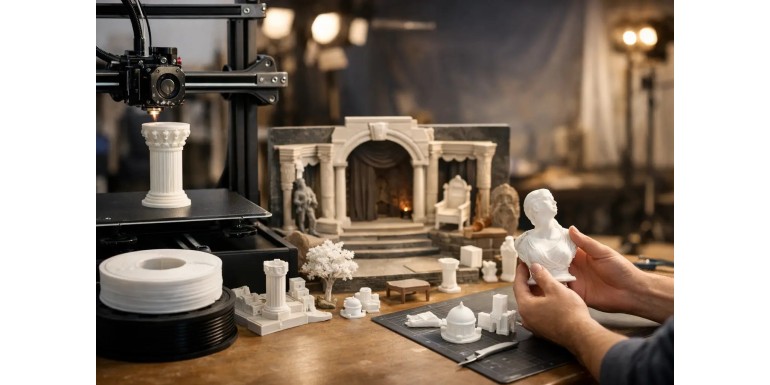
If you’ve been building gaming tables for a while, you’ve probably come across the question: what is PLA, and why is it used in wargaming terrain?
The short answer is simple: because it allows you to produce detailed, durable terrain at a reasonable cost.
The longer answer is more interesting—because not everything made in PLA performs the same when it comes to playing, painting, or surviving transport.
What is PLA and why is it used in wargaming terrain?
PLA is one of the most common plastics used in FDM 3D printing—the filament-based kind. It melts and is deposited layer by layer, which is why you’ll often see it used for buildings, containers, barricades, ruins, modular hills, and large terrain pieces.
In wargaming terrain, PLA is popular for both cost and practicality. Printing a large structure in resin would be more expensive, slower, and often unnecessary.
The big advantage of PLA is how well it fits the needs of a gaming table. You don’t need extreme levels of detail on every surface. On an industrial wall, walkway, or rock formation, tabletop presence, durability, and ease of painting matter more than perfect micro-texture. That’s why PLA has become a de facto standard for functional terrain.
What PLA offers compared to other materials
Compared to resin, PLA usually loses out in fine detail but wins in usable size and cost per piece. Resin still has the edge for display miniatures or busts. But for a 30 cm factory, a tower, a trench, or a modular building, PLA usually makes more sense.
Compared to MDF, PLA allows for more organic and complex shapes. MDF works great for clean, straight-line buildings and assembly kits, but PLA offers more freedom to create pipes, asymmetric ruins, craters, or sci-fi elements with built-in texture. It also doesn’t rely as heavily on slots, flat joints, or stacked layers.
If you compare it to XPS foam, foam board, or similar materials, PLA requires far less work from scratch. It’s less flexible for quick kitbashing, yes—but it saves a lot of time if your goal is consistent, ready-to-prime terrain.
Real advantages of PLA on the tabletop
The first is durability. A well-printed PLA piece holds up better under regular play than many lightweight or fragile alternatives. It’s not indestructible, but for moving terrain, storing it, and using it in frequent games, it performs reliably.
The second is scalability. You can produce large pieces without costs spiraling out of control. This matters a lot in wargaming, because an empty table convinces no one. You need volume, line-of-sight blocking, cover, and variety. PLA lets you fill a table without turning every piece into a major investment.
The third is compatibility with hobby finishes. You can prime it, lightly sand it, fill gaps, add texture, and paint it with acrylics without any unusual complications. If you work with earth tones, pigments, rust effects, texture pastes, or environmental weathering, PLA fits smoothly into a standard terrain workflow.
The limitations of PLA worth knowing
It’s not all advantages. The most obvious drawback is layer lines. On some pieces, the design helps hide them, but on smooth or curved surfaces they can be quite noticeable. This doesn’t always matter on the tabletop, but it may require heavier priming, some sanding, or filler if you’re aiming for a cleaner finish.
There’s also a thermal consideration. PLA doesn’t handle high heat well. Leaving a piece in a car under the summer sun isn’t a great idea—especially if it has thin or long sections. In normal indoor use, this usually isn’t an issue, but it’s worth keeping in mind.
Another point: PLA doesn’t replace every material. Some projects still benefit from resin for small details, MDF for certain structures, or traditional modeling materials for custom work. In serious terrain building, the norm isn’t to rely on one material, but to combine them.
When PLA terrain is the right choice
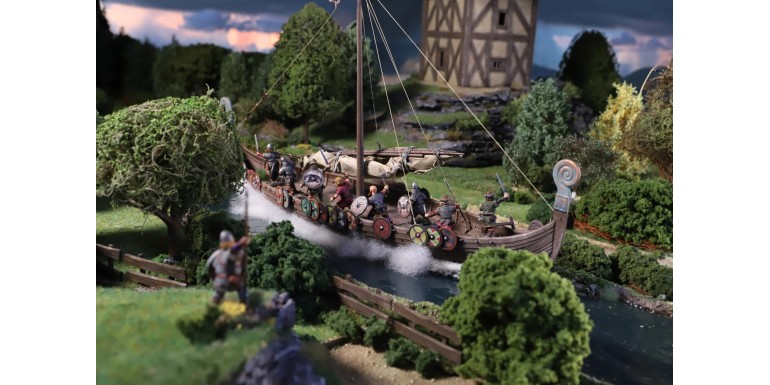
PLA is ideal when you’re looking for large, volumetric, playable pieces. Block buildings, ruins, silos, rocks, walls, display pieces, walkways, and modular elements are all a natural fit for this material.
It also works very well if you want a cohesive themed table, with consistent style and enough durability for regular use.
On the other hand, if your top priority is extremely fine detail on small elements, PLA may not be your first choice. A highly ornate altar, tiny accessories, or display-grade decorative pieces might require another material—or additional finishing work.
How to get the best results when painting PLA
There’s no need to overcomplicate things. The key is to start with a good primer to unify the surface and reduce the visual impact of layer lines.
If the piece has very visible striations, a filler primer or light texture coat helps a lot. After that, PLA responds well to techniques that are especially effective for terrain: dry brushing, washes, sponging, dust effects, mud, and weathering.
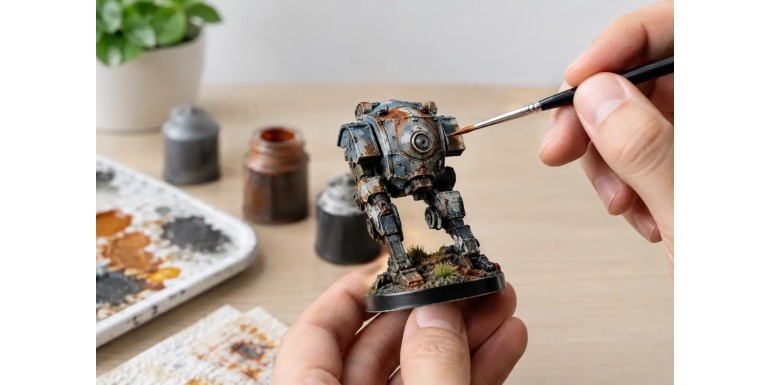
In fact, many PLA pieces look better when treated for what they are: gaming terrain, not competition miniatures. A finish with strong contrast, controlled grime, and good tabletop readability usually works better than trying to achieve a perfectly smooth surface.
For anyone who builds tables regularly, PLA strikes a balance that’s hard to beat. It’s not the perfect material for everything—but it’s one of the most useful when you need terrain with volume, character, and real gameplay durability.
And in a hobby where the table matters just as much as the miniatures, that carries a lot of weight.