Español

Lovecraft miniatures to paint: how to choose
- 05/07/2026 09:21:22
- Home , Assembly and Painting Guides , Tabletop Miniatures
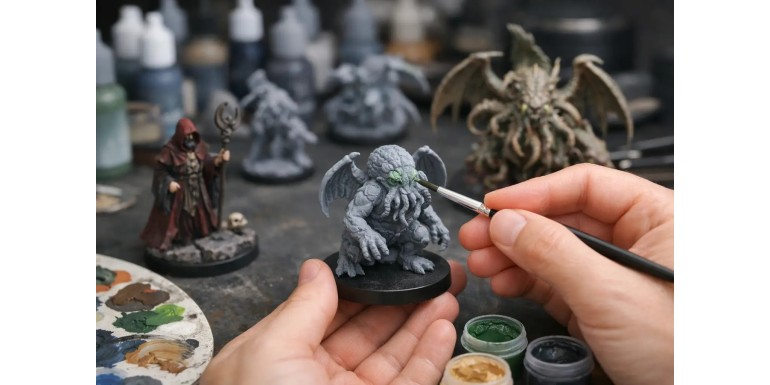
Not all Lovecraftian miniatures are created equal when it comes to the gaming table or the tip of your brush. With these types of figures, the challenge isn't just about highlighting volumes or crisp edge highlighting; it’s about finding the perfect balance between cosmic horror, readability, and finish. If the miniature looks too clean, it loses its atmosphere. If you overdo it with textures, contrasts, or effects, it turns into a messy blob that’s hard to read from a distance.
What Makes a Lovecraftian Miniature Different?
A Lovecraft-inspired miniature usually relies on three elements: ambiguous organic shapes, wet or weathered surfaces, and a silhouette that feels "alien" without becoming confusing. This significantly changes how you approach it compared to a soldier, a fantasy hero, or even a classic monster.
Many sculpts in this style feature tentacles, folds, eyes, secondary mouths, exposed bone, and soft flesh. While these are fun to paint, they require you to decide what the "star" of the piece is. If you treat every area with the same level of contrast, the figure will look flat. Instead, by saving your brightest highlights for the face, a specific claw, or an eye, you give the miniature a clear focal point.
It’s also worth considering the final use. Painting a display piece for a cabinet is not the same as painting a warband for a narrative campaign or a skirmish game. For display, you can afford slow transitions and selective varnishes. For the tabletop, you want the model to "pop" from three feet away and withstand handling.
Scale and Usage
Scale matters more than you might think. In 28-32mm (the standard for most board games and skirmishers), Lovecraftian miniatures benefit from simple schemes with a limited palette and a couple of strong focal points. There is little room for extreme subtlety, so a clear reading of light, shadow, and texture works best.
In larger scales, such as 54mm or busts, the priorities shift. Here, you can experiment with sickly skin, veins, purplish transitions, slime, and milky eyes. However, assembly flaws like mold lines or gaps become much more obvious at this size, so prep work is critical.
Materials and Preparation
Resin usually offers the finest detail—perfect for organic textures and runes—but it requires careful cleaning and occasional part-straightening. PVC or soft plastic is more durable for gaming but can lose definition in small areas. Hard plastic, when available, is often the most comfortable for assembly and conversions.
Before priming, check the tentacles and thin parts. It’s common for Lovecraftian minis to have spindly elements; a bit of pinning on larger pieces can save you a lot of heartbreak later. Also, decide on sub-assemblies early. A torso blocked by crossed arms or a mass of tentacles can become a nightmare to paint if already glued.
As for priming: Black or dark gray is great for grim, moist creatures with moody lighting. White or light gray helps if you’re aiming for pale skin or translucent glazes. If the sculpt has a lot of deep texture, starting from a dark base makes achieving a solid result much easier.
Palettes That Work for Cosmic Horror
A common mistake is thinking everything Lovecraftian must be dark green. Green works, but if your entire range is just greens and blacks, your minis will look identical. The trick is combining "dirty" cool colors with calculated accents.
A blue-gray skin with purple shadows can be far more unsettling than a flat green. Desaturated flesh tones and bone-whites also work well, especially when contrasted with satin-finished "wet" areas. For eyes or supernatural energy, a cold turquoise or a sickly magenta can break the monotony without ruining the mood.
Pro-tip: Separate materials through finishes. Keep the skin matte, make tentacles satin, and give the eyes a high-gloss finish. This contrast in sheen adds depth even with a limited color palette.
Painting Techniques: Speed vs. Detail
In this genre, fast techniques often yield great results. A dark base, translucent layers, controlled washes, and fine drybrushing can handle organic textures quickly. Just don't rely solely on the wash; if the shading hits every fold with the same intensity, the mini loses focus.
Glazing is essential for bringing "life" to alien skin. A bit of purple in the recesses or a diluted reddish-brown near wounds completely changes the feel of the biological matter. In mouths and suckers, soft transitions work much better than harsh edge highlights.
Effects: When to Add and When to Stop
Slime, old blood, and wet highlights are fantastic for Lovecraftian minis, but if they are everywhere, they lose their impact. A selective gloss varnish on the tongue, eyes, or a fresh wound has much more impact than coating half the figure.
The same goes for gore. This type of horror doesn't always need explicit blood. Sometimes a creature is more haunting if it looks ancient, aquatic, or diseased, rather than just having stepped out of a slaughterhouse.
The Base Tells the Story
In horror, the base often carries the narrative. Damp soil, temple ruins, rotted wood, or stagnant puddles help "place" the creature.
Keep a clear relationship between the base and the mini. If the creature is visually "busy," keep the base simple. If the model is straightforward, a narrative base can add a lot of character. At a specialized shop like Terrainandminis, you can find the pigments, water effects, and basing materials to plan the whole project from the start.
What to Look for When Buying
When choosing your next project, look past the promotional art and study the actual sculpt. Look for depth in the textures and a logical assembly. A spectacular-looking creature might be frustrating to paint if the best details are hidden by its pose.
You don’t need to start with the biggest, most complex monster. Often, a medium-sized miniature with a strong silhouette and a few key features will give you the best results and the most satisfaction. Whether you want a quick tabletop result or a high-end display piece, make sure the miniature works with your painting style, not against it.