Español

28mm Historical Miniatures: How to Choose Wisely
- 07/02/2026 16:59:48
- Home , Tabletop Miniatures
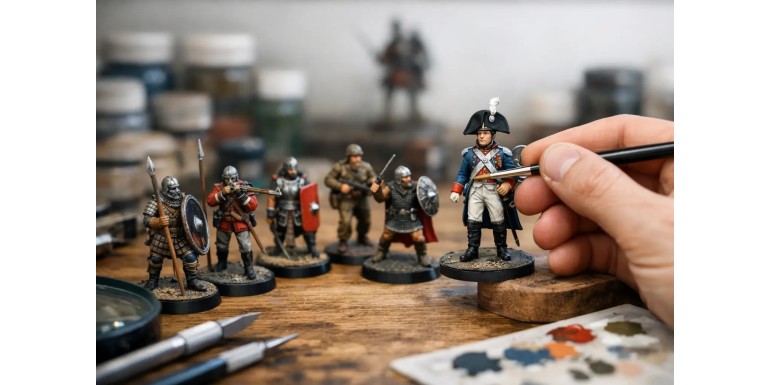
When a unit looks off on the tabletop, it’s rarely because of the uniform color. It’s usually due to scale, proportions, or the basing. In 28mm historical miniatures, these details matter far more than it seems when you are buying a box or mixing references from different brands.
The 28mm scale is one of the most rewarding for historical wargaming. It allows paintwork to shine, provides a strong tabletop presence, and remains manageable enough to build armies or warbands without demanding excessive space. However, it is also a scale where notable differences between manufacturers emerge: some lean toward "true" 28mm, others toward "heroic" 28mm, and some straight up border on a visual 30mm or 32mm. If your goal is to combine ranges, build a coherent force, or prepare a diorama project, you need to be clear about what you are buying.
What 28mm Actually Means in Historical Gaming
In theory, 28mm describes the approximate height of a human miniature from feet to eyes, or feet to head, depending on the manufacturer. In practice, there is no rigid standard. That is why two ranges labeled as 28mm can look completely different side by side.
In historical gaming, this matters much more than in fantasy or sci-fi. An overly bulky musketeer next to a more slender, anatomically proportioned line soldier stands out instantly. The same goes for horses, weapons, and artillery pieces. If you want a uniform collection, it is worth checking not just the height, but also:
-
Body width
-
Hand and head size
-
Thickness of the equipment and weaponry
The advantage is clear: 28mm offers a very comfortable level of detail for painting fabrics, webbing, faces, and weathering without forcing you to work at a microscopic scale. The downside is that any discrepancy in proportion becomes highly noticeable. That is why simply reading "28mm" on the box isn't enough.
How to Choose 28mm Historical Miniatures Without Making Mistakes
The first decision isn't the era; it's the purpose. You don't buy miniatures for a wargame the same way you do for a display cabinet.
-
For Wargaming: Material durability, pose consistency, and ease of unit identification on the tabletop should be your priorities.
-
For Display/Dioramas: You can opt for finer sculpts, unique poses, and more delicate details.
The game system also matters, even if you haven't settled on a specific one yet. Some rulesets work better with individual bases, while others require multi-figure element basing. This affects your purchase from the very beginning. A box that is excellent for skirmish games might not be the most efficient option if you need to form ranked blocks, and vice versa.
Range Compatibility: A Clever Visual Trick
Mixing manufacturers can work beautifully if you separate them by units, nationalities, or troop types. What rarely works is mixing miniatures with clear volume differences within the same unit.
Pro Tip: If a brand is chunkier and more robust, use it for grenadiers, guards, or elite troops. If another brand is more slender, reserve it for light infantry or command staff. This simple visual trick helps maintain immersion.
Material, Assembly, and Real-World Use
The choice of material changes the hobby experience more than you might think. There is no universal right answer; it depends on your project goals:
| Material | Best Used For | Pros | Cons |
| Plastic | Large armies, ranking up | Flexible for conversions, highly customizable, cost-effective | Details can sometimes be softer than resin |
| Resin | Characters, high-detail pieces | Exceptional crispness, crisp details | Requires careful cleanup, brittle during transport |
| Metal | Leaders, specialized units | Classic hefty feel, durable, crisp traditional sculpts | Heavy, can require pinning for secure joints |
The important thing is not to mix materials blindly without planning the final finish, as assembly, priming, and even the "hand-feel" during a game vary significantly.
Proportion, Bases, and Visual Coherence
If you want a historical force to look cohesive on the table, visual consistency is just as important as historical uniform accuracy. A well-executed base unifies different miniatures. Using the same mud texture, the same earth tones, matching tufts, and a consistent rim color does a lot of silent heavy lifting.
With 28mm historical miniatures, the base shouldn't steal the spotlight, but it shouldn't be a flat, uninspired brown either. In historical gaming, a believable base usually works better than a spectacular one. Think compacted dirt, low grass, broken stone, light snow, or arid terrain depending on the theater of operations. The key is for the ground to make sense within the campaign or region represented.
Basing size also dictates how the miniature is perceived. A beautifully sculpted figure can look clumsy if it is crammed too tightly onto a base—especially those with long rifles, pikes, or dynamic, open poses. Conversely, a slightly more generous base improves tabletop presence, protects delicate elements, and leaves room for realistic scenery without overdoing it.
When "Heroic" Scale Ruins the Look
Some historical ranges use slightly oversized hands, weapons, and heads to make assembly and painting easier. On the tabletop, these can look great, especially if the focus is purely on gameplay. The issue arises when you mix them with anatomically correct ranges. The contrast is jarring, even if the total height of the figures is identical.
If you already have an established collection and want to expand it, it pays to compare side-by-side photos online, check actual measurements shared by other hobbyists, or, better yet, buy a single test box before committing to an entire army. It’s much cheaper than discovering too late that your new cavalry looks like it belongs to an entirely different scale.
Painting 28mm Historicals Efficiently
The 28mm scale rewards clean, efficient painting techniques. It doesn’t demand the microscopic precision of smaller scales, but it doesn't forgive sloppy visual shortcuts either. A good primer coat, solid base colors, and clean shading usually yield better results than rushing into complex effects too early.
In historical painting, the common trap isn't lacking technique—it's overdoing it. Uniforms with extreme highlights, overly saturated leather tones, or blindingly bright metallics can ruin the cohesive look of a regiment. What looks spectacular on a single display figure doesn't always work on a unit of twenty.
Determine early on what you are aiming for:
1. Tabletop Standard: Work with a coherent palette, cleanly define faces, webbing, and weapons, and save the fine details for banners, officers, or musicians. This visual hierarchy makes the army look much better from a distance.
2. Display Quality: Invest time in selective highlights, realistic textures, and individual blending.
Washes, controlled drybrushing, and selective highlights remain incredibly useful tools in 28mm historical painting. They aren't "cheap tricks" when applied thoughtfully. The mistake lies in using them without considering the material they represent; a uniform blue fabric doesn't weather the same way a black leather cartridge box or a rolled-up wool blanket does.
The Right Scenery for 28mm Historical Miniatures
A great table elevates an average army, while a poor table ruins an excellent one. For 28mm historical gaming, the terrain must match both the scale and the era without looking like it belongs to a different game system. Oversized buildings, excessively thick walls, or out-of-scale trees immediately distort the perception of your miniatures.
This is where catalog depth and terrain compatibility become crucial. Having access to textures, bases, environmental effects, buildings, and finishing materials all in one place simplifies a project tremendously—especially if you want to maintain a consistent aesthetic across multiple tables or campaigns. For those building complete layouts, relying on a specialized hobby shop like Terrainandminis.com helps precisely because of this: it means less improvisation and more materials explicitly designed for the hobby.
The key is to adjust terrain density to the historical period and game type. A skirmish game allows for more localized detail per square inch. A large-scale battle needs terrain pieces that organize the table without blocking movement. Not every historical table needs to be an empty field, nor does every board need to be cluttered with scenery. It all depends on the ruleset, the period, and your actual gaming space.
Terrain Details That Make a Difference
There are three easily overlooked elements that dramatically improve the final look of your battlefield:
-
Roads with believable, modeled textures.
-
Natural color transitions in the soil.
-
Moderate environmental weathering.
A bit of mud on wheels and carriage chassis, light snow on edges, or dry dust settled on bases and buildings integrates the miniatures into the scene far better than a highly detailed building placed on a flat, unpainted gaming mat.
It is also wise to watch the height of hedges, walls, and fences. In 28mm, these reference points serve as the visual anchor for the eye to judge if everything else is in scale. When they are off, everything around them feels strange, even if the miniatures themselves are perfectly painted.
What is Worth Prioritizing When Buying?
If you are just starting out, prioritize coherence over variety. A small, well-chosen force with consistent basing and matching terrain looks far better than a scattered collection of incompatible eras and manufacturers. If you are a veteran hobbyist, it is likely more beneficial to look for specific gaps in your project—such as command elements, support units, dedicated terrain, specific textures, or tufts—rather than accumulating boxes that will never make it to the tabletop.
In historical gaming, buying smart doesn't always mean buying the model with the most detail. Sometimes it means choosing a range that fits your ruleset, your painting style, and the physical space you have to play and store your collection. The 28mm scale offers an incredible hobby experience due to its perfect blend of presence, detail, and versatility, but that is exactly why it pays to make informed choices right from the start.
If you love how a miniature looks in a photo but it doesn't fit your scale, your basing style, or your terrain, it might not be the right choice for that specific project. In this hobby, choosing wisely before assembly always saves more time than any painting technique can fix afterward.