Español

UV Resin vs. Epoxy for Miniatures and Terrain
- 07/01/2026 16:30:50
- Home , Tabletop Terrain , Tabletop Miniatures
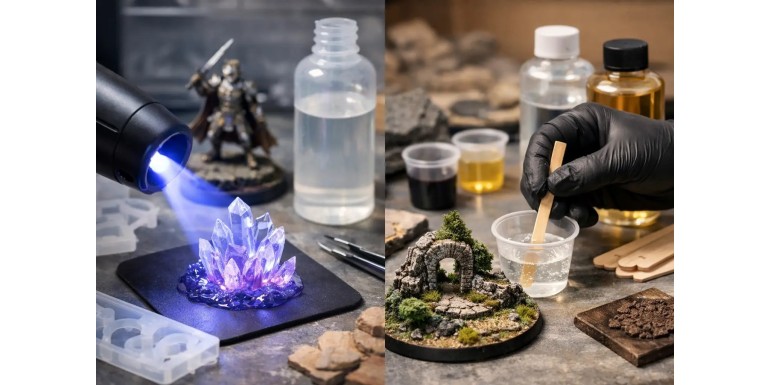
There is a difference you’ll notice almost immediately at your workbench: with one type of resin, you can set a single drop, cure it in minutes, and move on; with the other, you can pour a larger volume, let it self-level, and achieve much greater depth. That is, in essence, the comparison between UV resin and epoxy resin when working on miniatures, bases, terrain, or dioramas.
If you are creating water effects for a 32mm base, alien slime, a lens, a gem, or a thin glossy layer, UV resin is usually the most convenient option. If you are building a river, a canal, a deep pond, or a piece of scenery with significant volume, epoxy resin will generally yield better results. However, it isn’t always that simple, as working time, yellowing, heat, bubbles, and cost vary significantly from one case to the other.
UV Resin vs. Epoxy: The Real Difference
UV resin cures when exposed to ultraviolet light. This means almost immediate control over timing: you place it, adjust it, shine your light, and it hardens. For many detail-oriented tasks in modeling, this is a massive advantage, especially if you don’t want to wait hours between layers.
Epoxy resin, on the other hand, cures through a chemical reaction between two components. It doesn’t rely on a lamp to harden, but rather on respecting the mixing ratio and letting the process take its course. This makes it slower, but also better suited for thick pours and large surfaces where you need uniform leveling.
In practical terms: UV is excellent for localized, quick effects. Epoxy usually performs better for large bodies of water, extensive surfaces, and projects where visual depth really matters.
When to Use UV Resin
In the hobby, UV resin shines when the work is small, visible, and requires precision. It is great for water droplets, slime, shallow puddles, crystals, screens, visors, jewelry, glossy blood, or for fixing small transparent details. It can also be used to seal specific areas of a base without needing to prepare a large batch of mixture.
Its main advantage is control. If you are adding an effect to a base of a model that is already painted, you don't always want a resin that keeps moving for half an hour. With UV, you can place the effect exactly where you need it. This reduces accidents on finished pieces, which is something every painter appreciates.
It is also useful when working in very thin layers. For example, in shallow water with some tint, or a puddle on cobblestones, you can cure one layer, check the result, and add another without compromising the whole set. For display pieces or hero models with scenic bases, this ability to correct on the fly is highly valuable.
The problem is that it doesn’t handle everything well. In large volumes, it can cure unevenly, remain soft in deep areas, or generate excessive heat. Furthermore, the light must be able to reach the resin effectively. If you apply it in a very enclosed space, under opaque elements, or in deep cavities, curing becomes less reliable.
When to Use Epoxy Resin
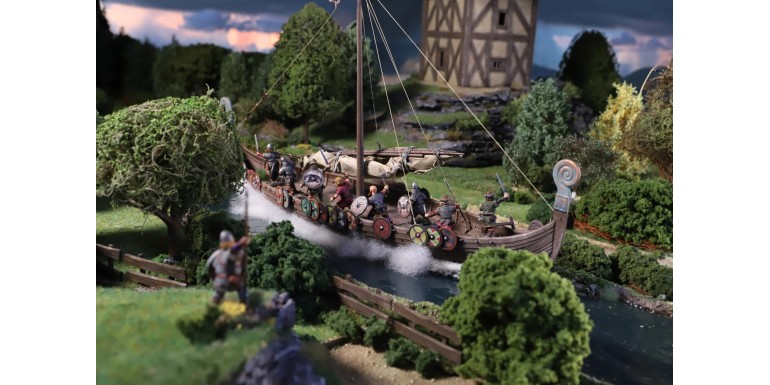
Epoxy fits better into scenery and dioramas where the effect needs "body." Rivers, ponds, sewers, industrial canals, pools, harbor water, or large surfaces with some depth are usually best handled with this type of resin. Once properly mixed, it spreads more evenly and leaves a very convincing finish.
It also offers more room to work on transitions, tints, and small suspended elements like vegetation, debris, or dirt. On a gaming table or a large piece of terrain, this helps build believable visual layers. Epoxy doesn't force you to rush, and that extra time is useful when you are adjusting details in a complex pour.
Another advantage is apparent depth. Even at moderate thicknesses, epoxy usually provides a more natural water effect than UV when dealing with larger surfaces. It’s not magic; it’s simply designed for that type of continuous work.
Its less friendly side is known to anyone who has mixed it in a hurry. If you miss the ratio or stir too aggressively, you end up with bubbles, sticky spots, or incomplete cures. And once poured, the piece demands patience. It is not the ideal material if you want to finish a base in a single session.
Finish, Transparency, and Yellowing
For miniatures and terrain, it’s not just about curing; it’s about how it looks at close range, under the bright lights of a display case, or on the gaming table.
UV resin can provide very glossy and transparent finishes in thin applications. For small effects, it stays very clear. The delicate point is that some formulations tend to yellow faster, especially if the piece is exposed to a lot of light over time. On a gem, a screen, or a greenish droplet, that might not be a drama—but in crystal-clear water, it can be noticeable.
Epoxy can also yellow, but with high-quality products, the behavior is generally more stable in decorative and modeling projects. Even so, if you are looking for perfectly transparent water for a long time, it’s best to assume that no resin is completely immune to change. That is why many hobbyists lightly tint the water, add green, brown, or blue nuances, or break the transparency with sediment and vegetation. Besides looking more realistic, it helps disguise any aging.
Working Time and Hobby Pace
Here is one of the most important differences for a miniature enthusiast. UV resin adapts very well to short sessions. If you paint at night, add a detail, cure, and put it away, it’s a better fit. You don't have to worry about leaving a piece still for hours or protecting it from dust all night long.
Epoxy demands a different rhythm. You have to prepare the mixture, measure carefully, pour with caution, and let it rest. If you are working on campaign scenery, a modular table, or a planned diorama, this is not a problem. It can even be better, as it allows you to think through the composition with more calm. But for quick finishes, it can feel slower than you’d like.
Cost and Waste
For small pieces, UV can be cost-effective even if the price per quantity is higher. You use very little material, you don't mix more than you need, and you use almost everything. For individual bases, specific effects, or miniature details, this efficiency pays off.
On large surfaces, the story changes. Filling a river or a lagoon with UV resin is usually expensive and impractical. In those cases, epoxy offers a better balance between volume and cost. It also allows you to plan pours more rationally if you create a lot of scenery.
There is another detail that is sometimes overlooked: epoxy waste usually comes from leftover mixture or ratio errors. UV waste appears more often when you try to use it for a job it wasn't meant for and end up repeating layers or correcting poorly cured areas.
Common Mistakes with UV vs. Epoxy
With UV, the typical mistake is wanting to create too much depth at once. If you are looking for a thick effect, it is better to work in thin layers and verify the real cure, not just the surface. It is also wise to watch out for shadows, corners, and opaque pieces that block the light.
With epoxy, the enemy is usually impatience. Poor mixing, pouring too thick at once, or touching the piece too soon ruins work that was going well. In scenery, you must also ensure the container or riverbed is perfectly sealed. A small leak is enough to ruin both the piece and your table.
In both cases, it is worth doing a test run on leftover material, especially if you are using pigments, inks, sand, plants, or foam effects. In this hobby, changing the brand or formulation can significantly alter the result.
What to Choose for Miniatures, Bases, and Terrain
-
If your main work is bases, miniature details, viscous effects, crystals, screens, eyes, gems, or shallow puddles: UV resin is usually the most convenient choice. It saves time, gives you control, and reduces the risk of ruining already finished pieces.
-
If you build scenery, rivers, canals, reservoirs, stagnant water, or dioramas with visible depth: Epoxy is usually the most sensible option. Not because of tradition, but because it performs better when volume really matters.
Many hobbyists end up using both. In fact, it is a very logical combination: epoxy for the main body of the water and UV for specific touches, splashes, droplets, glossy foam, or small surface adjustments. For those who build gaming tables, display bases, and varied terrain, having both on hand solves more problems than trying to force everything with just one.
In a specialized shop like Terrainandminis, where materials are chosen based on real-world use rather than generic craft labels, this difference is understood immediately: you aren't looking for the "perfect" resin for everything; you are looking for the one that fits the exact phase of your project.
If you are hesitating between one and the other, think less about the word "resin" and more about the specific task. What volume do you want to fill, how much time do you have, what level of transparency do you need, and how much margin for correction can you afford? That way of choosing usually yields better results than any absolute recommendation. And in this hobby, where a good base or a section of a river can completely change how an army looks on the table, it’s worth choosing your material with that level of precision.