Español

Sci-Fi Wargaming Terrain That Actually Works
- 05/05/2026 10:15:40
- Home , Tabletop Terrain
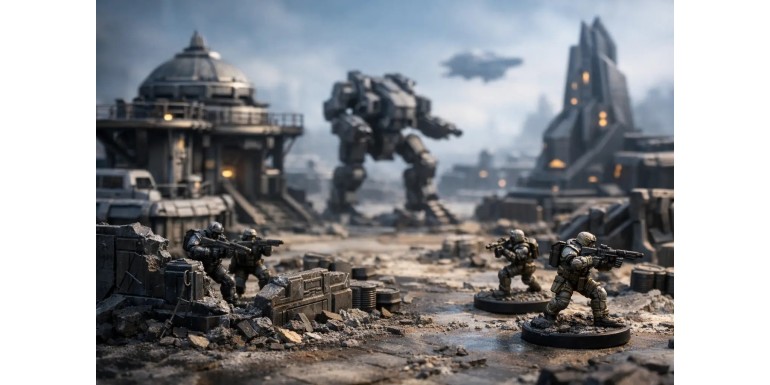
Sci-Fi Wargaming Terrain: Beyond Just Filling the Table
A table with four containers, two generic ruins, and a tower in the corner might be "playable." However, great sci-fi wargaming scenery does something much harder: it organizes the game, defines lines of sight, reinforces faction identity, and turns a "decent" board into one you can't wait to set up again. That is where you notice if a piece was designed for gameplay or just to take up space.
What Sci-Fi Terrain Should Bring to the Table
In science fiction, scenery often falls into two extremes: the table is either cluttered with spectacular pieces that hinder movement more than they help, or it’s filled with pieces so neutral that every board feels identical. The sweet spot lies in the middle: scenery with personality, clear geometries, and rules that are easy to read on the table.
The primary function is tactical: cover, line-of-sight blocking, advance routes, verticality, and bottlenecks. If a piece doesn't provide at least one of these, its presence is hard to justify beyond aesthetics. The second function is visual. In sci-fi, the environment tells the story: a mining colony doesn't read the same as a derelict ship, an industrial district, or an orbital refinery.
Scale, Footprints, and Heights: Where a Table is Won or Lost
Many gameplay issues don't stem from the rulebook, but from a poor relationship between the miniatures and the scenery. A door that's too low, a walkway too narrow for a base, or a building with walls so thin that models can't balance properly create constant friction. The table might look pretty, but it isn't functional.
In sci-fi scenery, scale is more than just visual. Access width, platform depth, troop placement area, and height all matter so that cover is understood at a glance. A railing that is too low looks nice but rarely protects. A wall that is too high blocks too much and can make the game feel "flat."
The footprint of each element also deserves attention. Small pieces are great for breaking partial lines of sight and enriching empty zones, but they cannot replace medium and large volumes. If the whole table is just scatter terrain, you’ll have detail but no structure. If it’s all large blocks, you’ll end up with obvious "firing corridors." Mixing sizes is what provides tactical depth.
Verticality is Not Just Decoration
On sci-fi tables, height changes the tempo. Walkways, accessible rooftops, elevated tanks, or technical platforms allow you to use verticality as a core mechanic, not an ornament. However, there is a limit: if being "up high" always pays off more than staying below, the table becomes unbalanced. The best scenery doesn't reward a single position but rather multiple reasonable decisions.
Types of Sci-Fi Scenery and When They Fit Best
-
Industrial Facilities: The most flexible option. Pipes, generators, cranes, and containers fit almost any system. They offer useful cover and allow the table to be built in layers.
-
Space Stations/Starships: These focus on interiors, corridors, and airlocks. They create tight games with measured movement and close-quarters combat.
-
Futuristic Urban Environments: These offer high potential but require control. Signs, bridges, and interior zones create rich tables, but don't let visual density complicate the "read" of the game.
-
Frontier Colonies/Mining Outposts: These are particularly rewarding as they allow you to combine human structures with hostile terrain (dust, snow, chemical mud).
Materials: MDF, Resin, Plastic, and 3D Prints
-
MDF: Practical for filling a table quickly and affordably. It fits the angular sci-fi aesthetic perfectly, though it requires some work to avoid a "flat" finish.
-
Resin: Provides incredible texture and presence for consoles, complex pipes, and machinery. It’s more expensive and delicate but adds great detail.
-
Plastic: A solid middle ground, especially in modular kits. It’s durable and easy to convert for frequent players.
-
3D Printing: Offers unmatched variety and customization, though it depends heavily on print quality and post-processing.
How to Assemble a Sci-Fi Table Without Overcrowding
A convincing table doesn't need to be packed to the last inch; it needs functional zones. Try building in three layers:
-
Large Blockers: To cut off long-range lines of sight.
-
Medium Elements: For cover and transitions.
-
Scatter Terrain: To fill gaps and provide detail without hindering base movement.
Real Modularity, Not Just Aesthetics
True modularity changes the game, not just the photo. It’s worth investing in compatible sets: walkways with consistent heights, connectors with standard measurements, and scatter pieces with a shared visual logic. When everything "talks" to each other, setting up a fast, balanced table becomes easy. This is where a specialized catalog, like the one at Terrainandminis.com, offers a practical advantage over generic solutions.
Painting: Avoiding the "Toy" Effect
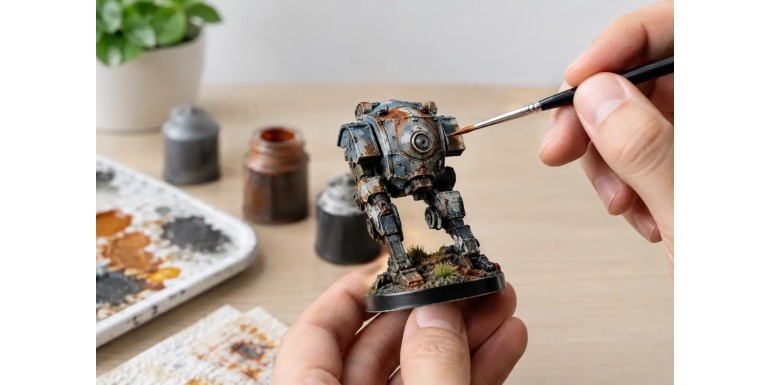
Sci-fi scenery doesn't need to be painted like a competition miniature; it needs to be "readable" at a distance. Avoid colors that are too clean. Even in high-tech settings, some technical grime, localized rust, or weathering helps sell the scale. Desert dust, industrial sludge, or chemical puddles can tie the buildings and the bases of your miniatures into one cohesive world.
What to Buy First?
If you are expanding your collection, don't just buy the biggest piece. Reinforce what’s missing. If your table has buildings but lacks transitions, add scatter terrain. If everything is low-level, introduce one or two serious line-of-sight blockers. The best scenery isn't what fills the most space in a photo—it’s what makes your games flow.