Español

WWII Tabletop Ruins: Building Believable Scenery
- 05/06/2026 11:34:12
- Home , Tabletop Terrain
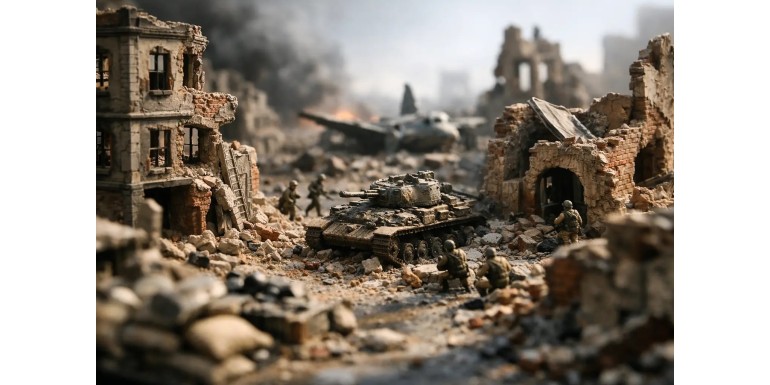
A WWII tabletop layout doesn't work simply because there are broken walls and a bit of rubble. It works when the terrain tells a story: a street battered by artillery, a partially collapsed factory, or an urban block where you can still glimpse what life was like before the impact. For wargames and dioramas, that difference is immediately apparent. Believable scenery doesn't just improve the final photo; it changes how the game is played and how the visual composition is read.
What Makes WWII Ruins Believable?
The most common mistake is building "generic ruins." They look decent at first glance, but they fail to convey historical weight or visual coherence. In this period, destruction follows a very clear material logic: brick, concrete, plaster, metal beams, shattered woodwork, and collapsed roofs. If all the debris appears to be the same thickness, or if the rubble is placed in decorative piles unrelated to the structure, the effect loses its impact.
It’s also worth considering which front or environment you want to reference. A street on the Eastern Front, a bombed Central European city, or an industrial position in the West are not the same. The type of building, the facade finishes, the ratio of masonry to concrete, and even the accumulated grime all vary. You don’t need to turn every piece into an exact historical reconstruction, but choosing a clear direction ensures the entire board speaks the same language.
On the gaming table, ruins must also meet a second requirement: functionality. They must block lines of sight, provide cover, allow for miniature placement, and withstand handling. Sometimes a highly realistic piece makes for a poor gaming element because it barely supports bases or snags easily on sleeves. That’s where the balance between fidelity and playability comes in.
Scale, Gameplay, and Visual Reading
Before gluing the first piece of rubble, you must decide which system or format you are working toward. In 28mm, for example, a half-destroyed wall can look fantastic, but if the windows are too low or the doorways too narrow, the miniatures look like giants inside the building. In 15mm, the problem is usually the opposite: if you exaggerate the thickness of the rubble too much, the piece becomes clunky and obscures more than it should.
The key is to exaggerate just enough. Fine details help "sell" the scale, but the general shapes must be readable from a distance. A good ruined building should be understood from three feet away: where the facade was, which floors remain, where the entrances are, and which areas offer cover. Then, as you move closer, the loose bricks, burnt frames, impact marks, and peeling plaster texture appear.
In gaming scenery, staggered heights offer great tactical depth. An intact corner, a semi-collapsed floor, and a pile of rubble next to an open wall create routes, firing positions, and tactical decisions. If everything is destroyed equally, the piece feels flat. If everything is nearly intact, it stops looking like a ruin.
Materials That Work Best
For this type of terrain, it is best to combine lightweight materials with harder ones at specific points. The base can be made of MDF, foamex (PVC foam), or reinforced foam core, depending on the required durability. For walls, XPS foam remains incredibly useful for carving damage, cracks, and volumes. Textured plastic or prefabricated pieces save time when you need to produce several ruins with a consistent visual language.
Broken bricks can be represented in many ways, but not all scale well. The problem with many commercial or homemade rubble mixes is that they are often too large for the miniature. Using a smaller quantity of correctly sized debris usually yields a more believable result. Fine rubble mixed with medium-sized fragments works better than a uniform mound.
Beams and girders also define the period. A few well-placed metal elements do more for the feeling of collapse than filling the piece with indiscriminate debris. The same applies to doors, window frames, and partial floors. You don't need to overstuff it; you need to suggest what the building looked like before it fell.
If you are looking for pieces ready to integrate into a table or project, the most practical approach is to work from scenery elements already designed for wargaming and then customize them with texture, damage, and debris. For many hobbyists, this route saves time without sacrificing a high-quality finish—especially when the goal is to set up a full table rather than a single display piece.
Building a Ruin That Doesn’t Look Like a Pile of Foam
The most common way to lose realism is to break walls without logic. A building doesn’t crumble like a bitten cookie. There are usually stress points, areas opened by impact, and parts that remain standing because they still have structural support. When cutting walls, leave corners, fragments of partitions, and varying heights that explain the collapse.
Another important point is thickness. Exterior walls, floor slabs, and interior partitions do not have the same presence. If everything is the same width, the piece feels visually flat. In urban wartime buildings, this distinction adds a lot of character. A thin, broken interior partition next to a heavier exterior wall provides immediate depth.
Interior surfaces matter too. A mistake in many projects is focusing only on the facade and leaving the interior empty. Even if it’s barely seen during a game, a remnant of flooring, a hint of wallpaper, broken plaster, or collapsed floor beams give the ruin meaning. You don't need to decorate entire rooms, but you should avoid making the building a simple shell.
Painting and Weathering Without Overdoing It
Painting WWII ruins usually turns out better when you work by material layers rather than final color. First, think about what’s underneath: brick, concrete, plaster, wood, metal. Then add dirt, smoke, moisture, and dust. If you do it in reverse, the building looks "painted as a ruin" instead of appearing as a damaged structure.
Dust is a great unifier. In a bombed environment, you rarely see materials with clean, distinct colors. A wash or filter of earth tones or light grey helps integrate rubble, walls, and the ground. However, overdoing this veil can dull the entire piece. Keep contrasts in specific areas: freshly exposed brick, rusted metal, splintered wood, or soot stains near impacts and windows.
Furthermore, pure black is often overused. Real smoke grimes a surface, but it doesn't turn everything into a black mass. Warm greys, dark browns, and localized charred areas provide a more convincing effect. It is also worth varying the moisture at the base of the building—cooler, dirtier tones at the bottom help break the monotony.
Integration into Gaming Tables and Dioramas
A ruin that looks great on its own can fail when placed on a table. This usually happens when the terrain color doesn't match the rest of the board or when the level of detail on the scenery clashes with the miniatures. If the building is meticulously detailed but the ground is flat and empty, it stands out for the wrong reasons.
For gaming, the ideal approach is to mix large pieces with transition elements: low walls, barricades, craters, explosions, bent fences, upturned cobblestones, poles, and street furniture. This avoids the "isolated building" effect and builds a truly devastated zone. In a diorama, the logic changes slightly; it’s more about directing the eye and creating a specific scene. Fewer pieces, better placed.
Common Mistakes
-
Oversizing the rubble: Debris that would be boulder-sized in real life.
-
Repetitive damage: Breaking every edge with the same pattern.
-
Monochromatic palettes: Usually "grey on grey" until the piece loses all definition.
-
Forgetting the base: A ruin needs a believable connection to the ground. Accumulated debris along the wall and broken pavement help "anchor" the piece.
When to Buy vs. When to Build
If you want a full table reasonably quickly, starting with specialized commercial scenery is usually the best option. It saves time, keeps the scale in check, and provides a solid base for customization. If you are interested in a very specific scene or a building with unique damage, building from scratch offers more freedom.
It’s not a matter of doing everything from zero or buying everything pre-made. In this hobby, the combination usually yields the best results. A well-constructed kit, enhanced with your own textures, rubble, and paint, offers an excellent balance between time invested and the final look.
Well-made ruins have one clear advantage: they never go out of style. They serve for gaming, photographing miniatures, and creating atmospheric scenes. If they are designed with scale, usability, and materials in mind, they stop being mere backdrops and become part of the story on the table. You’ll notice that difference every time you deploy your first unit.