Español

How to Choose Compatible Miniatures for Skirmish Wargames
- 09/16/2026 09:23:47
- Home , Tabletop Miniatures
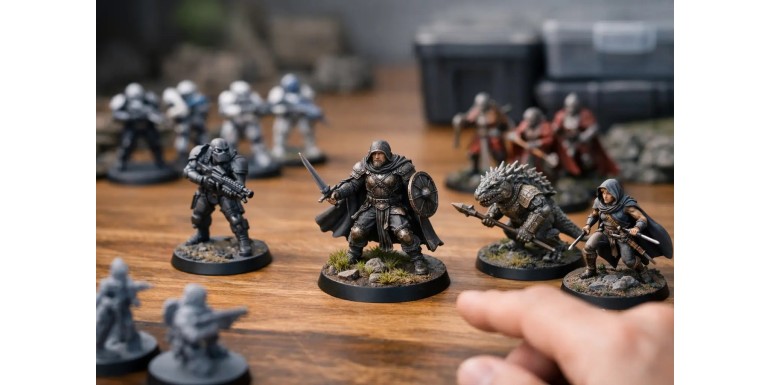
A skirmish warband is rarely purchased all at once. You typically start with five core miniatures, add a specialist, replace a leader with a more imposing figure, and eventually source civilians, monsters, or reinforcements when a new campaign launches. That is why learning how to choose compatible miniatures for skirmish wargames isn't just about picking figures you like—it's about ensuring they work seamlessly on the gaming table, within the rulebook, and alongside the rest of your collection.
In warband-level skirmish games, every single silhouette is examined up close. An out-of-scale miniature, an oversized base, or a weapon that misrepresents equipped gear can instantly ruin the visual clarity of a match. The good news is that with a few clear criteria, you can mix and match manufacturers, expand factions, and build immersive battlefields that give every encounter distinct personality.
1. What Miniature Compatibility Actually Means
Miniature compatibility consists of several distinct layers:
Rules and Event Requirements
Some wargames permit proxy miniatures from any range provided the base size and equipped weapons are easily recognizable. Others enforce strict official miniature requirements for sanctioned tournaments or organized events. Before buying third-party miniatures, review the game system's core rules, your local gaming club's guidelines, and event packet restrictions.
Visual Scale and Aesthetics
Two figures can both be labeled as "28mm" and still look like they belong to entirely different universes. This happens because scale measurement isn't universally standardized across manufacturers. Furthermore, some ranges use realistic proportions, while others employ heroic scale featuring exaggerated heads, hands, and weapons. In casual play, this might not matter, but in a six-model warband where figures stand side-by-side, scale discrepancies become glaring.
Practical Gameplay
A compatible miniature must fit properly on its assigned base size, maintain a reasonable height relative to terrain features like doors and barricades, and allow line-of-sight (LoS) rules to be applied without debate. If a sniper model visually occupies twice the physical volume of a standard infantry soldier, it might look impressive, but it won't function well as basic line troops.
2. Scale and Proportions: The Primary Filter
Scale labels like 28mm, 32mm, or 35mm serve as general guidelines rather than absolute guarantees. In scale modeling, these measurements can denote height to the eyes, height to the top of the head, or a manufacturer-specific standard.
| Proportion Style | Characteristics | Best Used For |
| Realistic / True Scale | Slimmer limbs, realistic weapon proportions, historical scale feel. | Detailed buildings, vehicles, historical wargames. |
| Heroic Scale | Exaggerated weapons, deep details, larger heads and hands. Easy to paint and read from a distance. | High-fantasy, sci-fi wargames, tabletop skirmish boards. |
You don't need every figure in a collection to share identical proportions. A mutant brute, an ogre, an exoskeleton suit, or an alien creature can intentionally break scale to emphasize bulk. The issue arises when a baseline human from one range looks like a giant next to another baseline human in the same squad. Always compare group photos, approximate heights, and head sizes before mixing product lines.
Terrain Influences Scale Perception
A compatible miniature requires a compatible environment. A low doorframe, a narrow staircase, or a tiny vehicle will instantly expose poorly matched scales. If you play urban skirmish campaigns, measure street widths, floor heights, and entryway dimensions. For sci-fi games, ensure catwalks accommodate standard base sizes without models hanging awkwardly off edges or blocking movement corridors.
At Terrainandminis.com, the ultimate goal isn't just finding a specific theme—it's assembling a cohesive gaming set where figures, bases, scenery buildings, and scatter terrain look like they naturally belong to the same world.
3. Base Sizes, Model Volume, and Line of Sight
A miniature base is a core gameplay mechanic, not merely decorative plastic. In many skirmish rulebooks, the base determines melee engagement ranges, objective control, movement through tight choke points, and Line of Sight (LoS). If a rulebook specifies a exact base diameter, adhere to it even when proxied or converted models are used.
-
25mm vs. 32mm Round Bases: A 7mm difference seems minor until you attempt to fit three models behind a barricade or squeeze through a door frame.
-
Oval, Square & Shaped Bases: Require extra care regarding facing, arcs of fire, and template coverage.
Upper Body Volume
Model volume matters equally. An ultra-crouched pose can grant an unintended tactical advantage behind low cover, whereas a miniature holding a tall banner, open wings, or a raised weapon might stick out excessively. While you don't need to avoid dynamic poses, discuss line-of-sight conventions with your opponent before rolling dice. Clarity and sportsmanship always outweigh self-serving silhouette interpretations.
4. Key Steps for Selecting Compatible Skirmish Models
1. Define the Model's Tactical Role: Don't buy a character figure purely for its looks if your list requires a scout, a medic, or a heavy weapon specialist. Readable gear reduces the need to constantly check army lists.
2. Verify Scale and Height: Compare new models against your existing warband miniatures, not just against isolated catalog photos.
3. Use the Required Base Size: Mount figures on the game system's recommended base dimensions to ensure fair play.
4. Maintain Equipment Readability: Ensure your opponent can identify what weapon a figure is carrying at a glance (WYSIWYG: What You See Is What You Get).
5. Match Faction Aesthetics: Armor styles, tech levels, clothing, symbols, and weathering should tell a compatible story.
Matching aesthetics doesn't mean repeating the same color scheme or buying from a single manufacturer. A mercenary warband naturally looks great with mismatched gear, while a post-apocalyptic gang gains credibility with scavenged clothing and improvised weaponry. Conversely, disciplined military units require a more uniform silhouette.
5. Materials, Assembly, and Converting
Different manufacturing materials offer distinct advantages for warband building:
-
Resin: Offers crisp detail, but requires careful washing to remove mold release agents and occasional straightening using controlled warm water.
-
Metal: Adds satisfying weight and durability to slender parts, though delicate joints require metal pinning.
-
Plastic: The most versatile material for converting, kitbashing, and assembling large squads, especially when swapping weapons or arms.
When combining bits from different brands, check neck, wrist, and hand proportions. An oversized head ruins a kitbash faster than a minor armor difference. Modeling putties help blend joints, add straps, and fill gaps, but shouldn't be used to mask severe scale mismatches.
Unifying Warbands Through Basing
Basing is the single best way to harmonize a heterogeneous warband. Applying consistent ground textures, static grass, soil colors, or urban debris creates immediate visual unity. A display base featuring red brick, grey dust, and rusted signs can instantly tie figures from completely different manufacturers into inhabitants of the very same city district.
6. Compatibility in Narrative vs. Competitive Play
Narrative campaign games allow for greater freedom. You can use unique alternative models to represent battle-hardened veterans, mission objectives, or characters evolving with injuries and gear upgrades. The golden rule here is ensuring every player understands what each model represents—a simple reference card prevents mid-game confusion.
In competitive tournament play, tolerance varies by event organizers. Guidelines often dictate official model usage, conversion percentages, strict base sizes, and exact weapon representation. If you are building a warband for a tournament circuit, never assume an alternative model accepted at your local club will be allowed at the event. Always consult the event pack beforehand.
The best warband isn't the one with the highest number of different sculpts—it's the one that reads clearly on a table filled with great scenery. When every miniature serves a clear role, shares a convincing scale, and fits the setting, you have a gaming force ready to paint, play, and expand campaign after campaign!