Español

Sieges in Warhammer Fantasy: A Practical Guide
- 05/24/2026 09:15:47
- Home , Miniature Wargames
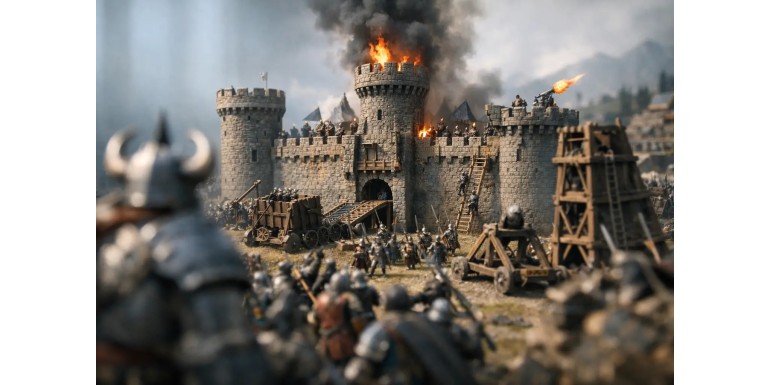
Few tabletop games carry the dramatic weight of a well-crafted siege. In Warhammer Fantasy, a pitched battle can be spectacular, but everything changes when there is a gate to batter down, siege towers to push forward, and battlements to defend. This practical guide to recreating memorable sieges starts with a very clear premise: a siege is a tactical challenge, an incredible Warhammer terrain project, and the perfect excuse to build a tabletop board that captivates players before the first die is even rolled.
The Epic Nature of Warhammer Fantasy Sieges
A siege works because it concentrates everything hobbyists love into a single scenario. There is the gameplay aspect, featuring tenser, less abstract decisions than those found in an open field battle. There is the visual appeal, as high-quality wargame walls transform the tabletop into an objective in its own right. Finally, there is the narrative element, which is where these games truly shine. It is not just about winning; it is about seeing if the battering ram reaches the gates, if the wall holds, or if a veteran unit can hold the breach for just one more turn.
This is why improvised cardboard scenery, while useful for testing an idea, falls short very quickly. On a siege table, the terrain does not just accompany the game—it defines it. If the defensive line lacks presence, the battle loses part of its identity. Furthermore, if you want to replay that scenario multiple times, you need something far more flexible than a fixed, single-piece fortress.
The Heart of the Siege: Modular Walls
Modularity is what separates visually striking scenery from truly useful terrain. A fixed wall section looks great in photos, but it severely limits replayability. It forces you into the same deployment, the same central gate, and virtually the same tactical plan every time.
In contrast, a modular wall system allows you to assemble:
-
A small border fort for a quick skirmish.
-
An Imperial city featuring multiple firing angles.
-
A compact, brutal Dwarf stronghold closer in style to Karaz-a-Karak than a simple campaign stockade.
A solid terrain set should include straight sections, corners, and at least a pair of flanking towers. Straight sections provide length and presence. Corners allow you to close perimeters or create bends that break clean lines of sight. Towers are more than just ornaments; they add verticality, firing positions, and key vantage points that both players will fight over from turn one.
Then, there is the main gate, which becomes the focal point of the story in almost any siege. Without a convincing gatehouse, the battering ram loses its purpose, and the attacker is often forced to create breaches in less visually satisfying ways.
Choosing the Right Material: 3D Printing, Resin, and Plastic
Material options are significantly better today than they were a few years ago. 3D printing has vastly improved in terms of detail and variety, making it easy to find pieces designed for the classic 28mm scale without needing heavy modifications.
| Material | Best For | Pros | Cons |
| Plastic | Gameplay & Durability | Highly durable, easy to assemble, lightweight for transport | Can sometimes look less textured without extra paintwork |
| Resin / 3D Print | Visual Impact & Detail | Fine textures, high realism, unique custom designs | Requires more care in transport; can be brittle |
There is no single right answer. If your priority is a durable, highly playable table, plastic usually wins. If you are chasing maximum visual impact above all else, resin or a well-finished 3D print will deliver a more striking result.
Breaching the Walls: Siege Weapon Miniatures
In a siege, heavy artillery is not just background noise—it takes center stage. The game dynamic shifts completely when you introduce siege weapon miniatures that are not just decorative, but actively open gates, break lines, and force your opponent to react.
For the Attacker:
-
The Battering Ram: Virtually mandatory if the gatehouse is to play a real role. It provides an immediate visual objective; as soon as it hits the table, the defender recognizes the threat and the attacker has a tangible goal.
-
The Siege Tower: This piece offers immense narrative value. While it takes up significant space, is cumbersome to move, and remains vulnerable to enemy fire, it allows an elite unit to reach the battlements without being left completely exposed in no-man's-land. If you have ever imagined Black Orcs or Greatswords storming the ramparts directly, you know why it is worth including.
-
Scaling Ladders: While they are not the most reliable option, they are incredibly cinematic. They are cheap, cost lives, and create those movie-like moments where a mediocre unit buys just enough time for the main strategy to succeed.
-
Demolition Artillery: An Orc Rock Lobber or a Bretonnian Trebuchet does not just fire to rack up casualties. They fire to reshape the map, blast a breach open, and shift the axis of the entire battle.
For the Defender:
Defenders require specialized tools as well. Bolt throwers and cannons are excellent for neutralizing monsters, punishing dense infantry blocks, or—if the scenario rules allow—wrecking siege towers before they touch the stone.
Classic defensive mechanisms like boiling oil, dropping stones, or gatehouse traps add something that is occasionally lost in highly competitive games: flavor. They might not always be the most points-efficient choices, but they make the game feel like a genuine siege rather than a standard pitched battle with a few walls in the way.
Faction Dynamics in Warhammer Fantasy and The Old World
Not all sieges play out the same way, and this is where Warhammer Fantasy and The Old World truly excel. The asymmetry between factions ensures that the gameplay experience changes drastically depending on who is attacking and who is defending.
-
The Empire and Dwarfs: The natural candidates for classic fortress layouts. They belong behind stone walls, backed by gunpowder, artillery batteries, and layered defenses. A well-designed Dwarf siege can be frustrating for an attacker, which is precisely why it requires careful point balancing and objective design to prevent the match from turning into a tedious war of attrition.
-
Skaven and Orcs: Their strength lies not in elegant planning, but in overwhelming the defense through sheer saturation. Skaven are perfect for introducing sub-surface tunnels, miners, or unexpected entry points that bypass the main wall. Orcs and Goblins shine when they turn the siege into pure chaos—ladders everywhere, improvised machinery, and endless waves of units keeping the pressure constant.
-
High Elves and Dark Elves: These factions offer a different playstyle entirely. Their sieges revolve heavily around ranged superiority, mobility, and threats that ignore walls altogether—from highly accurate skirmishers to soaring flying creatures. This forces the defender to stay alert; elevated terrain grants an advantage, but it will not single-handedly win a matchup against high offensive projection.
Siege Rule Tip: To keep the game moving smoothly, follow two principles. First, simplify the rules regarding shooting at structures and gates to avoid constant rules debates. Second, grant genuine mechanical value to battlements and high ground; if controlling the wall does not offer a tangible advantage, the scenario loses its purpose. However, ensure this advantage is strong without being absolute—if the attacker sees no viable path to breach the fort, the tension evaporates.
Three Adjustments for a Fun Siege Game
1. Adjust the Points Ratio: The most common mistake is balancing a siege like a symmetrical matchup. It isn't. The defender starts with a massive advantage, meaning the attacker typically requires 50% to 100% more points, depending on the toughness of the fortification, the number of access points, and the weight of defensive artillery.
2. Phase the Battle: Divide the narrative into distinct stages. First, cross the killing fields to reach the wall. Next, create a breach or seize the battlements. Finally, if the defense collapses, fight inside the courtyard. This structure prevents the entire game from hinging on a single gate-shattering roll or an infantry gridlock in a corner.
3. Set a Turn Limit: Managing time is crucial. Long sieges can be unforgettable, but they can also become exhausting. A strict turn limit forces the attacker to make aggressive moves and pushes the defender to make tough resource sacrifices. Without that ticking clock, matches can degenerate into passive shootouts.
Planning Your Ultimate Wargaming Table
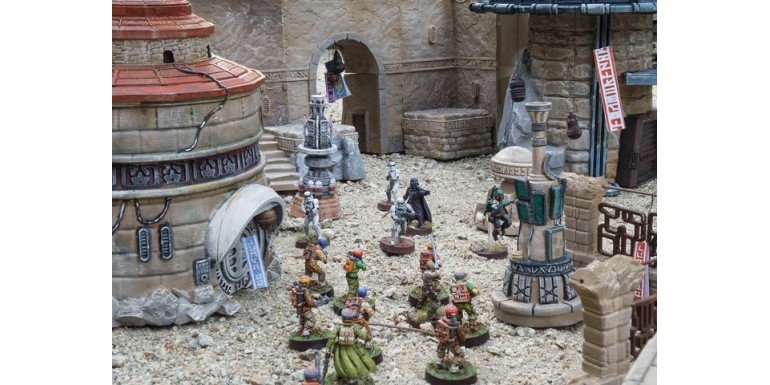
To ensure your hobby project succeeds, view the tabletop as a complete ecosystem rather than a collection of loose terrain pieces. Walls require open ground ahead of them for an approach. Siege towers need wide lanes to maneuver. The gatehouse requires a clear frontal zone for the ram to function. Even the wall breaches should be planned into the layout from the start, even if they only open up mid-game.
Scale consistency is equally vital. While many medieval scenery brands cater to 28mm gaming, parapet heights, door sizes, and platform dimensions can vary. A wall that is too low looks out of place next to heroic-scale miniatures, while a wall that is too high can render ladders or certain weapons useless. In a specialized store like Terrainandminis.com, where ranges from various manufacturers come together, compatibility between pieces is just as important as the final paint finish.
When a table is thoughtfully designed, a siege stops being a rare event you play once a year. It becomes a favorite format you want to return to again and again.
Over to you: Do you prefer defending the ramparts with black powder and volleys of arrows, or pushing the ram toward the gates while stones rain down from the battlements? If you have built a fortress at home, let us know in the comments below! Ready to start your next build? Check out our modular terrain collections to construct your own unbreakable stronghold.