Español

Useful miniature painting accessories
- 05/25/2026 12:42:34
- Home , Assembly and Painting Guides
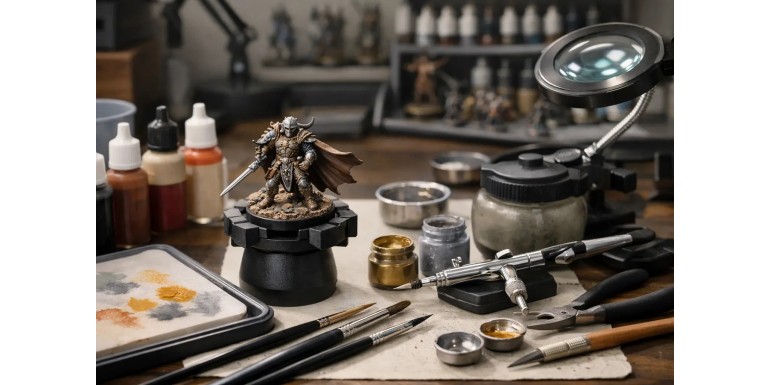
There is a very recognizable moment in this hobby: you unbox a brand-new miniature, set up your desk, grab four paints, and suddenly realize that what’s holding you back isn't the color—it’s everything else. A spilled paint pot, poor lighting, a brush that has lost its point, or a base that is impossible to hold properly.
That is why talking about miniature painting accessories isn't about indulging in luxury whims; it’s about tools that make your workflow cleaner, more comfortable, and significantly more consistent.
The key lies in separating truly essential accessories from those that just clutter your workspace. Not everyone needs a full hobby desk setup from day one, but it is highly beneficial to understand which pieces will actually upgrade your results and which ones simply make the process more pleasant. When it comes to tabletop wargaming, where you are batch painting entire units, this matters just as much as it does for a display piece.
Which Miniature Painting Accessories Are Worth It?
If we had to start with what makes the biggest impact, the list wouldn’t kick off with paints, but with control. Properly holding your miniature, seeing it clearly, and keeping your paint mix in optimal condition will transform your experience from the very first session.
-
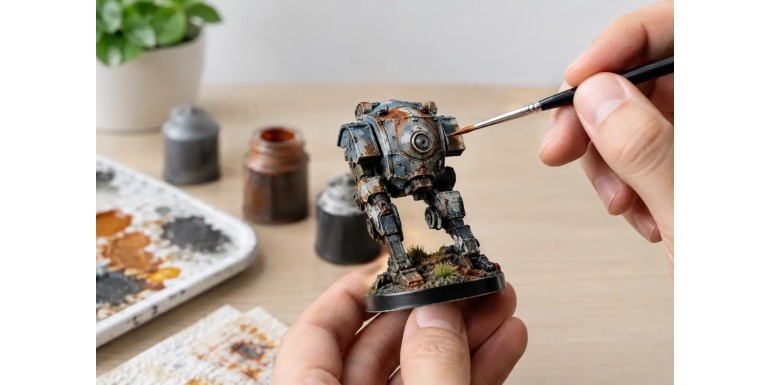
Painting Grips / Handles: A good painting handle prevents you from touching freshly painted areas, reduces hand fatigue, and allows you to rotate the figure with precision. It might seem like a minor detail until you spend two straight hours doing fine detail work on shoulder pads, straps, or faces.
-
The Wet Palette: For many painters, this quickly falls into the "must-have" category. It keeps your paint workable for longer, helps control dilution, and prevents the constant waste of dried-up paint drops on a random tile or plastic palette. It won’t work miracles on its own, but it definitely facilitates smoother transitions and longer sessions without the need to remix every single minute. If you paint in layers or work with fast-drying acrylics, it is a game-changer.
-
Correct Lighting: This is also way more critical than most people expect. A lamp with good intensity and a neutral color temperature allows you to better judge real saturation, edge highlights, and coverage. Painting under warm or insufficient light usually leads to classic mistakes: overly harsh shadows, muddy whites, or metallic paints that deceive your eyes until you take the miniature off the table.
Gripping and Control Accessories
For many hobbyists, the painting handle is the first accessory that goes from "I'll just wing it" to "I'm never going back." You can find simple ones with clamps or adjustable systems for different base sizes.
Hobby Tip: The most important factor isn't a flashy design; it’s that the miniature remains secure so you can rotate it without straining your fingers.
If you are batch painting infantry, a basic handle does the trick perfectly. If you constantly switch between round bases, square bases, and large models, it’s worth looking into something more versatile.
+--------------------------+-------------------------------------------------------------+
| Accessory                | Main Benefit                                                |
+--------------------------+-------------------------------------------------------------+
| Painting Handle          | Reduces hand fatigue, protects wet paint, improves precision|
| Blue-Tack & Corks        | Cheap, flexible solution for sub-assemblies and small parts |
| Fine Tweezers & Clippers | Ensures clean assembly, removing mold lines seamlessly     |
+--------------------------+-------------------------------------------------------------+
This category also includes sticky tack (Blue-Tack), corks, temporary mounts, and pinning rods for sub-assemblies. These are simple but incredibly useful solutions when you don’t want to glue a piece together just yet, or when you need to work on a helmet, shield, or backpack separately. On complex miniatures, sub-assemblies are not just a quirk for perfectionist painters—they are often the difference between reaching a tricky area smoothly or resigning yourself to leaving it half-done.
Finally, fine tweezers and clippers aid more during the preparation stage than the actual painting, but they are part of the same workflow. Cleaning up mold lines, holding tiny bits, and placing delicate elements without touching them too much reduces headaches later on. A poor assembly complicates the painting process; a clean assembly makes it much more logical.
Palettes, Water, and Brush Care
While the wet palette steals most of the spotlight, it isn't the only valid choice. For quick touch-ups, specific mixes, or products like washes and technical effects, a dry palette remains highly practical. It’s not about choosing one and discarding the other, but knowing when to use each. If you are applying quick basecoats to an army, combining both can be the most efficient route.
Where you absolutely should not skimp is on brush cleaning.
-
A stable water pot: Ideally with a decent depth or ridges to clean the bristles.
-
Brush soap / conditioner: Specifically designed for hobby brushes, this will massively extend the lifespan of your bristles. It won't turn a ruined brush into a brand-new one, but it prevents the tip from splitting prematurely and removes dried paint trapped near the ferrule, which is where most brush issues begin.
It is also worth keeping paper towels or lint-free cloths within arm's reach. This is no minor detail—wicking away excess moisture, fixing over-thinned paint, and wiping away small mistakes on the fly saves both time and frustration.
Lighting and Magnification
Painting a tiny miniature well depends just as much on your eyesight as it does on your pulse. A desk lamp with a neutral white LED light is usually more than enough for most hobby desks. If it distributes light evenly without creating harsh shadows, even better. You don't need to build a professional studio booth to get a real upgrade in comfort.
Magnifying glasses or magnifying visors are a more personal choice. Some painters consider them essential for painting eyes, buckles, or freehand details; others prefer to avoid them because they alter distance perception or cause eye strain. It is best to try them out before making them a permanent fixture of your setup. However, for anyone focusing on ultra-fine details or experiencing eye fatigue, they can be a serious lifesaver.
Accessories for Priming and Airbrushing
If you prime with rattle cans, your main accessory doesn't need to be high-tech: just a safe, well-ventilated area and a stick or board to handle the miniatures without touching them. A simple temporary priming stick prevents stained fingers and ruined finishes. If you use spray cans frequently, a cardboard spray box or a dedicated area helps keep things tidy.
With an airbrush, the scale of your equipment changes completely.
-
Compressor and hose
-
Airbrush cleaners and thinning mediums
-
Cleaning station (pot)
-
Pipettes and mixing cups
These are no longer optional extras; they are vital parts of the system. The airbrush offers incredible speed and ultra-smooth layers—especially for priming, preshading, and painting vehicles—but it demands strict maintenance. If you aren't going to use it frequently, it can easily become a source of interruption rather than an advantage.
For a hobbyist strictly focused on tabletop infantry, an airbrush isn't always the most logical first investment. However, for anyone painting terrain, tanks, massive monsters, or entire armies, the investment can pay off incredibly fast.
Hobby Desk Organization
A cluttered painting station doesn't just look messy; it slows you down. Keeping your paints sorted, your brushes protected, and your tools right where you can find them reduces unnecessary breaks and helps you maintain a solid hobby routine.
Paint racks, organizers, and bit boxes won't improve your brush technique, but they will drastically improve your workflow. And when you paint regularly, workflow is everything.
However, there is a common trap: spending too much money on storage solutions before you actually know what supplies you use the most. It is much smarter to expand your organization system gradually as your collection grows. First, focus on easy access to your core essentials; later on, it will make perfect sense to optimize with modular drawers, specialized trays, or custom dividers.
What You Can Safely Postpone
Not every trendy hobby accessory requires an immediate purchase. Automatic paint vortex mixers, highly specialized clamping rigs, or tools designed for a single niche technique can easily wait. If you are still mastering the fundamentals—priming, basecoating, washing, highlighting, and basing—what will move the needle the most is simply practicing with a straightforward but reliable setup.
You also don’t need to chase the "perfect" configuration you see in professional studios or YouTube channels. Plenty of hobbyists paint breathtaking miniatures on a modest table, using a good light, a functional wet palette, and well-cared-for brushes. Your skill ceiling is defined by consistency and a clean process, not by the number of gadgets on your desk.
Building a Smart Setup Without Buying Things Twice
The best way to choose accessories for miniature painting is to design around your actual painting style, not an idealized one.
-
If you paint armies: Prioritize speed, ergonomics, and easy organization.
-
If you paint busts or display models: You will likely benefit more from magnification visors, high-end lighting, and advanced sub-assembly tools.
-
If you alternate between minis and terrain: You’ll want a flexible, modular workspace that is easy to wipe down and clean.
Always buy with compatibility in mind. Handles that accept various base sizes, modular organizers that can expand over time, stable water containers, and easily replaceable tools generally yield the best results in the long run.
In a specialized hobby shop like
If there is one key takeaway, it is this: the best accessories aren't the ones that look coolest on your desk, but the ones that allow you to forget about the friction and just focus on painting. When a tool removes an obstacle, prevents mistakes, and inspires you to sit down at your hobby desk once again, it has already proven its worth.