Español

Black or white primer: which one to use
- 05/30/2026 13:52:09
- Home , Assembly and Painting Guides
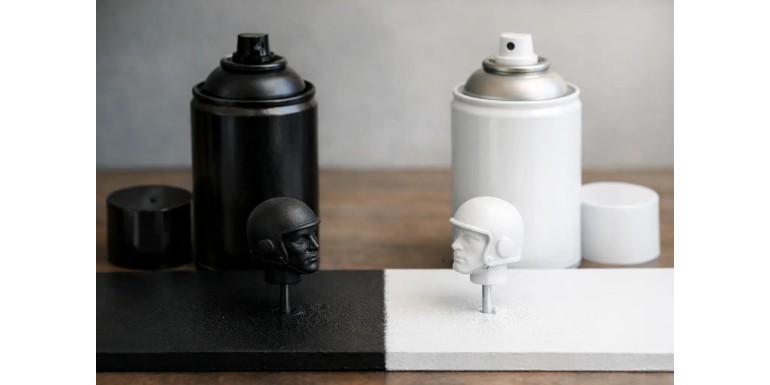
There is one decision that alters the final outcome of a miniature far more than it might seem: choosing between a black or white primer. It is not just a matter of personal preference. The base layer you select directly impacts paint coverage, color vibrancy, painting speed, and even how noticeable on-table mistakes will be.
In the miniature hobby world, this choice is frequently driven by habit. Those who started with dark armies tend to default to black. Painters who favor bright color schemes or rely on contrast paints usually lean toward white. The issue is that neither option is superior in every scenario. The real value lies in understanding exactly what each undercoat offers and knowing when it pays off to use it.
Black or White Primer for Miniatures
Black primer provides a much more forgiving painting experience. If you leave a deep, hard-to-reach area slightly uncovered, that dark shadow naturally blends in and goes unnoticed. For gaming infantry, horde units, or large-scale projects where finishing a batch with a solid overall tabletop look is the priority, this saves an immense amount of time. Furthermore, it naturally yields a more sober, muted finish. Metals, dark leathers, drab uniforms, and grimdark color schemes gain an immediate head start.
White primer does the exact opposite. Everything appears brighter, cleaner, and more intense. Yellows, reds, oranges, and skin tones benefit immensely from a white base because they achieve opacity much faster and retain their native vibrancy. It is also the most practical choice if you work with translucent paints, inks, speed paints, or contrast lines, as these require a bright underlying surface to function correctly.
Crucial Nuance: Black does not always equate to "easier," nor does white automatically mean a "better finish." If you plan to paint a miniature with yellow armor over a black undercoat, you will find yourself applying countless coats or building up an intermediate base layer. Conversely, if you paint a highly detailed, bright figure over white, any missed spot in the recesses will force you to spend extra time lining and carefully correcting mistakes.
How It Impacts Coverage and Color
The most obvious difference between the two primers is how paint behaves on top of them. Over black, many colors lose luminosity. This can be a significant advantage if you are aiming for military tones, worn leather, weathered steel, or muted fabrics. The color immediately comes out less striking and more integrated into the piece. The trade-off is that certain pigments cover poorly and demand extra layers of work.
Over white, color saturation surges. Pigments look cleaner from the very first layer, and transparent gradients blend much more effectively. For fantasy miniatures with vivid palettes, creatures with intense skin tones, or light-colored scenery, a white base provides excellent assistance. It also makes it much easier to read the details of the sculpt and track volumes while you paint.
However, white shows absolutely no mercy with poorly handled recesses. On a miniature packed with filigree, straps, crossed weapons, or chains, any unpainted corner will stick out like a sore thumb. While it might pass unnoticed on the gaming table, it can completely disrupt the harmony of a display piece.
Quick Comparison
-
Black Primer: Forgiving in hard-to-reach recesses; speeds up batch painting; ideal base for metallics and grimdark schemes.
-
White Primer: Maximizes color saturation; essential for Contrast, Speedpaints, and glazes; makes fine details easy to see.
When to Choose Black Primer
Black primer excels in three distinct scenarios. The first is when you are painting for tabletop standard and need absolute efficiency. Large units, entire armies, and dark terrain pieces benefit from a base layer that establishes pre-made shadows right from the start. The second scenario is when the color scheme relies heavily on deep tones: blacks, browns, olive drabs, navy blues, dark metallics, or weathered garments. The third is when you explicitly want a more dramatic, less luminous finish.
It also performs exceptionally well for terrain and scenery. Stone walls, ruins, industrial structures, scrap metal, dungeons, or urban bases generally start better from black because any dark crack or crevice adds instant realism. From there, you can work rapidly with drybrushing, quick over-layers, or pigments without fighting overly bright spots.
However, it is not without its downsides. If your project features a lot of bone, ivory, yellow, off-white, or bright red, starting from black will drastically slow down your progress. It is not impossible, but it is far less direct. In these cases, it is worth asking whether that initial convenience in the shadows truly outweighs the extra coats required later.
When to Choose White Primer
White primer is typically the optimal choice when the color scheme relies on luminosity. Elven miniatures, bright armor, clean uniforms, magical creatures, vibrant textiles, or warm palettes consistently perform better over a white base. If you use a lot of controlled washes, glazes, or high-flow paints, it also gives you more room to leverage paint transparency.
For terrain, it makes sense for elements that need to look clean or exceptionally bright: snow, marble, plaster, limestone, whitewashed buildings, or source-lighting effects. While it is not the most forgiving undercoat for every type of terrain, it prevents you from having to pull light colors up from an overly dark background in these specific instances.
Where its advantage shines brightest is in modern speed-painting techniques. If your workflow relies on translucent layers, contrast paints, and tones that naturally pool into the recesses, white or a very light off-white tone is practically mandatory. The paint requires that underlying clarity to separate highlights and shadows on its own.
The Overlooked Factor: Your Painting Style
The question should not just be black or white primer, but rather: how do you paint? If your standard process consists of a base coat, a heavy wash, and drybrushing, black tends to integrate much better. If you prefer thin layers, glazing, or contrast paints, white makes your job significantly easier.
It also matters how much you correct mistakes along the way. Black forgives minor slips because a dark gap reads simply as a shadow. White demands cleaner execution and more deliberate brush placement. In return, it rewards you with richer colors and crisper transitions.
This explains why two talented painters can approach the exact same miniature and logically choose completely different primers. It is not a contradiction; it is a matter of adjusting the tool to the method.
Where Does Grey Primer Fit In?
While the main debate centers on black and white, grey primer deserves a mention because it is often the most pragmatic middle ground. Grey tempers the extremes. It does not dull down colors as much as black, nor does it leave every unpainted spot as exposed as white. For mixed color schemes, miniatures with a balance of light and dark areas, or projects where you have not yet finalized the color scheme, grey is usually a safe bet.
Even so, choosing grey by default does not solve everything. If you need an ultra-dark base to speed up your work or an ultra-bright surface for contrast techniques, grey ends up stuck in no man's land. It works brilliantly when you are looking for balance, but less so when you need a specific technical advantage.
How to Decide Based on Your Project
If you are painting a sci-fi army with plenty of weaponry, mechanical joints, and dark armor, black will give you a much faster rhythm. If you are tackling a skirmish warband featuring yellow robes, pale skin, or glowing magic, white will save you countless layers. For terrain, think about the final finish first: a gothic ruin demands a completely different starting point than a whitewashed Mediterranean house or a snow-covered base.
Consider also the standard of finish you are aiming for. For tabletop standard gaming, black remains one of the most practical options because it accelerates production and masks errors. For display-level pieces or high-contrast schemes with intense colors, white provides that extra touch of visual cleanliness.
Another practical detail is the scope and material of the project. In large batches, every single extra layer adds up. If a primer forces you to fight for opacity across twenty miniatures, you will absolutely feel the fatigue. On a single character miniature, however, you can easily afford a less efficient base layer if the final look justifies the extra care.
Common Pitfalls When Choosing Primers
One of the most frequent mistakes is choosing out of pure inertia. Many painters prime everything exactly the same way simply because it worked for them once. The issue is that a primer perfectly suited for dark space marines can be an actively bad foundation for undead models featuring bone, light fabrics, and ethereal glow effects.
Another error is expecting the primer to fix a poorly planned color scheme. The base layer assists, but it cannot replace a logical color progression. If your project demands high-coverage light tones, you will still need a solid layering strategy even if you start on white. If it requires deep volume and stark shadows, black helps, but it will not perform miracles on its own.
Lastly, pay attention to the finish of the primer itself. Beyond the color, a poor application can clog fine detail or leave an unwanted gritty texture. On high-quality miniatures, that mistake ruins a model just as easily as picking the wrong color. It is always worth testing your spray on a spare piece of plastic before committing to an entire unit or a large terrain piece.
Conclusion
If you are torn between black or white primer, do not turn it into an absolute rule. Reflect on which colors will dominate the model, how much time you want to invest, and which technique you plan to use next. In this hobby, picking the right base layer might not make headlines, but it saves you hard work and brings you much closer to the exact look you want to see on the tabletop.