Español

Why a Bridge is the Ultimate Wargame Terrain Piece: Strategy and Narrative
- 05/26/2026 19:38:49
- Home , Tabletop Terrain
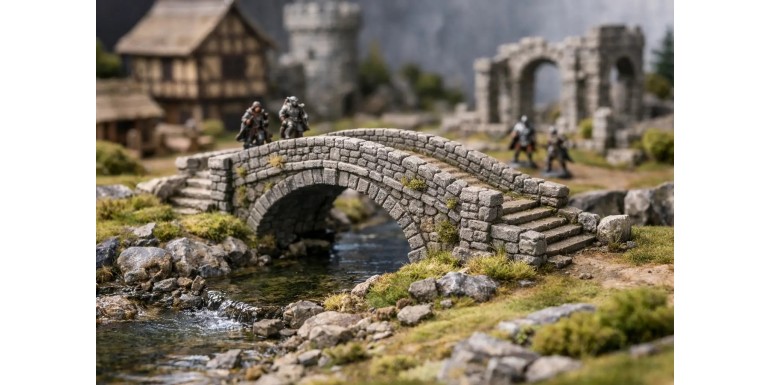
There are terrain pieces that simply fill the table, and then there are pieces that command the entire game. A bridge belongs to the second group. As soon as it appears in the center of the board, something highly recognizable happens to any tabletop fan: it stops being just a decorative element and becomes the objective. That is the core of this introduction: the sheer magnetism of a bridge on the tabletop.
It doesn't matter if you play Warhammer, Bolt Action, Star Wars: Legion, or if you are setting up a DnD terrain layout for a Pathfinder campaign. A good bridge changes how people move, how they shoot, which missions work, and, above all, the story everyone remembers when the game ends.
The problem with many tables is the usual one: flat terrain, three hills, two houses, and overly obvious lanes of advance. You can play on it, sure, but the game often feels predictable. Wargame terrain should do more than just occupy space. It should force you to make choices. A bridge achieves this almost single-handedly because it concentrates the action, creates high-risk situations, and provides an immediate reason to fight over a specific point on the board.
The Tactical Impact of a Tabletop Bridge
In wargames, a bridge introduces a term that every player quickly understands: the chokepoint. A bottleneck doesn't just narrow the path; it narrows your options. If the river, ravine, or impassable zone flanking it penalizes movement, the match stops being a race across an open field and begins to revolve around an uncomfortable choice: force your way through or look for a worse, longer route.
This is exactly where those heroic defenses that always work so well on the tabletop come into play. A few well-placed miniatures can hold off a much larger contingent if access is restricted. You don't need to replicate Thermopylae to the millimeter to feel this effect; a tight width, clear access, and an obvious reward for controlling the bridge are more than enough.
-
In alternating activation systems: This kind of position generates incredible tension because every single activation counts.
-
In mass-battle systems: It turns a specific zone into the operational hub of the entire battle.
[ Safe but Slow Route ] <---> ( The Bridge / Chokepoint ) <---> [ Fast but Exposed Route ]
Lines of sight change dramatically as well. An elevated bridge usually grants an advantage to shooting units, spotters, or troops that need to lock down a long fire lane on the board. However, not everything favors the defender. The underbelly, the pillars, and the nearby banks can offer vital cover for troops attempting to approach without exposing themselves completely. This opens up fascinating tactical scenarios: one unit can dominate the top deck while another tries to cross underneath, hide behind the structure, or prep a charge for the next turn.
It all comes down to the balance between risk and reward. Crossing the bridge is usually the fastest route to an objective, but also the most exposed. Going around might be safer, even if it means wasting turns or leaving key units out of position. This type of decision-making is exactly what elevates a game. When the table forces you to choose between speed, safety, and battlefield control, the game gains depth without needing to add complex rules.
Beyond Crossing: A Narrative Engine for RPGs and Campaigns
In roleplaying games, a bridge does not merely connect two sides of a map. It functions as a gate, a filter, and a stage. It forces the party to negotiate, fight, investigate, or improvise. Plus, it has a highly practical advantage for both Dungeon Masters and players: everyone understands at a glance why this point matters.
1. Hold the Bridge
The premise is simple and highly effective: the characters or a specific faction must hold the position for a set number of turns, rounds, or scenes until reinforcements arrive, an evacuation is completed, or a retreat is secured. It works equally well in fantasy, historical, or sci-fi settings, and it scales beautifully—you can run it as a small skirmish or as the grand climax of a campaign.
2. The Demolition Charge
This scenario works exceptionally well when you want asymmetrical mission objectives. One side needs to plant explosives, powder kegs, or a breaching spell at critical points of the structure, while the other side must detect and prevent it. Here, the bridge stops being mere terrain and becomes an objective with critical components: the approach, the center, the lateral supports, and the pillars. This detail ensures the scene has far more layers than a standard frontal clash.
3. The Classic Guardian's Toll
Whether it's a troll, a monster, or a legendary knight, this trope never fails. On the tabletop, it works because the narrow width and elevation turn combat into something entirely different. Fighting on an open plain is nothing like fighting in a single file line—complete with shoves, checks to avoid falling, partial cover, and the very real fear of ending up in the water or at the bottom of a ravine. For a DnD terrain setup, few pieces generate so much tension with such basic rules.
One Bridge, Many Worlds
One of the smartest terrain purchases you can make isn't the most spectacular looking one, but the one that hits your table game after game. This is why miniature bridges hold so much value. If the design is clever, a single piece can fit into multiple settings with minimal changes to paint, layout, or narrative context.
| Setting | How the Bridge Fits the Narrative |
| Fantasy / Medieval | The gateway to a castle, the entrance to elven ruins, or the only safe crossing over a cursed river. |
| Historical | A vital military objective in a WWII match or a critical crossing for infantry and artillery in a Napoleonic scenario. |
| Sci-Fi / Post-Apocalyptic | An industrial walkway, a damaged catwalk, or a modular bridge connecting high-tech platforms. |
This adaptability makes it an incredibly sound investment for improving your hobby table without cluttering your shelves with overly specific pieces. We aren't talking about situational terrain; we are talking about an element that can feature in a massive percentage of your games because it always makes sense: it connects zones, blocks routes, anchors objectives, and makes the board feel like a real place.
What to Look for in a Quality Resin, MDF, or PLA Bridge
Not every beautiful bridge functions well during a game. When choosing one, it pays to be practical.
Scale and Stability
The first consideration is scale. The bridge must comfortably accommodate standard 25mm to 32mm bases without miniatures half-hanging off the edge or requiring constant readjustment. If you also plan to use it with cavalry, large creatures, or light vehicles, width and stability become paramount.
Stability matters far more on the table than it does in a storefront or a photo. A piece can have great visual presence but become a nightmare as soon as hands, tape measures, and dice start moving around it. A good bridge must withstand real gameplay. If it wobbles, if the ramps don't sit flush, or if the base requires you to perfectly level the gaming board, it will end up spending more time on the shelf than you'd like.
Playability Over Visual Clutter
Playable accessibility is another essential filter. Some designs overload the sides, railings, or internal details so much that placing miniatures becomes a frustrating chore. They look great in a display case, but not on the battlefield. Playability rules. If you can't place a unit flat on its feet or move it without knocking over half the terrain, the piece loses its practical value, no matter how visually stunning it is.
Material Choice: PLA vs. Resin vs. MDF
The material you choose will impact your gaming experience:
-
MDF terrain usually stands out for its lightweight nature, ease of assembly, and excellent size-to-cost ratio.
-
Resin terrain typically offers richer textures and a heavier tabletop presence, making it ideal if you are looking for high-character finishes.
-
PLA terrain (3D printed) makes a lot of sense when you want highly specific designs, good volume, and a durable piece built for frequent use.
There is no single correct answer; it depends entirely on your table's style, how rough your gaming sessions get, and whether you prioritize texture over modularity.
Hobby Tip: Look for rewarding textures when it comes to painting. The best pieces for regular use feature prominent stone, wooden planks, deep grain, cracks, and rivets. These elements work wonderfully with fast techniques like drybrushing and washing, allowing you to achieve a striking look without turning every project into a display-case grind. For most hobbyists, this balance between tabletop presence and speed is exactly what gets a piece into regular rotation.
When a Bridge Truly Upgrades Your Table
Not every table needs a bridge, but almost every table needs an element that brings order to the game. That is where the difference lies. A well-placed bridge doesn't just decorate; it defines routes, creates conflict, and gives context to everything that unfolds. It makes two armies look like they are actually fighting over something tangible, and it gives a party of adventurers a clear, undeniable challenge right in front of them.
That is why it remains one of the most useful pieces of wargame and RPG terrain you can own. If you choose a model that is playable, stable, and easy to integrate into various settings, the return on investment in terms of gameplay hours is massive. At Terrainandminis.com, we have seen time and again that a table featuring a river and a bridge doesn't just catch the eye—it improves the game from the very first turn. If you are currently reviewing your terrain collection, few additions will shift your gameplay dynamics as dramatically as a single, well-crafted bridge.