Español

Which airbrush to buy for miniatures
- 06/29/2026 16:57:55
- Home , Assembly and Painting Guides
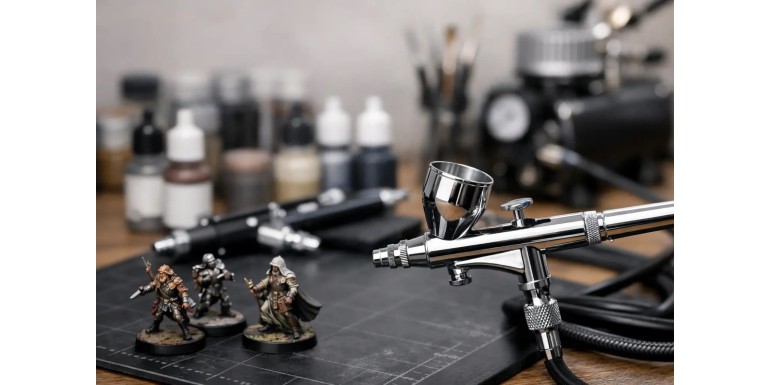
When someone asks which airbrush to buy for miniatures, they rarely need "the best airbrush" on the market. What they actually need is one that fits their painting style, the type of army or project they are working on, and the time they are willing to dedicate to maintenance. Priming large pieces of terrain is a completely different task than painting fine highlights on a 28mm infantry model.
The problem is that many guides mix tools for illustration, general scale modeling, and miniature painting as if they were all the same. In the hobby, it doesn't work like that. Control, ease of cleaning, spare parts availability, and durability during long sessions of priming, base coating, camouflage, and varnishing are what truly matter.
How to Choose an Airbrush Based on Your Needs
The first decision isn't the brand; it’s the intended use. If you want an airbrush for priming, base coating, and varnishing entire units, prioritize comfort and flow. If you want it for smooth transitions, zenithal highlights, and controlled details on characters, you need precision over volume.
That is why a double-action, gravity-feed airbrush is the standard for most hobbyists. Double-action allows you to control air and paint with the same trigger—invaluable when switching from a wide base coat to a tighter highlight without breaking your rhythm. Gravity-feed, with the cup on top, requires less pressure and offers a more predictable response with acrylic hobby paints.
While siphon-feed (bottom-feed) models have their place in high-volume work, they are less practical for most miniature painters. They add weight, require higher pressure, and aren't usually the best entry point.
Why Nozzle Size Matters More Than You Think
If you only remember one spec, make it this one: the nozzle matters. For miniatures, the "sweet spot" is usually between 0.3mm and 0.35mm. This range allows you to prime, apply base colors, create gradients, and work on vehicles or monsters without the airbrush becoming overly delicate.
-
0.2mm or smaller: Offers more precision, but clogs faster, requires thinner paint, and is less forgiving. It can be a source of frustration for beginners.
-
0.4mm or 0.5mm: Excellent for primers, varnishes, and terrain, but loses the necessary finesse for fine detail.
If you only own one airbrush, a 0.3mm nozzle is the most versatile option that doesn’t require an expert hand.
One Airbrush or Two?
Starting with one is logical. However, as your hobby grows, owning two airbrushes saves real time: one with a larger nozzle for primers and metallics, and a finer one for detailed color work. You don't need to start this way, but keep it in mind—many painters struggle with clogs because they try to use a fine-detail brush for a heavy priming job.
What Features Are Worth the Investment?
Cheap models can paint, but the real cost is measured in time lost to cleaning, loose parts, and inconsistent spray. In miniature airbrushing, paying a little extra pays off in the daily user experience. Look for a smooth trigger, easily accessible spare parts, a medium-sized integrated cup, and straightforward disassembly.
Robust needles and nozzles are key. A delicate nozzle can deform with aggressive cleaning or over-tightening—a common mistake when starting out. While a needle limiter (back stop) can help beginners prevent accidental splatters, it is not mandatory. What you shouldn't compromise on is spray consistency. An unreliable tool will inevitably lead to graininess, spider-webbing, and uneven coats.
The Compressor Is Just as Important as the Airbrush
Pairing a great airbrush with a weak, unstable compressor will make you blame the tool for performance issues that are actually air-related. For miniatures, a compressor with a tank (air receiver) is highly recommended. It maintains steady pressure, runs quieter, and eliminates the pulsing flow.
Don't skip the pressure regulator and moisture trap. Moisture in the line causes real problems, especially during long sessions. This isn't a luxury; it's essential.
The Common Pitfall: The "Too-Basic" Kit
Very cheap, all-in-one starter kits are tempting, but they often pair a mediocre airbrush with a bottom-tier compressor. If your budget is tight, it is better to prioritize a decent compressor and a simple but reliable airbrush rather than a set filled with cheap accessories you will rarely use.
What Kind of Painter Are You?
-
The Army Painter: If you want to speed up priming, base coating, and pre-shading, look for a tolerant, easy-to-clean model with a medium nozzle.
-
The Character/Bust Painter: If you already have good brush control and want to take your models to the next level, a higher-end model with better trigger response and precision mechanics is worth the investment.
-
The Terrain Builder: If your hobby focuses on tanks, buildings, and game tables, prioritize something with higher flow.
Conclusion: The Sensible Choice
For most hobbyists, the most sensible purchase is a gravity-feed, double-action airbrush with a 0.3mm nozzle, paired with a compressor that includes a tank, regulator, and moisture trap.
At a specialized store like Terrainandminis.com, we understand the hobby from the perspective of the painting desk. Don't look for an airbrush to admire; look for one that reduces your workload, gives you control, and encourages you to paint more often. When you find that balance, your airbrush stops being a fancy gadget and becomes the most useful tool in your kit.
If you’re torn between two similar models, pick the one that is easiest to clean and easiest to get running on a Tuesday night—when all you want to do is finish those ten miniatures before your next game.