Español

Drybrushing vs. Airbrushing – Which One is Right for You?
- 06/03/2026 12:43:56
- Home , Assembly and Painting Guides
There is a very clear difference between a miniature that is simply "tabletop ready" and one that truly catches your eye from three feet away. More often than not, the secret isn't using twenty different paints or spending an entire weekend on a single model—it’s choosing the right technique. That is why the drybrushing vs. airbrushing debate comes up so often in miniatures, terrain, and basing. They don't do the same thing, they don't require the same setup, and they don't solve the same problems.
Whether you paint for gaming, display, or to power through an entire army without taking forever, it pays to have this clear from the start. Drybrushing and airbrushing can coexist perfectly in the same project, but they are not interchangeable. When you try to force one to do the job of the other, frustration usually follows, along with mediocre finishes or the classic "well, it didn't look this bad in the photos."
Drybrushing vs. Airbrushing: The Real Difference
The most useful comparison isn't "which technique is better," but rather "what kind of job does each one do best."
-
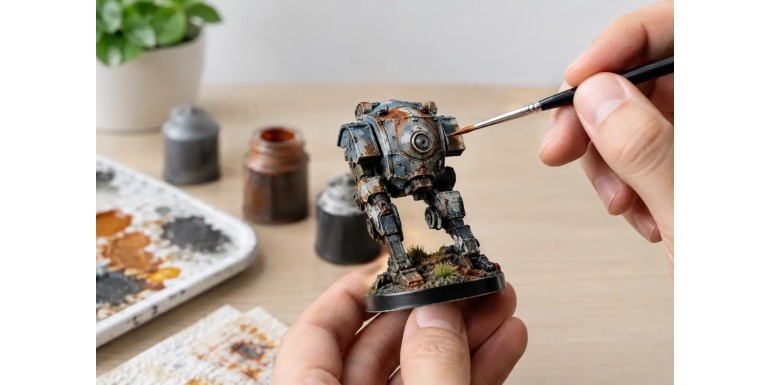
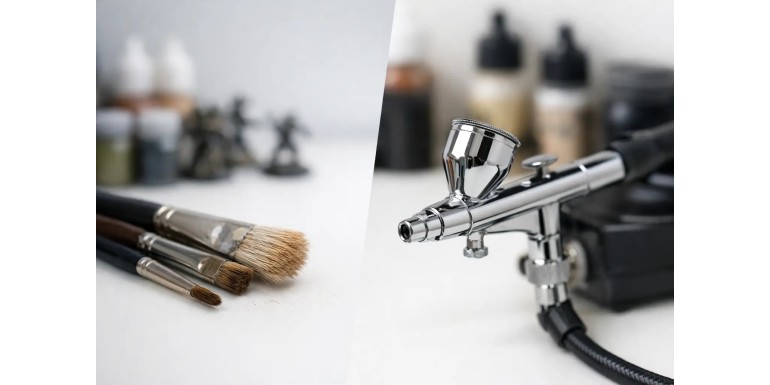
Drybrushing works through friction. It deposits paint onto raised areas, textures, and sharp edges. It is a physical, direct technique that is incredibly rewarding on rough or highly detailed surfaces. This is why it works so well on stone, weathered leather, fur, battered metal, bone, ruins, and almost any terrain piece with distinct volume.
-
Airbrushing works through atomization (spraying). It covers large surfaces or progressive transitions in a much smoother, uniform, and controlled manner. This is where it shines: clean basecoats, gradients, zenithal highlights, filters, color modulation, and repetitive schemes for batch-painting. On vehicles, monsters, smooth armor plates, or large terrain elements, it saves a massive amount of time and delivers a finish that is hard to match with a traditional brush.
Put simply: Drybrushing pulls out texture. Airbrushing builds volume and transition. On a rock, drybrushing usually wins. On a smooth shoulder pad or a tank hull, the airbrush starts with a massive advantage.
When Drybrushing Wins Hands Down
Drybrushing remains one of the most useful techniques in the hobby because it delivers great results with very little hassle. It doesn’t require a compressor, demands no technical cleaning between colors, and allows you to make corrections on the fly without setting up a massive workstation. For many gaming projects, that convenience carries more weight than you might think.
Where it truly shines is in terrain and basing. A stone wall, an industrial walkway, a textured desert base, or a fallen log all respond beautifully to a succession of drybrushes. In just a few minutes, you can boost contrast, catch edges, and separate volumes that would take significantly longer with standard layering.
It is also incredibly valuable when you need speed. If you need to churn out a gaming table, some ruins, or a large batch of organic elements, drybrushing allows you to move fast with more-than-respectable results. Plus, for beginners, it offers a friendly learning curve. You don't need to master the exact paint dilution or control air pressure. It takes practice, yes, but the margin for achieving useful results early on is much wider.
The Limits of the Drybrush
However, it has very clear limits. On smooth surfaces, it can leave a dusty or chalky finish. On clean armor, fine fabrics, or large panels, that visual grain stands out like a sore thumb. And if overused, every single piece starts to look like it was made with the exact same recipe, lacking real depth between shadow and light.
The most common drybrushing mistake: The issue usually isn't the technique itself, but the amount of paint. Many painters wipe off some paint, but not enough. The result is a harsh, streaky brushstroke that smudges rather than highlights. The type of brush and the surface texture also play a huge role. It can look fantastic on chainmail; on a smooth cloak, not so much.
That is why it’s best to view it as a specific tool, not a universal solution. When it fits, it’s excellent. When it doesn't, it shows immediately.
When the Airbrush Makes All the Difference
An airbrush completely changes your workflow pace when you have a high volume of miniatures, large surface areas, or color schemes that rely on smooth transitions. Priming, applying base colors, shading from below, or spraying a zenithal highlight from above are tasks where it wins in both speed and finish.
In full armies, the difference is massive. If you are repeating the same primary color across infantry, cavalry, vehicles, or large creatures, the airbrush cuts down hours of work and maintains strict consistency across units. It also helps immensely with large terrain pieces—especially buildings, containers, industrial panels, or war vehicles where you want tonal variation without visible brushstrokes.
Another real advantage is value control. With an airbrush, you can build up shadows and highlights very gradually. This leaves an excellent foundation for you to finish later with a traditional brush, adding edge highlights, details, and weathering. In that sense, it doesn't compete with the traditional brush—it prepares the canvas for it.
The Trade-Offs of Airbrushing
The catch is that it is not a plug-and-play tool. It requires dedicated space, regular maintenance, constant cleaning, and a baseline learning curve. If you don't master paint thinning, you will run into speckling, dry tip, clogs, or spider-webbing. And if you only paint one miniature every once in a while, it can feel like you spend more time setting up and cleaning than actually painting.
What the Airbrush Won't Fix
Sometimes people buy an airbrush thinking it will automatically improve every finish, but it doesn't work that way. An airbrush cannot replace the fine control of a traditional brush for eyes, trims, badges, leather, localized weathering, or tiny details. It also won't "work magic" on a poorly assembled miniature with visible mold lines or a bad prime job.
Furthermore, on very deep textures, it doesn't always reach where it matters most. It sprays beautifully, but it doesn't hug the physical relief of a model the way a good drybrush does. That’s why on many rocks, rubble, or tree trunks, it ends up being a preliminary phase rather than the final touch.
Drybrushing vs. Airbrushing in Miniatures and Terrain
If you paint individual characters, the choice depends heavily on your style:
-
For grimdark, fantasy, fur, worn cloaks, heavily textured bases, and weathered finishes: Drybrushing offers a ton of mileage.
-
For sci-fi, vehicles, power armor, creatures with smooth volumes, or ultra-clean schemes: The airbrush typically brings more to the table.
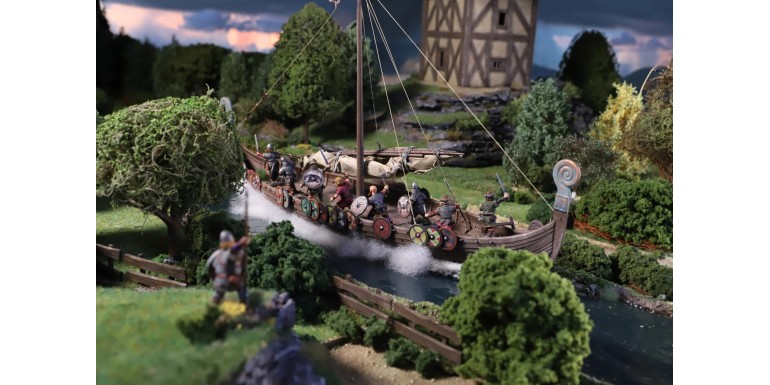
In terrain, the scales tip slightly. Drybrushing offers an excellent effort-to-reward ratio on stone, wood, dirt, and ruins. The airbrush comes in strong when you need to cover a lot of material, vary base tones, or establish an overall atmosphere. In an abandoned factory, for example, the airbrush can handle the industrial basecoat and ambient tones, while a drybrush finishes off the edges, rust, and texture.
This explains why many hobbyists naturally progress toward a mixed workflow. Not because it's more "pro," but because each technique solves a different part of the puzzle. A black prime, a soft zenithal highlight with the airbrush, and a few well-chosen drybrushes can yield incredibly convincing terrain without needing complex processes.
Which Technique Suits Your Painting Style?
-
Choose Drybrushing if: You value speed, paint primarily for tabletop gaming, and work on a lot of terrain, ruins, bases, or highly textured miniatures. It will give you the most immediate utility. It is inexpensive, flexible, and highly effective at creating visual volume with minimal setup.
-
Choose Airbrushing if: You paint large armies, vehicles, monsters, and smooth surfaces, or if you want a cleaner, more modern finish from your very first layers. It pays off significantly if you repeat projects and can integrate it continuously. The investment only makes sense when it becomes a core part of your workflow.
If you are stuck somewhere in the middle, the honest answer is to look at what is slowing you down the most right now. If your bottleneck is taking too long on basecoats and transitions, get an airbrush. If your bottleneck is that your terrain looks flat or you struggle to bring out quick details, master the drybrush. There is no superior option in a vacuum—there is only the most useful option for the bottleneck you have today.
The Best Answer is Usually a Combo
In the miniature hobby, the most efficient techniques rarely live in isolation. The airbrush provides speed, consistency, and smoothness. Drybrushing provides texture, quick readability, and visual punch. Together, they cover almost everything a well-presented gaming table demands.
A highly practical workflow would look like this:
1. Use the airbrush to prime, modulate color, and establish general lighting.
2. Reserve the drybrush for textures, chipped edges, stone, dirt, and terrain elements.
By doing this, each tool works exactly where it adds the most value. It’s not about overcomplicating your process; it’s about avoiding a fight with a technique that wasn't built for the job at hand.
In a specialized shop like Terrainandminis.com, this becomes crystal clear when looking at the sheer variety of projects the community tackles. Someone painting a skirmish warband doesn't approach a project the same way as someone building a full gaming table complete with buildings, snow, mud, and artificial water. That’s why it’s always better to think about your specific needs rather than hobby trends.
If you have to choose just one tool, choose the one that allows you to finish more projects with better results—not the one that looks the most advanced. A truly useful technique is the one that gets you painting more, playing sooner, and looking at your tabletop eager to start the next piece.