Español

MDF or resin terrain: which is better
- 06/02/2026 08:09:10
- Home , Tabletop Terrain
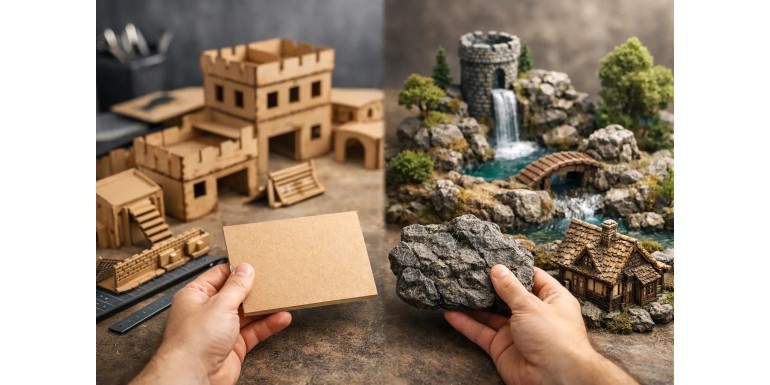
There is a difference you notice almost instantly on the tabletop: buying a piece of scenery just to fill space is not the same as building an environment designed for intensive gaming, frequent transport, and years of battles. That is why the dilemma between MDF or resin terrain isn’t just about materials. It is about actual usage, hobby time, budget, and the specific type of tabletop you want to build.
If you play wargames frequently, you have probably already noticed the pattern. MDF terrain usually steps in when you need volume, modularity, and a budget-friendly cost. Resin terrain, on the other hand, gains ground when you are looking for texture, character, and centerpiece elements. Making the right choice prevents purchases that end up gathering dust on the shelf or terrain that looks amazing in photos but performs poorly during a match.
MDF vs. Resin Terrain: The Real Difference
MDF (Medium-Density Fireboard) is a pressed wood fiberboard that is typically laser-cut. In wargaming scenery, it is widely used for buildings, walkways, modular ruins, playable interiors, and structures with clean geometries. It offers a clear advantage: it allows for the manufacturing of large volumes at a reasonable price and with very consistent dimensions. When you are setting up an urban, industrial, or sci-fi table, this becomes highly apparent.
Resin plays an entirely different game. It allows for a much more organic level of relief and detail, featuring cracks, stone, sculpted wood, ornaments, symbols, bones, skulls, roots, or highly integrated ground textures. It is commonly found in fantasy props, decorative elements, scatter terrain with character, statues, altars, heavily textured ruins, or buildings where the visual finish outweighs modularity.
To put it simply: MDF usually handles structure and quantity; resin usually handles finish and tabletop presence.
When is MDF Terrain Worth It?
MDF works exceptionally well when your priority is to fill the table without skyrocketing your budget. For many players, that is already half the decision. A playable board requires lines of sight, verticality, cover, and pathways. If you try to achieve this with resin in large quantities, the cost escales rapidly. With MDF, you can set up a significant amount of scenery within a smaller budget and, in many cases, with options heavily optimized for gameplay.
It is also an incredibly convenient option if you value accessible interiors, removable floors, and modular pieces. In skirmish games, narrative campaigns, or dense urban combat tables, this carries a lot of weight. A beautiful building is of little use if placing miniatures inside is clumsy, or if it is hard to distinguish which areas block line of sight and which do not.
Advantages of MDF:
-
Predictable assembly: Many MDF kits come precisely die-cut or laser-cut, and the process is usually quite clean. You do have to build it, but the joints are typically designed to ensure a stable and straightforward result. For the hobbyist looking to produce a playable table without spending weeks on a single building, it is a very logical solution.
-
The downside: MDF has its limits. Fresh out of the box, it can look flat if you don't work on the edges, texture, and paint. Laser cutting leaves dark edges, large surfaces can look too smooth, and some pieces greatly benefit from texture paste, sand, plasticard, or extra accessories to bring them to life. If you love customizing, this isn't an issue. If you want immediate visual impact, it might be.
When is Resin Terrain the Better Choice?
Resin shines when a piece needs to bring character all by itself. A shrine, a broken statue, a crypt, elven ruins, a well, a portal, or a rocky outcrop can completely shift the aesthetics of the entire table. You don’t need as much additional work for the scenery to look rich in detail. The textures are already there, making priming, drybrushing, washes, and quick finishes highly rewarding with great results.
For dioramas and display projects, resin also tends to have the upper hand. The depth of the sculpt helps the piece hold up well even with a simple paint job and responds beautifully to weathering techniques. If you are more interested in a spectacular table than a massive one, resin usually delivers that "finished piece" feeling right from the start.
The Trade-offs of Resin:
Resin is heavier, usually costs more, and is not always forgiving with bumps or drops. Depending on the piece, it may require cleaning, straightening, or a bit more preparation before painting. Furthermore, when it comes to large scenery pieces, transport can be less forgiving than with lightweight MDF kits.
Price, Time, and Hobby Effort
This is where the comparison becomes most useful. If you only look at the purchase price, MDF usually wins for bulk scenery. However, the real cost is not always that simple. A large MDF kit can demand hours of assembly, texturing, and detailing if you want to prevent it from looking like "painted MDF." Resin, while more expensive upfront, can sometimes reduce conversion time because it already features enough detail to look great with a proper paint job.
Therefore, it is worth asking yourself which resource you value more: money or time. If you enjoy building, texturing, and customizing, MDF gives you plenty of creative freedom. If you prefer to focus on painting and getting pieces onto the table sooner, resin can be much more rewarding.
In club environments or gaming groups where a lot of functional scenery is required, MDF offers a massive practical advantage. In personal projects with fewer pieces but higher aesthetic ambition, resin easily justifies its price tag.
Painting and Finishing: Different Behaviors
When it comes to painting, MDF and resin require different approaches:
-
MDF needs a proper primer and usually improves significantly if you seal or prepare certain surfaces to prevent uneven absorption. Additionally, on very smooth pieces, it is highly recommended to add texture to floors, walls, or bases so the final look doesn't feel too clean or artificial.
-
Resin, once properly prepared (and washed to remove mold release agent), responds incredibly well to fast techniques. Washes, drybrushing, and pigments find relief instantly. This doesn't mean it is always easier, but the material itself helps you achieve visual impact with less structural prep work.
If you are someone who batch-paints to get a table ready as soon as possible, this matters a lot. A batch of resin walls or rocks can look convincing in no time. A batch of MDF buildings might require an extra preparation phase to achieve an equally solid result.
Durability and Tabletop Wear and Tear
Not all scenery suffers the same amount of wear. Some pieces are barely touched, while others are moved every single turn. Under intensive use, MDF holds up remarkably well structurally if assembled correctly. It is lightweight, stable, and easy to store. For buildings, platforms, and large elements for recurring games, it is usually a safe bet.
Resin can withstand regular use, but certain pieces with thin elements or decorative protrusions are more delicate. This doesn’t matter in a display cabinet, but it does in a backpack or a poorly stacked storage box. If you set up a table every week and pack up quickly at the end of the game, it is wise to consider this before prioritizing detail alone.
The type of game also plays a role. In games involving heavy miniature movement through floors, ladders, or interiors, MDF is usually more practical. On tables where the terrain acts primarily as cover, line-of-sight blocking, and heavy thematic immersion, resin can stand out without getting in the way.
MDF or Resin Scenery Based on Your Project
If you are building a complete tabletop from scratch, the wisest move is often not to choose just one material, but to combine them.
-
MDF can take care of the main architecture: buildings, walkways, factories, houses, and large ruins.
-
Resin can come in for elements that provide identity: statues, rubble, walls, rocks, tombs, faction-specific accessories, scattered terrain, and centerpieces.
This mix usually offers the best balance between cost, playability, and final appearance. Plus, it prevents the table from looking too uniform. An entire city made solely of MDF can turn out a bit flat unless you put a lot of work into it. A large table made exclusively of resin can be expensive and cumbersome to manage. By bringing both together, each material does what it does best.
For anyone buying with a gamer's mindset, this is usually the most useful answer. Don't think about "which material is better," but rather "which part of the table should each material solve."
So, Which One is Best for You?
If you are looking to fill a board, play frequently, build practical structures, and keep your budget under control, MDF is usually the best foundation. If you want pieces with more texture, greater visual presence, and less conversion work, resin is the better investment. And if you want a table that performs flawlessly while bursting with character, you will naturally end up using both.
At a specialized store like Terrainandminis.com, this becomes obvious immediately because no two projects have the same requirements. A tournament table, a narrative campaign, a dungeon, a skirmish board, or a diorama are not built with the same logic. The right material is the one that fits your playstyle and the amount of time you are truly going to dedicate to the hobby.
The best purchase isn't the flashiest or the cheapest—it’s the one that still makes perfect sense when the piece is built, painted, and has ten games under its belt.