Español

Metallic Paint Guide for Miniatures
- 05/29/2026 09:19:42
- Home , Assembly and Painting Guides
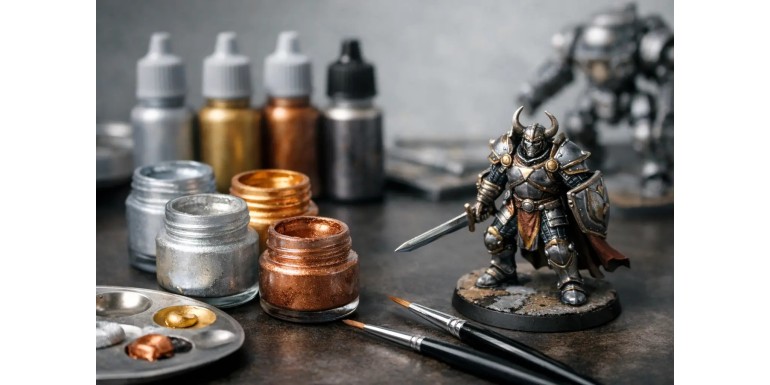
There is a very clear difference between a miniature with painted metal and a miniature with metal that actually looks like metal. That difference rarely comes down to buying the most expensive paint; instead, it is about understanding the finish you are looking for, how each range behaves, and which technique suits each piece best. In this miniature metallic paints guide, we are going to focus on exactly that: choosing well, applying better, and avoiding the mistakes that dull any armor, weapon, or machinery.
What to Look for in a Metallic Paint
Not all metallics do the same job, even if they look similar in the bottle. The first real difference lies in the metallic pigment particle size. Paints with finer particles usually provide a cleaner, more controlled finish, especially in small scales like 28mm or 32mm. Coarser particle paints can work well for wargame terrain, vehicles, or heavily weathered areas, but on a small chainmail shirt, they can sometimes leave a somewhat crude, chunky shine.
Coverage also matters a lot. Some metallics cover wonderfully in a single pass—which is incredibly useful for army speed-painting—while others require two or three thin layers but offer a more elegant finish. Neither option is inherently better. If you are painting forty troops, you will probably prioritize speed. If you are working on a display-case character, you will likely prefer a thinner paint, even if it demands more time.
The third key factor is shine. Not all metal should shine the same way. A newly forged steel, an aged bronze, and a ceremonial gold require entirely different finishes. That is why it is best to think of metallic paint not as a finished color, but as a base that you will later nuance with shades, inks, glazes, or varnishes.
Miniature Metallic Paints Guide According to the Effect You Want
Clean Steel and Sharp Edges
If you want clean steel for swords, armor, or blades, you want a medium silver or a steel paint with good coverage and moderate reflection. Starting from a base that is too bright makes shading complicated because it immediately takes on a chromed appearance. In fantasy or historical miniatures, a somewhat subdued metal almost always works better, allowing you to later push the highlights on the sharp edges.
Dark Iron and Industrial Machinery
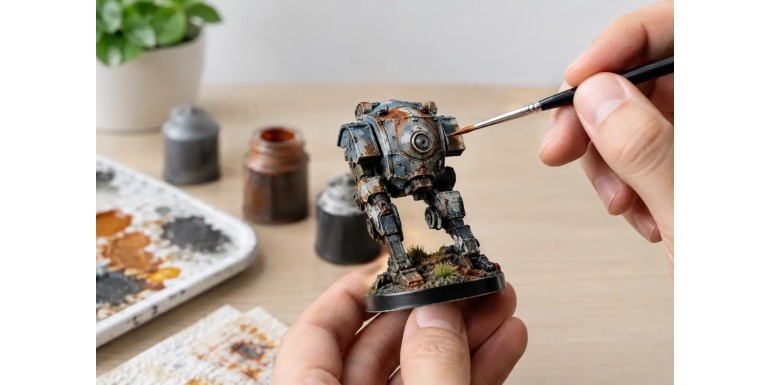
For dark iron, troop weapons, or industrial machinery, a gunmetal or blued iron metallic is usually more useful than a standard silver. It has more visual body and accepts black or brown washes much better. This is a very forgiving option for gaming projects because it ages well and hides minor mistakes.
Golds and Bronzes
With golds, there is more variation. A very yellow gold can look artificial on small figures if it isn't toned down afterward with warm shades. For ornamental details, emblems, trims, or ceremonial armor, it usually works best to build the gold in layers: a bronze or warm brown base, then a medium gold, and finally a touch of light gold or silver-gold on the points of maximum reflection.
Bronze and copper are especially useful for fantasy miniatures, steampunk, and scenery. They offer a lot of versatility because they accept patinas, verdigris, and grime without losing their definition. Furthermore, on gaming tables with uneven lighting, these warm tones tend to stand out better than some overly dull silvers.
Priming and Base Colors: Where the Result Begins
Metallics react very differently depending on what is underneath them:
-
Over a black primer: Metals look deeper and more sober. This is the safest option for steel, iron, aged bronze, and any dark color scheme.
-
Over a grey primer: The result is more balanced and easier to read.
-
Over a white primer: Many metallics look too flat or overly bright, unless you are aiming for an exceptionally clean finish.
There is a simple trick that is well worth using more often: change your base color according to the metal. For steel, a black or charcoal grey base works beautifully. For gold, a reddish-brown or terracotta base helps immensely to add richness without needing ten coats. For copper and bronze, a warm brown or a dark red does half the work before you even open the metallic bottle.
It isn't mandatory, but it is highly practical. If you already know you are going to do a lot of weathering and shading, this prior preparation saves time and improves the final result.
How to Apply Metallics Without Leaving Unwanted Texture
The most common mistake with metallic paints is treating them exactly like normal matte paint. They do not respond in quite the same way. If you overload your brush, the pigment clumps up and the surface loses definition. If you over-thin them, the metal becomes watery and covers poorly. What usually works best is a light thinning and two thin layers, letting it dry thoroughly between coats.
Brush Tip: It is best to use a brush with a good point but one that isn't too soft. Metallics are harsher on brushes than other colors due to the nature of the pigment itself, so many hobbyists reserve a specific brush just for this work. It makes total sense—you extend the life of your good brushes and manage wear and tear better.
On large surfaces, such as big armor plates or vehicles, it pays to watch the direction of your brushstrokes. If you apply the metal haphazardly, the light bounces off irregularly and the finish looks messy, even if it has good coverage. On the other hand, if you maintain a consistent direction, the result looks cleaner even before shading.
Highlights and Shades: Where the Miniature Gains Credibility
A base metallic paint is rarely enough on its own. What makes metal believable is contrast. To shade steel, black, dark brown, or bluish washes work beautifully depending on the atmosphere you want to achieve. Black adds harshness. Brown adds grime and age. Blue cools down the tone and gives it a slightly more polished feel.
With gold, bronze, and copper, brown, sepia, or even purplish shades usually yield better results than pure black. Black can kill the richness of the tone if used carelessly, whereas a warm shade keeps the metal alive.
The final highlights are where you should exercise restraint. If you highlight everything, nothing stands out. On gaming miniatures, it is enough to reinforce edges, rivets, blades, and areas that would catch the most light. A mix of your base metallic with a light silver usually works better than going straight to a very bright silver across the entire piece.
When to Use True Metallic Metal (TMM) vs. Non-Metallic Metal (NMM)
This comparison always comes up, and the real answer is that it depends on the project. Classic metal with metallic pigment (TMM) remains the most efficient choice for armies, scenery, vehicles, and any miniature intended for the tabletop. It is fast, readable from a distance, and withstands regular handling quite well.
NMM (Non-Metallic Metal) offers enormous visual control and can look spectacular for display pieces, but it demands much higher precision in highlights, volumes, and lighting direction. For a skirmish warband you play with every week, it isn't always worth the effort. For a centerpiece or a competition miniature, it absolutely makes sense.
There is also a very useful middle ground: classic metallic reinforced with very stark highlights and deep shadows. It isn’t NMM, but it gains depth without overcomplicating the process. For many painters, this balance offers the best ratio between time investment and final result.
Common Mistakes in Painting Miniature Metals
-
Using the same silver for everything: Swords, servomotors, chainmail, and ornamental armor shouldn't look identical. Tweaking the base tone slightly differentiates materials and makes the miniature more visually interesting.
-
Overusing washes: A poorly controlled wash leaves pooling rings and dulls the metal’s natural shine. Two thin, targeted applications are much better than flooding the entire piece. This detail changes the outcome dramatically, especially on golds.
-
Choosing the wrong varnish: A completely matte varnish can ruin hours of work on metals. If you need to protect the miniature, it is sometimes worth varnishing the entire figure in matte and then recovering the metals with a final highlight or a localized satin varnish. High gloss isn't always necessary, but respecting the metallic property is.
Which Metallics Should You Always Have on Hand?
You don't need to hoard twenty different paints to work effectively. With a dark silver, a medium silver, a light silver, a gold, a bronze or copper, and a couple of useful inks, you can tackle countless projects. From there, specific ranges expand your options, but they do not replace basic technique.
If you paint both miniatures and terrain, it is well worth separating your products by usage. For terrain and large elements, you can tolerate coarser pigments or rougher finishes. For heroes, commanders, and display figures, a finer metallic paint for miniatures makes all the difference.
This is where a specialized catalog, like the one at Terrainandminis.com, makes practical sense: you can search based on the actual needs of your project rather than relying on guesswork.
How to Choose Based on Your Painting Style
If you batch-paint, prioritize coverage, stability, and ease of fast shading. If you work piece by piece, you will probably be more interested in a metallic that allows for smooth transitions and more controlled reflections. No choice is universal. The best metallic paint for miniatures isn't the most famous one; it is the one that fits your scale, your pace, and the finish you want to see on the tabletop.
It is always worth testing on leftover sprue bits, spare shields, or pieces of scenery before committing to an entire unit. Metals can be very deceptive inside the bottle and under different lighting. What looks perfect on the workbench might look flat on the gaming table.
If you take just one idea away from this, let it be this: good metal on miniatures does not depend solely on shine, but on contrast, intention, and context. When you choose your paint with the specific piece in mind, the results show immediately.