Español

MDF or PLA Terrain: which is better
- 05/10/2026 08:17:07
- Home , Tabletop Terrain
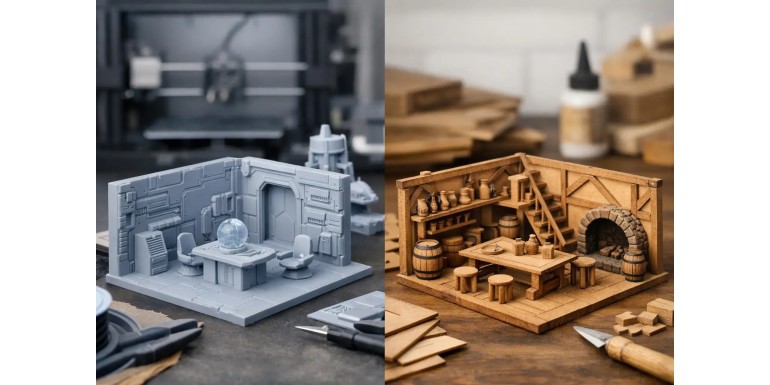
If you’re torn between MDF or PLA Terrain, the short answer is: there is no absolute winner. On the tabletop, both materials perform exceptionally well, but they do so for different reasons. PLA typically stands out for its detail and complex shapes, while MDF shines in terms of cost, rigidity, and the speed at which you can build up a large amount of playable terrain without overcomplicating things.
For wargames, skirmish games, and dioramas, choosing the right material significantly changes the experience. It’s not just about the final paint job; it’s also about assembly time, durability during play, and how easy it is to store or transport the pieces. If you are buying with the intention of expanding your table in the mid-term, it pays to think beyond just a single "pretty" piece of scenery.
MDF vs. PLA Terrain: Real Differences in the Hobby
PLA (Polylactic Acid) is a very common plastic used in 3D-printed scenery. It allows for the design of ruins, pipes, consoles, doors, containers, or facades with highly defined volumes and integrated details that would require more parts or manual labor in other materials. For sci-fi, industrial, or dungeon settings, this level of detail is highly noticeable.
MDF (Medium Density Fiberboard), on the other hand, starts from sheets—usually laser-cut. This gives it a more modular and geometric aesthetic. Buildings, walkways, barricades, playable interiors, or stackable structures are often best executed in MDF because the material is stable and rewarding when assembling large kits. If you prioritize cover, line-of-sight (LoS), and functional scenery for gaming, it remains a very solid bet.
The Key Takeaway: PLA excels at selling volume and form, while MDF excels at selling structure and price-per-square-inch.
When to Choose PLA Terrain
PLA is a great fit when you are looking for pieces with a strong visual personality. A 3D printer or specialized manufacturer can produce reliefs, rivets, panels, pipes, and battle damage directly onto the piece. This reduces the need for "scratch building" and makes it easier to achieve striking results with just primer, dry brushing, and washes.
-
Specific Themes: It’s an excellent choice for highly specific thematic scenery. In Fantasy, think of statues, crypts, or portals. In Sci-Fi, think of terminals, generators, hatches, or high-tech elements.
-
Organic Shapes: Wherever the design depends on curves, layers, or organic forms, PLA has a clear advantage over MDF.
The trade-offs: Some pieces may show "print lines" and require light sanding or filler if you’re aiming for a display-quality finish. Additionally, depending on the thickness, certain thin parts may be more brittle than a well-assembled MDF structure. For very large pieces, the cost can also increase significantly.
When to Choose MDF for Tabletop Terrain
MDF remains one of the most practical materials for setting up a full table without blowing your budget. With just a few kits, you can cover a large area, especially in urban, industrial, or indoor environments. Once assembled, it withstands regular use well and is often designed to be easily stackable.
-
Consistency: For players who need consistent and repeatable scenery, MDF makes a lot of sense. You’ll commonly find buildings with playable floors, removable roofs, balconies, and walls that clearly block line-of-sight.
-
Functionality: This matters more than fine detail when you are preparing balanced tables for frequent matches.
The trade-offs: Its biggest limit is visual. If used as-is, it can look flat or "too clean." Laser cutting leaves characteristic burnt edges, and many surfaces require extra texturing to achieve realism. The good news is that MDF responds very well to fine sand, texture pastes, paneling, and bits. With a little extra work, a simple kit can be vastly improved.
Painting, Assembly, and Durability
-
Painting: PLA usually needs a good primer to ensure paint adhesion and, occasionally, to hide layer lines. MDF requires sealing or a controlled base coat because it is very absorbent and can warp if you use too much moisture or diluted glue.
-
Assembly: MDF typically requires more initial assembly. While many kits are intuitive, some involve many parts and tight tolerances. PLA usually arrives more "ready to use," depending on whether you are buying whole pieces or modular printed kits.
-
Durability: This often depends more on the design than the material itself. A well-glued MDF building is very sturdy. A solid PLA piece is too. The issues usually arise with thin elements or delicate joints. If your scenery will be traveling frequently to clubs or tournaments, keep this in mind.
Which Is More Worth It for Your Table?
If your priority is filling a board with playable, modular, and cost-effective scenery, MDF is usually the better value. If you are looking for hero pieces with more character, integrated detail, and a specific thematic aesthetic, PLA will give you better results straight out of the box.
The Pro Approach: Many advanced hobbyists end up mixing both. Use MDF for the large buildings, platforms, and main structures, and PLA for accessories, scatter terrain, doors, machinery, statues, or details that break up the uniformity. This combination usually offers the best balance of cost, tabletop presence, and ease of play.
For a specialized shop like Terrainandminis.com, this distinction is vital because not all terrain serves the same purpose. A great table isn't just about how it looks, but how it plays, how it’s stored, and how much work it requires before it’s ready for battle. Once you understand these differences, choosing between PLA and MDF is no longer a dilemma—it’s a tactical decision for your project.