Español

Modular vs Fixed Wargaming Terrain: Which Is Best For Your Table?
- 07/20/2026 17:08:13
- Home , Tabletop Terrain
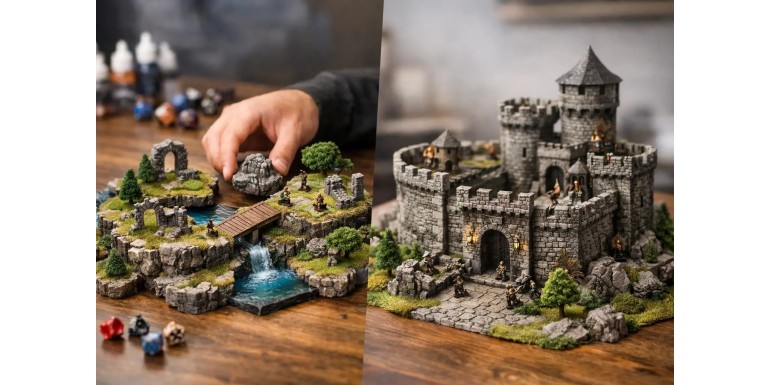
An spectacular gaming table doesn't always require a permanent board, and a fixed tabletop doesn't have to trap your games in a repetitive loop. The choice between modular vs. fixed wargaming terrain impacts much more than just the final look of your battlefield. It directly determines the storage space you need, your setup time, the scenarios you can play, and the type of hobby projects worth building.
For a wargamer or miniature enthusiast, the answer is rarely black and white. It depends on the game system, the scale, how often you play, and, crucially, where you plan to store the terrain once the battle is over.
The Real Difference Between Fixed and Modular Terrain
Fixed terrain is built directly onto a specific surface, typically an MDF board, extruded foam (XPS), or a dedicated gaming table. Hills, roads, rivers, ruins, and buildings form a permanent composition. The result offers a level of visual continuity that is hard to match with standalone pieces: a battlefield with natural elevation changes, integrated trenches, roads leading to a specific objective, or an urban district with a highly calculated layout.
Modular terrain, on the other hand, consists of individual pieces that you rearrange between games. This setup can include gaming mats, tiles, loose hills, forests, walls, buildings, sectional rivers, and objective markers. Its strength lies not in making every single table perfect, but in allowing a single collection to create dozens of different battlefields.
There is an important nuance to keep in mind: modular does not mean simple or flat. A set of 12x12 inch (30x30 cm) tiles, connectable road sections, and well-finished scatter terrain bases can deliver highly immersive tables. Similarly, a fixed table doesn’t have to be covered in glued-down elements. You can still keep buildings, destructible terrain, or removable forests to ensure comfortable gameplay.
When a Fixed Wargaming Table Is Worth It
A fixed tabletop layout makes sense when you have a dedicated space reserved for gaming or display. If you have a hobby room, a club with permanent tables, or a large display case for a diorama, you can prioritize visual composition over storage.
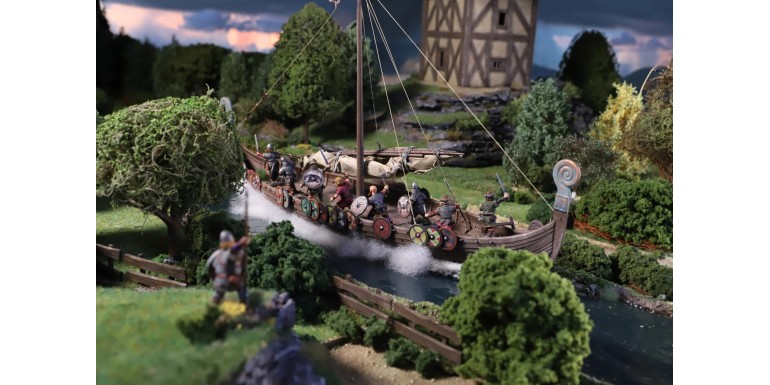
It also works exceptionally well when chasing a specific narrative setting. A table built for trench warfare campaigns, an industrial port, a ruined city, or a frozen battlefield gains massive realism from integrated details. Height transitions are smoother and more believable, roads don't break at the seams, and vegetation follows the natural contours of the land instead of looking like isolated patches.
For the hobbyist, this format allows you to work as if you were creating a large-scale diorama. You can use texture pastes, sand, cork, roots, pigments, static grass, and water effects without worrying about how pieces fit together. On a fantasy table, for example, a fixed river with detailed banks and integrated bridges delivers a sense of a continuous landscape that is incredibly hard to replicate with loose sections.
However, that quality comes with a practical cost. Once the table is finished, changing its narrative requires major remodeling. If the bridge is in the center, it will be there every single game. If you built a massive hill in one corner, it might cause balance issues for certain scenarios. Furthermore, a surface with permanent elements must be protected from dust, accidental bumps, and direct sunlight.
Advantages of Fixed Terrain
-
Seamless Integration: Allows for deeper terrain, natural transitions, and a display-quality finish.
-
Faster Setup Time: Since the table is already set up, you only need to deploy your miniatures, objectives, and a few scatter pieces.
-
Perfect for Campaigns: Highly rewarding for narrative campaigns set in the same region. A frontier village can evolve game after game by adding barricades, battle damage, or scorched zones, while the base of the table retains its identity.
Gameplay Limitations
Aesthetics should never ruin gameplay. A glued-down building might block access to its interior, a slope that is too steep will make miniatures slide off, and overly dense vegetation can make moving units a nightmare. Before fixing anything permanently, always test the layout by placing miniatures with large bases, vehicles, and bulky models on the area.
Transport is another critical factor. A large fixed table is not a practical solution if you play at different friends' houses or take your terrain to tournaments and local clubs. Even if split into panels, it may require custom transport boxes and a vehicle with enough trunk space.
Why Modular Wargaming Terrain Is Usually the Most Versatile Choice
Modularity solves the most common issue of home gaming: you want a realistic battlefield, but your dining table needs to go back to being a dining table after the game. A themed gaming mat and a well-curated selection of pieces can be stored neatly in boxes, allowing you to vary the layout without starting a new project from scratch.
You don't need to buy dozens of random elements either. It is much more effective to start with terrain that serves clear gameplay functions: two or three pieces of tall line-of-sight blocking terrain, several areas of light cover, some elevated elements, and objectives compatible with your rulebook. From there, you can expand your collection toward fantasy, sci-fi, historical, post-apocalyptic, or skirmish games.
Modular terrain is also the ultimate answer for those who play multiple game systems. Generic ruins, shipping containers, walls, forests, or hills can work for several games as long as they respect a consistent scale. Not everything has to be completely neutral, but it pays off to ensure your most expensive or bulkiest pieces get the maximum amount of table time.
Modular Doesn't Mean Random Layouts
A modular table can look messy if you distribute the terrain symmetrically or if every element shares the exact same height. To avoid this, think about the scenario's function first:
-
Is there a key route that troops will want to control?
-
Is there an elevated zone that dominates the center of the board?
-
Do you have a tighter flank tailored for close-quarters combat?
-
Is there enough space to maneuver vehicles or large units?
Next, place the pieces with visual logic. Grouping buildings creates distinct urban districts; clustering trees forms believable forests rather than four isolated bases; connecting sections of rivers or roads gives the table a clear direction. A good gaming mat helps unify everything, preventing the gaps between elements from distracting from your painted miniatures.
Variety is also vital. Combining ruins with low walls, barricades, containers, craters, and scatter foliage forces interesting tactical decisions. A table made exclusively of tall buildings might look great, but it will heavily favor ambushes and eliminate long-range shooting. Conversely, a completely wide-open table leaves little room for armies that rely on advancing under cover.
Cost, Time, and Storage Comparisons
The initial cost of a fixed table might seem low if you build it from scratch using basic DIY materials. The catch is that costs rise quickly as you add detail: primers, paints, textures, static grass, resins, sealants, and specialized tools. Additionally, a single design mistake might force you to scrap and repair a massive chunk of the board.
Modularity allows you to spread out your investment. You can start with a quality mat and a few core pieces, test them in actual games, and expand as you discover what your games are lacking. For many players, this approach prevents hoarding beautiful but ultimately useless scenery. Gathering buildings, scatter elements, paints, and finishing materials designed for the same project style keeps your budget and hobby time focused.
When it comes to time, the comparison isn't as simple. A fixed table requires dozens of hours before it is playable, but it dramatically reduces pre-game setup later. Modular terrain requires assembly every time you play, though you can finish the pieces one by one and use them immediately. If your hobby time is limited, finishing a single forest, a hill, or a small ruin is often much more motivating than facing a massive blank board for months.
Storage requires a realistic approach. Measure your shelves, boxes, and closets before you start building. Pieces with fragile parts—like tall trees, antennas, or signs—need internal protection. If you build modular tiles, make sure they fit standard stackable plastic bins so you can store and transport them without warping.
The Hybrid Solution: The Best of Both Worlds
Many hobbyists end up combining both methods. They use a flat base, a gaming mat, or lightweight blank panels as the main surface, reserving fixed elements only for features that don’t need to change position: a water area, a town square, a road intersection, or a trench line. They then place interchangeable buildings, forests, rocks, and objectives on top of that base.
Another great option is creating large modules with their own identity. A swamp tile, a fortified hill, a highway crossroads, or an industrial sector can be connected in various configurations. This allows you to keep the visual integration of a fixed table without giving up the ability to reorganize the battlefield.
The key is defining what you want to remain permanent and what needs to change. The overall topography can stay stable if you always play in the same setting, while the elements that affect cover and fire lanes should remain mobile. For skirmish games, where the map changes drastically between missions, mobility is usually your top priority. For a historical campaign or a display diorama, permanence is the goal.
Before gluing down a single piece or buying another storage box, set up a test game using markers, books, or proxy elements. You will instantly see where you lack cover, which lanes are too narrow, and whether miniatures actually fit where you imagined. The best wargaming terrain isn't the one that takes up the most space—it's the one that ensures every game is filled with tactical choices, immersion, and the desire to roll dice again.