Español

How to apply river resin without mistakes
- 05/27/2026 08:03:41
- Home , Tabletop Terrain
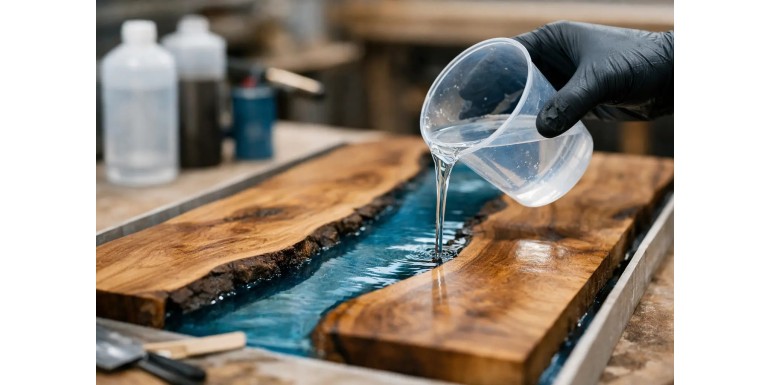
A poorly made river stands out for all the wrong reasons. On a gaming table, it can ruin a highly detailed piece of scenery: warped edges, leaks underneath, yellowing resin, or a surface so flat it looks like cheap plastic. That is why, if you are looking into how to apply resin for rivers, what truly matters isn't just pouring the product—it’s properly preparing the riverbed, controlling the volume, and knowing which finish best fits your project.
In wargaming terrain and dioramas, a river must work on two levels. It needs to look believable up close when someone inspects the piece, and it must also look great from a gaming distance, where visual clarity rules. This shifts how you work with resin compared to more traditional decorative crafts. Here, you don't need to chase absolute transparency if the riverbed isn't up to par, nor is it wise to create an overly thick layer if the piece is going to be transported frequently.
How to Apply Resin for Rivers in Scenery
Before mixing anything, decide what type of river you are building. A shallow stream for a miniature base requires a completely different approach than a wide river channel on a modular gaming board.
-
Small rivers: A thin pour works best here, relying heavily on a solid prep and paint job underneath.
-
Large rivers: Visual depth is built in layers—base color at the bottom, details along the banks, and a controlled, not necessarily deep, resin pour.
Preparation Matters More Than the Resin Itself
The riverbed must be completely sealed. If you are working with XPS foam, MDF, foamboard, putties, or acrylic textures, any pore or micro-crack can cause slow, painful leaks. These are the worst because you often don't notice them until the product is already mixed and poured.
Pro Tip: A layer of sealer, well-cured PVA glue, or acrylic varnish will save you a lot of headaches. If your terrain has loose sand, gravel, or flock, fix it in place securely beforehand. Resin will find any weak spot instantly.
Painting the Riverbed: The Unsung Hero
It is highly recommended to paint the bottom before pouring. This step adds the most realism and is often the most underestimated. A transparent river over a flat, monochrome base looks artificial. However, if you darken the center of the channel and lighten it towards the banks, you create an illusion of depth even with a thin pour. Greenish tones, cold browns, and ochres usually work much better than pure blue, unless you are aiming for a very specific stylized look.
Don't Improvise the River Channel
The profile of your river needs to make sense. If the banks drop vertically like a plaster trench, the resin might be technically flawless, but the overall effect will look poor. It is always worth softening slopes and adding semi-buried rocks, roots, mud, or transition zones. In miniatures and terrain, the context sells the water just as much as the water itself.
If you want to include logs, debris, reeds, or riverbank vegetation, place them before the pour if they need to be submerged, and after if they should sit on top. It sounds obvious, but mixing these two up without planning for the final water level is a common mistake.
Which Resin to Use (And When to Choose Alternatives)
Here is a crucial point: you don't always need epoxy resin.
For very shallow rivers, puddles, or basing effects, an acrylic water gel or a "still water" product might be much more practical. They might dry slower in some cases and take longer to fully cure, but they are generally easier to fix, odorless, and cause fewer mixing issues.
Epoxy resin makes sense when you want a hard surface, a stable transparent finish, and a real sense of volume. However, it demands strict control:
-
The mixing ratio must be exact.
-
The thickness per layer must respect the manufacturer's instructions.
If you pour too much at once just to finish faster, you risk overheating (exothermic reaction), uneven curing, or yellowing. For gaming scenery, working in thin layers is often the safest bet. It takes longer, but you control transparency better, reduce leaks, and can fix mistakes between stages. Plus, if the river is part of a modular piece or board section meant for transport, an excessively thick pour adds unnecessary weight without offering any real visual upgrade.
Flawless Mixing and Pouring
1. Mix slowly and use a clean container: Rushing introduces air, which turns into trapped bubbles. Scrape the walls and bottom of the cup thoroughly to integrate both components, but do not whip it.
2. Tint with caution: If you use pigments or inks to slightly tint the resin, do so in moderation. Too much can affect the curing process or make the water cloudier than intended.
3. Pour in a thin stream: Let the product self-level. There is no need to move it around too much. If you push the resin with tools once it starts to settle, you might leave marks or trap more air. For long sections, it is better to distribute it in short steps and watch how it creeps toward the edges.
Dealing with bubbles: If small bubbles appear, you can pop them with a toothpick or gently pass a light heat source over them. Do not overdo it. Too much heat can warp nearby materials, damage acrylic paint, or ruin the cure. In scenery—where foam, plastics, and textures are common—patience is worth more than trying to get a perfect surface in ten seconds.
Common Mistakes When Applying Resin for Rivers
-
Poor sealing: As mentioned, this is the number one culprit behind failed water effects.
-
Not leveling the piece: If your base is even slightly tilted, the resin will pool at one end, leaving an awkward, crooked waterline. It might look level to the naked eye, but resin doesn't lie once cured.
-
Relying solely on thickness for depth: On a gaming table, depth comes from the painted riverbed, the color transitions, and the realistic banks—not from a thick block of plastic. Most pieces look better with 2 or 3 mm of well-planned resin than a deep pour with zero prep.
-
Rushing between layers: If the first layer hasn't cured properly, the next one can react badly, cloud up, or leave visible seam lines.
-
Ignoring the environment: If you work in a cold or highly humid space, adjust your expectations. Resin behaves differently depending on the weather. Sometimes it’s worth waiting for a dry, stable day rather than risking your time and materials.
How to Add Water Movement
Once the base has cured, you can leave the river completely calm or add surface texture. For a moving stream, gentle currents, or small ripples, the standard method is to apply clear acrylic gel or water texture paste over the hardened resin. This allows you to sculpt ripples, wakes around rocks, or small crests without disturbing the main layer.
This step completely transforms the result. A perfectly smooth surface works for slow canals, ponds, or stagnant rivers. But the moment there is a slope, an obstacle, or a narrow channel, a bit of texture sells the scene. The trick is not to overdo it. At miniature scales, an oversized wave instantly breaks the illusion.
You can finish the look by adding gloss varnish to high points or a very contained drybrush of off-white to simulate foam and white water. Less is definitely more. If every rock has a bright white crest, your river will look like shaving cream rather than moving water.
Rivers on Modular Boards and Tables
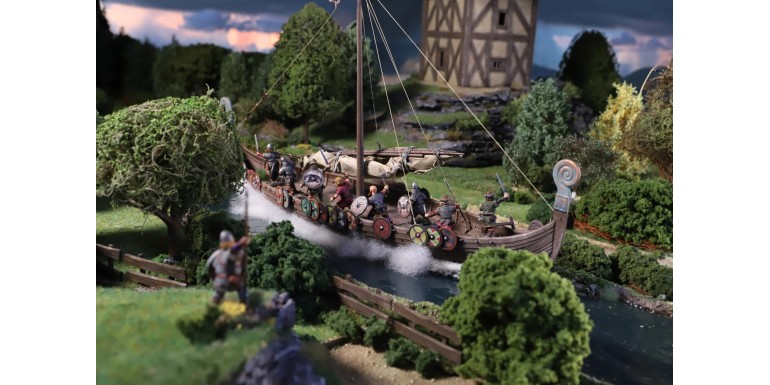
When a river crosses multiple modular tiles, the job gets a bit more complex. It’s no longer enough for each section to look good on its own; the water height, riverbed tone, and surface texture must match perfectly between pieces. Otherwise, when you set up the table, the cuts will be glaringly obvious.
[ Module 1 ] ---> [ Module 2 ] ---> [ Module 3 ]
  (Keep color, depth, and resin thickness consistent across all sections)
The most practical approach is to prepare all segments at the same time, using the exact same paint mix for the bed and the same depth criteria. If you pour resin module by module on different days, you might end up with slight variances in tone or gloss. While not always a disaster, it stands out on a continuous waterway.
On larger projects, it is always worth running a test on a small scrap piece before tackling the final board. It is time well spent. It tells you if your sealer works, how much the resin darkens your painted background, and if the final effect matches the scale of your table.
In a hobby shop like Terrainandminis.com, where many enthusiasts work on everything from miniature bases to full gaming tables, this "test before you pour" logic saves more material than any shortcut ever could.
Summary: The Layers of Success
If you want a reliable, high-quality result, think of your river as a combination of compatible steps:
1. Structure & Shape (Realistic banks and slopes)
2. Sealing (Locking down porous materials)
3. Base Painting (Creating forced depth with color transitions)
4. Controlled Pour (Applying resin in thin, manageable layers)
5. Surface Texture (Adding movement only where necessary)
There isn’t just one correct way to do it, as it depends on the size of the riverbed, the type of terrain piece, and how it will be used on the tabletop. But when you tackle each phase with a plan, resin stops being the stressful part of the build and becomes exactly what it should be: the ultimate finish that brings your entire gaming table to life.
After all, the best sign of a well-made river isn't that it steals the spotlight, but that it looks like it truly belongs to the world on your table from the very first glance.