
 Español

Where to Buy Wargames Terrain in Europe
- 11/06/2026 08:49:23
- Home , Tabletop Terrain
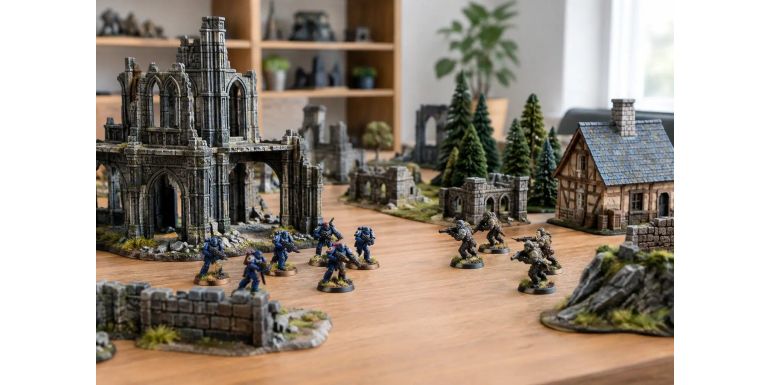
A well-painted miniatures table loses its impact if the buildings look out of scale, the forests block unit movement, or the ruins take up more space than the scenario allows. When buying wargames terrain in Europe, the secret isn't just hoarding pieces at random: it is choosing elements that are compatible with each other, with your game system, and with the style of games you want to play.
Scenery serves two functions at once. It builds the atmosphere of a battlefield and dictates tactical decisions regarding movement, lines of sight, cover, and objectives. That is why it’s best to buy with a specific table layout in mind, even if you plan to expand it piece by piece. A cohesive selection will usually yield far more memorable games than a massive collection of isolated items.
Buy Wargames Terrain in Europe to Fit Your Table
Before you start thinking about ruins, hills, or vegetation, measure your standard gaming surface. Preparing a $90 \times 90 \text{ cm}$ skirmish board is not the same as setting up a $180 \times 120 \text{ cm}$ table for massive battles. The amount of terrain required changes, but so does the physical footprint of each piece.
On a small table, a single large building can easily become the absolute focal point of the game. That can work if the scenario revolves around an urban assault, but it will leave very little room for flanking and maneuvers. On a spacious table, that exact same building might just be an interesting landmark nestled among streets, barricades, forests, and open zones.
Also, think about the pace of the game. Skirmish players generally appreciate dense scenery featuring verticality, corridors, interiors, and plenty of cover points. Regiment- or vehicle-based battle games need clearer movement corridors and pieces that don’t force you to constantly reposition units every turn. A visually stunning piece isn't always a practical one.
Scale is King, Even with a Large Catalog
Scale compatibility is the ultimate real-world filter. In 28-32 mm, doors, windows, fences, and furniture must look well-proportioned next to your miniatures. In 15 mm or smaller scales, fine details should be simplified to avoid cluttering the board or making it difficult to place miniature bases.
It is never enough to just look at the scale indicated on the product. Check the actual measurements of the piece and compare them to your miniatures, especially if you mix manufacturers. A wall that looks correct in a photo might be too high for infantry to shoot over from behind, or too low to provide convincing visual cover.
The same caution applies to vehicles and large creatures. A 28 mm door might work fine for fantasy troops, but look tiny next to mechs, tanks, or miniatures with heroic proportions. If you are torn between two sizes, prioritize playability: a slightly generic piece of scenery usually integrates much better than one that is out of scale.
Choose Terrain Based on Its In-Game Function
An interesting table combines open zones with obstacles and areas that draw conflict. If everything offers heavy cover, games can quickly become slow and defensive. If nothing blocks vision or movement, firepower becomes disproportionately powerful. The exact balance depends on the rulebook, but variety works across almost all systems.
Buildings and ruins are great for urban combat, narrative objectives, and breaking up shooting lanes. It’s worth checking whether they feature accessible floors, removable roofs, or separate base plates. Removable pieces make it much easier to move miniatures inside and prevent arguments over which unit is occupying the building.
Forests, hedges, and vegetation outline cover areas without turning the board into a rigid maze. For comfortable play, tree canopies should be removable, or the bases must leave enough room for standard miniature bases. A forest that looks hyper-realistic but is impossible to play around will end up sitting off the table.
Hills, rocks, and elevations introduce verticality. Gentle slopes allow you to easily place bases and vehicles; steeper rock formations work better as impassable terrain or line-of-sight blockers. If you want modularity, several small hills offer more configurations than a single large piece.
Barricades, sandbags, containers, fences, and rubble are especially rewarding purchases. They take up very little storage space, can easily fit sci-fi, historical, or post-apocalyptic settings depending on the paint job, and are great for filling in zones that would otherwise look empty. They are the kind of scenery pieces that let you fine-tune your table right before a match.
Materials: Assembly, Durability, and Finish
Resin offers incredible detail and visual weight, making it ideal for ruins, statues, thematic centerpieces, and display pieces. In exchange, it requires care during transport and may need washing, flash removal, or a gentle heat-straightening before painting. It’s an exceptional choice for focal points, but not always the most practical for a gaming table that travels every week.
Laser-cut MDF is lightweight, modular, and well-suited for multi-story buildings, walkways, or interiors. It usually requires assembly and edge-sealing before painting. If you love customizing facades, adding posters, textures, or battle damage, it provides a wonderfully receptive canvas.
Plastic is practical for durable, repeatable pieces, while foam, cork, and other lightweight materials are staples for hills and rocky outcrops. These lighter materials cut down on weight, but benefit from a solid primer and proper sealing to prevent chipping. For a club table or frequent transport, durability matters just as much as fine detail.
When buying unpainted scenery, calculate the full scope of your project. Beyond the terrain piece itself, you might need primer, adhesive, modeling putty, paints, drybrushes, static grass, pigments, or varnish.
Create Cohesion with Textures and Effects
Terrain gains credibility when it shares a unified color palette and environmental logic. A desert board doesn't mean every piece needs to be bright yellow, but the rocks, buildings, bases, and dust should all speak the same visual language. A few layers of pigment, drybrushing, and well-chosen tufts can easily tie together products from different manufacturers.
Decide on your setting first: an industrial city, a temperate forest, snow-covered ruins, an alien frontier, a desert, or a historical farmlands. Then, pick a base color paired with two or three contrast tones. For urban terrain, cool grays can be warmed up with rust and dust effects. For a green table, varying shades of brown, muted greens, and damp earth will prevent a flat, toy-like look.
Snow, water, mud, or sand effects should be used with moderation. Applied in logical zones—gutters, puddles, exposed corners, tire tracks, or wall bases—they ground the table in a story. If applied uniformly across all surfaces, they tend to obscure details and strip away realism.
Buy in Phases and Avoid Pieces You Won't Use
To kick off a new table, it's best to acquire a playable core: one central centerpiece, several line-of-sight blockers, some low cover options, and a way to section off difficult terrain. Afterward, you can add thematic elements that flesh out the lore and atmosphere. This way, you’ll discover what your setup actually lacks after playing a few games.
Avoid buying purely for visual spectacle. A massive gateway, an oversized fortress, or a crashed starship can be memorable, but they might only fit hyper-specific scenarios. On the other hand, modular walls, rocks, vegetation, and ruins will find their way into countless configurations. The best balance is usually one standout centerpiece for every group of versatile, utility pieces.
It’s also smart to think about how you will store your terrain. Removable roofs, detachable trees, and flat-packing folding buildings drastically reduce the space required. If you buy for a club or play away from home, prioritize durable, stackable pieces that are easy to pack up at the end of the night.
A great gaming table isn't built overnight, nor does it need to replicate a flawless landscape. It needs to provide cover where it counts, leave room to move miniatures, and offer compelling reasons for armies to advance. Choose pieces you actually look forward to setting up game after game—those are the ones that will ultimately give your matches true personality.