Español

Which Paints Can You Use in an Airbrush?
- 06/06/2026 08:13:20
- Home , Assembly and Painting Guides
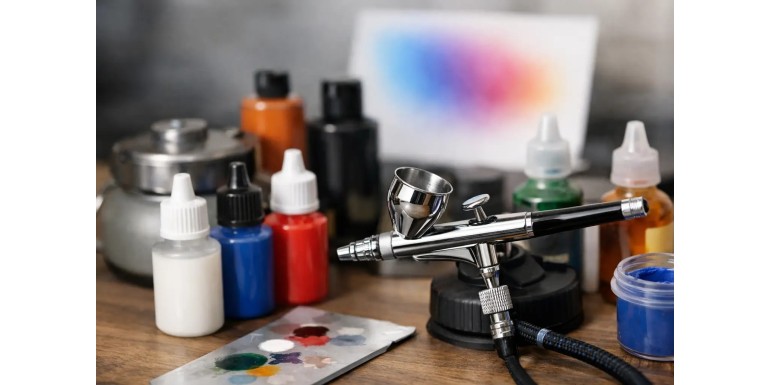
If you have ever loaded your airbrush cup with a paint that worked flawlessly with a brush, only for it to sputter and spit out clumps, you already know that asking which paints can be used in an airbrush is no minor question. In the miniature and scenery hobby, choosing the right paint saves you from clogs, tip dry, and finishes that look worse than you expected.
Which Paints Actually Work in an Airbrush?
The short answer is simple: water-based acrylic paints formulated specifically for airbrushing work best, alongside many traditional brush-on acrylics when properly adjusted. The useful answer is a bit longer, because not all paints behave the same way, nor do they share the same margin for error.
-
"Air" Ranges: When painting miniatures, vehicles, busts, or terrain, "Air" paint ranges are the most convenient option. They are formulated with finely ground pigments and a viscosity designed to flow through small nozzles without forcing you to constantly tweak your mix. They work wonderfully for light primers, base coats, transitions, and filters. If you want consistency and less trial-and-error, they are usually your safest bet.
-
Standard Acrylic Paints: Regular acrylics can also be used in an airbrush, but their performance depends heavily on the brand, the specific color, and how much you thin them. A base black or brown tends to tolerate the process well. On the other hand, certain whites, bone tones, or heavily pigmented colors will give you a harder time. It’s not that they are useless; they just require tighter control over your mixture and air pressure.
-
Inks, Contrasts, Lacquers, and Enamels: While these also exist, it is important to separate their use cases. In the miniature and diorama hobby, most hobbyists stick to water-based acrylics because they are easier to clean, low-odor, and fit seamlessly into a home workshop setup. Lacquers do offer an incredibly fine and durable finish, but they demand serious ventilation, a proper respirator mask, and specialized cleaning products. For many, the hassle simply isn't worth it.
The Difference Between Brush Paint and "Air" Paint
The label matters, but it isn’t magic. An "Air" paint doesn't inherently paint better on its own; it is simply more prepared to enter the airbrush without fighting the tool.
The secret lies in three factors: viscosity, pigment size, and additives.
| Paint Type | Viscosity | Pigment Size | Best Used For |
| Standard Brush Paint | Thicker / Denser | Larger | High coverage, brushwork, staying where placed. |
| "Air" Paint | Fluid / Pre-thinned | Micro-ground / Finer | Smooth atomization, stable flow, layering. |
Using brush paint in an airbrush can lead to irregular flow, immediate buildup on the needle, and poor atomization. However, this does not mean you need to repurchase your entire collection in an airbrush version. If you already have a large assortment of miniature paints, many can be adapted. For priming, zenithal highlighting, base coating vehicles, or covering large terrain pieces, it is often more cost-effective to thin standard paint rather than duplicating your entire range. The key is understanding when it's worth the effort and when it will just waste your time.
Types of Paint You Can Use for Miniatures and Scenery
1. Airbrush Acrylics
These are your primary option. They work beautifully on plastic, resin, and metal miniatures, as well as terrain pieces, buildings, ruins, and vehicles. The advantage is clear: less guesswork, a lower risk of clogging, and a highly predictable finish. They are especially practical for batch-painting or army color schemes.
2. Thinned Brush Acrylics
These are perfectly viable—in fact, many hobbyists use them daily. The trick is to thin them gradually using a dedicated airbrush thinner, rather than just water. While water can work, it doesn't always maintain proper surface tension or adhesion. A proper thinner improves flow and significantly reduces tip dry.
3. Inks and Transparent Colors
These are excellent for filters, glazes, and highly saturated highlights. On scenery, they are perfect for modulating stone tones, rusted metal, or energy glows. The risk is overdoing the intensity or building up an unwanted glossy finish, so it is always wise to test them on a scrap piece first.
4. Airbrush Primers
Not every black paint works as a primer. True primers are formulated to chemically bite into the surface and create a stable foundation. For miniatures that will be handled frequently during gaming, using a dedicated airbrush primer is essential. The finish resists wear much better, and subsequent paint layers sit more evenly.
5. Lacquers and Enamels
While they can be used, they are not the most practical route for the average hobbyist. They possess real virtues—such as incredible durability and excellent atomization—but they complicate cleanup, safety, and product compatibility. If you primarily paint miniatures and terrain at home, acrylics will give you almost everything you need with far less trouble.
How to Tell if a Specific Paint Will Work for You
Rather than looking solely at the brand, look at how the paint behaves.
Pro Tip: If a paint leaves thick sediment at the bottom of the bottle, separates poorly when shaken, or has a pasty texture even when freshly opened, it will likely require heavy adjustment. If it forms strings or tiny clumps when you thin it, save it exclusively for your brushes.
Another factor to consider is the color and pigment type. Metallics, whites, ivories, and certain dense pastels are notoriously delicate. They can be airbrushed, but they aren't the best starting point if you are still mastering the tool. Conversely, blacks, grays, browns, and most mid-tone base colors are much more forgiving.
Your nozzle size also changes the game entirely:
-
0.2mm to 0.3mm Nozzles: Require much thinner, finer mixtures.
-
0.4mm Nozzles or Larger: The airbrush becomes far more forgiving—making it ideal for terrain, scenery, or priming large pieces. It’s not just a matter of "good" or "bad" paint; it’s about matching the tool, pressure, and density.
Thinning, Pressure, and Why Viable Paints Sometimes Fail
This is where most hobby frustration occurs. A paint can be perfectly suitable for an airbrush and still cause issues if your mixture is unbalanced.
-
Too thick: You will experience clogs, splattering, or dry paint spiderwebs on the needle.
-
Too thin: You will lose coverage, control, and adhesion, leading to pooling (spider-webbing on the model).
There is no universal thinning ratio. It changes depending on the brand, color, ambient weather, and the job at hand. For base coating miniatures, a mixture that is fluid but still retains coverage works better than a watery wash. For smooth transitions or filters, you can safely drop the density much lower.
Air pressure (PSI) must match your mixture. If you crank up the pressure to force a thick paint through, you will get dry spray and texture. If you drop the pressure too low with a dense mix, the flow will sputter or stop entirely. Taking a moment to do a quick test spray on a piece of cardboard before approaching your miniature will save you from stripping paint and cleaning your tool twice.
Common Mistakes When Choosing Airbrush Paints
-
Thinking any paint will work if you thin it enough: Sometimes this works, but other times you break the paint's binder, causing the finish to lose its grip or dry irregularly. Thinning cannot fix a poorly ground pigment.
-
Using only water when the product demands more: For certain acrylics, water is fine. For others, a specific thinner and a single drop of flow improver make a world of difference. It’s not a luxury; it’s about stabilizing the mix.
-
Forcing old or poorly preserved paints: In the miniature hobby, we tend to stretch paint bottles for years. However, a partially dried or contaminated paint will cost you more time in clogs than it saves you in money.
-
Forgetting to clean between colors: We often blame the paint when the actual culprit is dried residue accumulated on the nozzle or needle. In airbrushing, half of your result depends entirely on maintenance.
What to Use Depending on the Project
-
Priming Miniatures & Vehicles: A dedicated acrylic airbrush primer is the most reliable choice.
-
Speed-Basecoating Armies: "Air" colors or properly thinned standard acrylics.
-
Camouflage, Modulation, & Highlights: High-flow paints with fine pigments.
-
Large Scenery & Terrain: You can afford thicker mixtures and larger nozzle sizes, as clean, efficient coverage matters more than microscopic detail.
-
Special Effects (Rust, Grime, Glows): Inks and transparent colors are incredibly effective here.
-
Fine Metallics: Always test these first on a plastic spoon or a spare base. Not all metallic pigments react the same way, and this is where premium pigment quality truly shines.
If your hobby desk sees a mix of miniatures, tanks, and terrain, the smartest approach isn't to look for a single magic paint for everything, but to build a balanced toolkit. A solid primer, a few core "Air" colors for bases and highlights, and your standard acrylics to adapt as needed will cover almost any project without overcomplicating your life. In a specialized store like Terrainandminis.com, this practical approach makes far more sense than impulse-buying based on the packaging alone.
Summary: So, Which Paints Can You Use?
To sum it up, water-based acrylics formulated for airbrushes are your best option, alongside standard brush acrylics if thinned correctly. Inks and transparents are perfect for specific effects, while lacquers and enamels work beautifully but come with safety and cleanup demands that don't always fit a casual home hobby workflow.
The best choice doesn't depend on the label alone. It depends on what you are painting, the nozzle size you are using, and how much time you want to spend mixing. If you want reliability for your miniatures and scenery, start with specific airbrush acrylics and expand your toolkit from there. Your airbrush doesn't need miracles—it just needs compatible paint and a sensible mix.