Español

How to paint a rust effect on terrain
- 05/20/2026 07:47:40
- Home , Assembly and Painting Guides
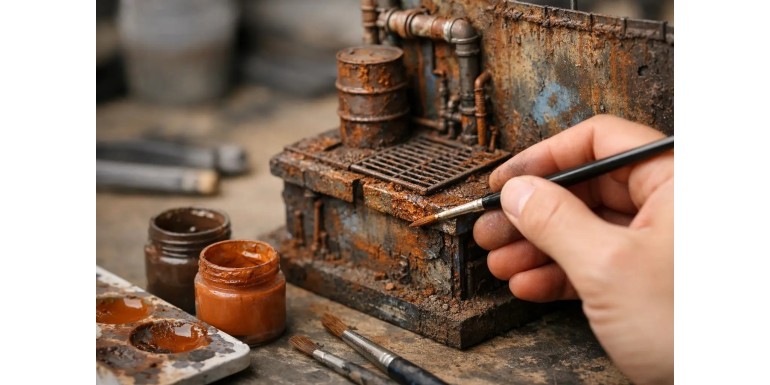
In terrain making, bad rust doesn't fail due to a lack of orange; it fails due to a lack of logic. Flat surfaces, randomly placed chips, and tones that fail to tell the story of a metal exposed to the elements for years will quickly ruin the illusion. If you are looking for how to paint realistic rust effects on miniature terrain for your gaming table or diorama, the secret lies less in the color and more in the sequence.
How to Paint Rust Effects on Terrain Without Looking Flat
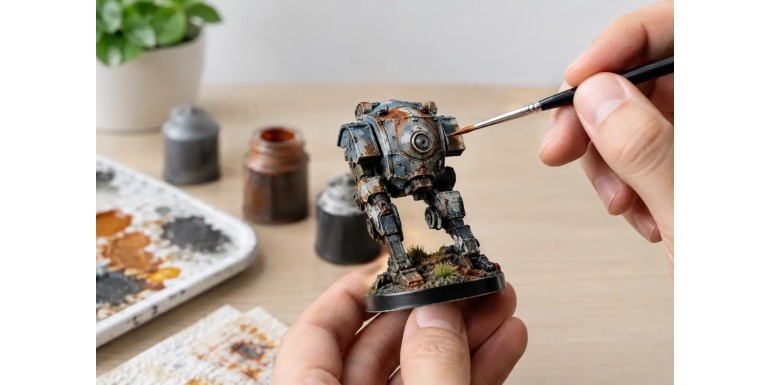
The most common mistake is starting directly with browns and oranges over just any random base coat. Rust works best when there is a clear layer of weathered metal underneath. That is why it is best to first prepare a dark base coat, usually using charcoal grey, a very deep brown, or an off-black. Over that base, a muted metallic drybrush provides just the right touch so that when you add corrosion, it still looks like metal and not mud.
In terrain pieces for wargames, this matters a lot. At tabletop distance, contrast is king. If the entire surface is rusted equally, the volume disappears. On the other hand, if you leave some areas with visible metal, worn edges, and deep shadows, the piece will read beautifully on the table.
The Sequence That Works Best
1. Work on the general structure first: Think about where moisture accumulates—rivets, joints, grilles, pipe bases, bottom corners, and horizontal areas. That is where rust makes sense. High edges and high-friction areas usually have less, because handling and wear expose cleaner metal.
2. Apply an irregular reddish-brown: Do not apply it as an even coat. It is best to use a sponge or stipple with an old brush to break up the surface.
3. Add depth: Over that tone, add a darker brown to the center of some patches to create depth.
4. Introduce the orange: Next comes the rust orange, but use it with moderation. If you overdo it, the piece will look cartoonish. The orange belongs in active areas of corrosion, not across the entire plate.
5. Tie it together: Once that base is dry, a highly controlled wash of dark brown or sepia helps blend everything together. If you feel it has lost its vibrancy, bring back small spots with a light orange or even a touch of weathered pigment. In terrain making, pigments work wonders because they provide a dry, mineral texture that paint alone cannot always achieve.
Texture Before Color
If you want truly convincing rust, add some texture. There is no need to overcomplicate it: fine texture paste, pigment mixed with a medium, or even thick paint stippled onto the surface works perfectly to break up a flat area. This makes a massive difference on oil drums, industrial scrap, armored doors, or sci-fi structures.
A quick note on scale: Not all terrain needs heavy texture. On railings, thin metal sheets, or small-scale pieces, too much texture can swallow the detail and look out of proportion. However, on industrial ruins, storage tanks, or heavy machinery, that roughness adds a lot of character.
Colors That Actually Look Like Real Rust
Good rust is rarely just one tone. Ideally, you want to mix chocolate brown, reddish-brown, burnt sienna, muted orange, and a touch of dirty beige or weathered metal. Pure red usually looks artificial, and so does a clean orange. If in doubt, always mute the color a bit more than your eye tells you to. It looks much better on the tabletop.
It also helps to add grime around it. Rust does not appear in isolation; it usually coexists with grease, dust, rain streaks, and chipping paint. A very fine vertical streaking grime effect underneath bolts or joints goes a long way. You don’t need to cover the entire piece—just suggest that water has been working on that surface over time.
Chipping and Streaking With a Purpose
On industrial or military terrain, chipping must follow the logic of the object. Door edges, exposed corners, steps, and high-traffic areas peel first. If you place random chips in the middle of a pristine plate for no visual reason, the effect loses credibility.
For streaks, use highly diluted paint and draw the line downward from the point where water would pool. Then, feather it out downward with a clean, damp brush. It is better to have three subtle marks than one harsh, bright orange line that looks like it was drawn with a marker. On larger pieces, combine multiple tones in the same streak: dark at the top, more reddish in the middle, and just a faint earthy glaze at the end.
How It Changes Depending on the Terrain Type
You don't paint a grimdark refinery the same way you paint a modern shipping container.
-
Post-apocalyptic terrain: Rust can dominate the surface, blending with dust, ash, and extreme chipping.
-
Functional industrial settings: It is better to leave more of the original factory paint visible.
-
Fantasy pieces: Weathered metal usually benefits from more muted browns and less bright orange.
Scale also dictates the rules. On 28mm–32mm terrain, you can exaggerate the contrast slightly so it reads well from a distance. On an exhibition diorama, however, it pays off to refine the transitions and vary the smaller micro-patches. If the piece is meant for heavy gaming rather than display, prioritize visual impact and durability.
A Finish That Withstands Gaming Sessions
Once you are happy with the result, seal it. This is especially useful if you have used pigments, sponging, or very thin washes. A matte varnish unifies the finish and protects the piece, though it can dull some of the richness of the metallics. If you want to bring back that metallic sheen, just go back in afterward with a quick touch-up of silver or steel on the edges and bolts.
Ultimately, painting rust on terrain isn’t about throwing orange paint over metal. It is about telling the story of how that piece has aged—where it gets wet, where it gets banged up, and where it is still standing as a living element of your gaming table. If you respect that logic, even with simple techniques, your results will instantly level up.