Español

MDF or XPS foam for tabletop terrain
- 07/14/2026 10:21:43
- Home , Assembly and Painting Guides
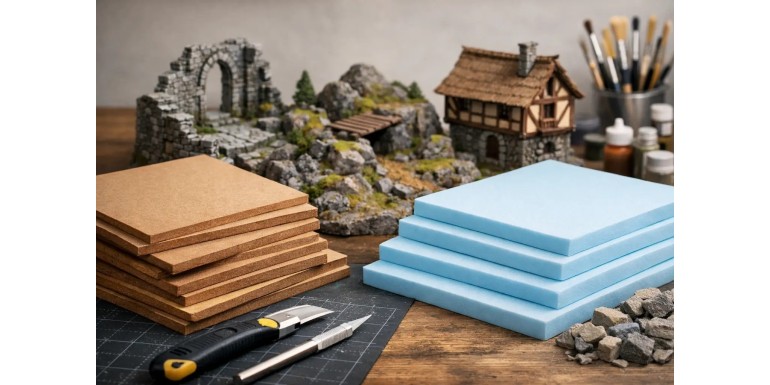
A gaming table can have spectacular buildings and beautifully painted miniatures, but if the hills warp, the ruins chip during transport, or the edges look unfinished, the whole setup loses its appeal. Choosing between MDF and XPS foam shapes a major part of the outcome: not just how the scenery looks, but how well it holds up to play, storage, and travel.
There is no absolute winner. MDF and XPS serve different needs, and many wargaming scenery projects turn out best when you combine both. The key is deciding what role each material will play before you make your first cut.
MDF vs. XPS Foam: The Key Difference
MDF is a board made of compressed wood fibers. In terrain making, it is mostly used as a rigid base for buildings, terrain templates, platforms, roads, or modular elements. You can cut it with lasers, a coping saw, or a utility knife in thin thicknesses, though finishing the edges takes some work.
XPS foam, also known as extruded polystyrene, is a lightweight and dense material. It is commonly used to build hills, rocks, walls, ruins, trenches, and terrain heights. Unlike traditional white Styrofoam, it has a smoother surface and carves with much more precision. It lets you carve stone, brick, wood grain, or battle damage directly into the board.
Therefore, the question shouldn't just be which material is better. Instead, ask yourself: do you need a flat, firm structure, or organic volume and carved texture? For the first, MDF is usually the logical choice. For the second, XPS offers more possibilities.
When to Use MDF
MDF shines when it comes to stability. A 3mm or 5mm base keeps a building flat, prevents a modular piece from warping, and adds a sense of sturdiness that is incredibly useful for terrain handled frequently. It is also an excellent backing for gluing other materials: plasticard, cardboard, sand, textures, putty, or 3D-printed parts.
On a skirmish table, for example, you can use it to create the floor plan of an industrial factory, a landing pad, or an urban base with sidewalks. In historical games, it works perfectly as a base for fields, roads, and village sections. If your terrain needs to line up precisely with other pieces, the accuracy of straight MDF edges is a clear advantage.
The main limitation of MDF is when you want to build organic height. Stacking boards can create terraces or tiers, but it isn't practical for carving a natural mountain or rock face. It is also heavier than XPS. On a full table, you will definitely feel that weight difference when carrying boxes of terrain.
You also need to protect it from moisture. MDF can swell if it absorbs too much water, especially along the edges. A coat of primer and paint helps seal it, but avoid leaving finished pieces in damp areas or applying overly runny mixtures without control.
Cutting and Finishing MDF Edges
For simple shapes, a heavy-duty utility knife works fine on thin boards if you make multiple passes on a cutting mat. For more complex cuts, a coping saw gives better results. If you use laser-cut kits, assembly is faster and highly repeatable—great for building a multi-story city block.
MDF edges tend to absorb more paint than the flat surfaces. Before painting, seal them with slightly diluted PVA glue, primer, or filler depending on the finish you want. It’s a quick step that keeps the base from looking unfinished once textured.
When to Use XPS Foam
XPS foam is the most forgiving and rewarding material for shaping terrain. You can build a hill by gluing several layers together, shaping it with a utility knife, and smoothing it down with sandpaper. For a rock formation, simply cut irregular angles, chip off small sections, and score cracks into the surface. The ease of modifying a piece as you work is one of its biggest perks.
It is also perfect for building lightweight ruins with damaged walls, carved stone blocks, and elevated areas for miniatures to stand on. At 28mm to 32mm scale, a 20mm or 30mm thick sheet gives enough height for most features without becoming an awkward obstacle on the table.
Its low weight is ideal for large tables or terrain that travels to clubs, events, and other players' houses. A massive XPS hill can be lifted with one hand. Just don't mistake lightweight for indestructible: thin details and sharp corners can chip, and a piece without a rigid base can get dented if heavy objects are stacked on top of it.
XPS is also sensitive to certain chemicals. Solvent-based aerosol sprays can melt it or eat craters into the surface. Before using a spray primer, make sure it is polystyrene-safe, or completely seal the foam with a protective layer first. For many projects, brush-on primer is the safest bet.
Carving Textures Without Losing Scale
XPS makes it easy to overdo detailing. A wall covered in deep brickwork or a rock face with massive cracks might look cool up close, but it will look wildly out of scale next to your miniatures. Keep a model nearby as a reference while you carve.
For dressed stone, draw your grid with a pencil and trace the joints with a blunt tool. For natural rock, angular cuts and shifts in planes work much better than repeating textures. Adding sand, fine gravel, cork, or putty in specific spots breaks up the uniformity without burying the volume the foam already provides.
Durability, Weight, and Storage
If a piece is going to stay on a permanent table, you can use XPS quite freely. If it is going to be packed into boxes, travel weekly, or pass through many hands during games, it is worth reinforcing. Gluing your foam onto a thin MDF base is a common solution: you get the structural rigidity without adding too much weight.
For buildings, a highly effective combo is using MDF for floors, straight walls, and modular levels, while reserving XPS for damage, rubble, rock, insulation, broken walls, or integrated terrain features. This lets you leverage the precision of the board and the carving versatility of the foam.
To protect your XPS, a coat of PVA glue, textured paint, or thick acrylic helps harden the surface. You don’t need to encase every millimeter in thick plaster. In fact, too much texture can muddy details and ruin how well your modular platforms fit together.
Real Costs and Required Tools
The cost is about more than just the sheet of material. MDF may require more specialized cutting tools, especially for thicker boards or tight curves. XPS can be worked with simple tools, but a sharp blade, a metal ruler, and foam-safe glue make a massive difference in the final look.
Avoid solvent-based glues on foam. PVA glue, solvent-free construction adhesives, and foam-safe hot glue or silicone are standard choices, though you must respect their drying times. For large pieces, apply the adhesive sparingly and spread it evenly to prevent warping or air pockets.
For repeatable projects, like a full urban table, laser-cut MDF kits can save you hours of work. For a single hill, a rocky outcrop, or a trench line, XPS usually gives you better results with less effort. It is not just a budget decision; it is also about how much time you want to spend building each module.
A Practical Choice for Every Terrain Type
For buildings, bridges, platforms, and modular bases, start with MDF. For hills, cliffs, weathered ruins, and natural slopes, start with XPS. For features that need to be both lightweight and highly stable, combine them: MDF on the bottom, foam on top.
There are exceptions. A building made of foam board or XPS works fine if you want lightweight ruins, and a tiered MDF hill might fit a highly geometric or industrial table. But for most gaming tables, forcing one material to do what the other does naturally just adds extra work without improving the final look.
The best scenery isn't the most expensive or the most heavily textured. It’s the scenery that survives games, lets miniatures stand flat, and maintains a consistent scale with your army and board. Before starting your next build, think about where it will be played, how it will be stored, and how often you will have to move it—that answer will tell you whether you need MDF, XPS foam, or a mix of both.