Español

Mordheim terrain that actually works
- 05/18/2026 07:57:12
- Home , Tabletop Terrain
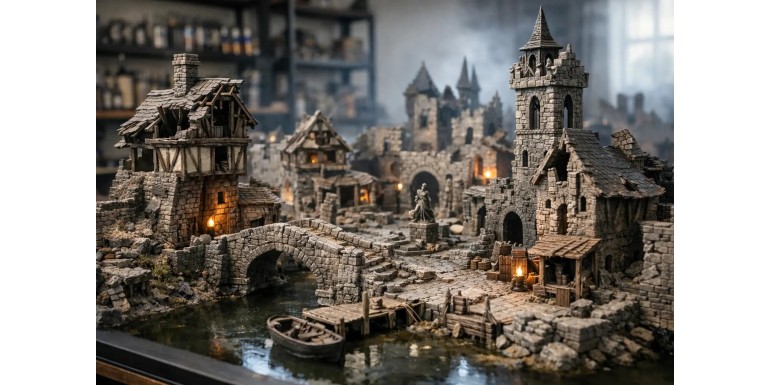
Terrain for Mordheim isn’t just there to decorate a random match; it’s meant to create broken streets, awkward heights, alternative routes, and bad decisions that look great until a miniature hits the dirt. That is the whole point of the game: a ruined city where movement matters just as much as fighting.
What Mordheim Terrain Actually Demands
Mordheim works best when the board feels tight and claustrophobic. Just throwing down four houses and a couple of walls won't cut it. You need vertical density, partial cover, playable interiors, and enough line-of-sight blockers so each warband can advance without handing free shots to the rival players. A great table forces you to choose between taking the long way around, climbing, exposing yourself for a turn, or seeking a high vantage point that might just leave you completely stranded.
That is why generic fantasy terrain doesn't always work straight out of the box. In many tabletop games, simple line-of-sight blocks and occasional high ground are enough. Not here. Mordheim requires urban ruins with intent. Windows, walkways, ladders, half-collapsed balconies, and narrow alleys. Even the gaps between buildings matter, as they determine whether a charge is viable or if a miniature will end up trapped in a bottleneck.
Mordheim Terrain: Less Symmetry, More Layers
An overly tidy table usually plays poorly. Destroyed cities are not visually balanced, but they can be balanced in how they play. The key lies in distributing opportunities rather than mirroring one side to the other. If one flank features a high tower, the opposite side can offer a safer network of walkways. If a central area provides great firing lines, reaching it should demand a high degree of risk.
In practice, it helps to plan the table in layers:
-
The Ground Floor: Dictates basic movement and close-quarters positioning.
-
The First Level: Creates firing lines, ambush spots, and escape routes.
-
The Second Level (and above): If included, it shouldn't dominate the entire game. Instead, it should offer powerful but fragile positions.
When every elevation comes with both perks and penalties, the board feels alive.
Playable Interiors vs. Closed Facades
This depends entirely on how much time you want to spend assembling your terrain and the level of detail you want in your games. Buildings with fully playable interiors are iconic to Mordheim because they multiply your tactical options: entering, exiting, peeking out, climbing, or hiding. However, they can slow down the pace of the game if they are too enclosed or if moving miniatures inside becomes physically awkward.
On the other hand, closed or semi-playable facades definitely have their place. They allow you to fill the table with bulk, block vision, and maintain a cohesive aesthetic without turning every ruin into a jigsaw puzzle. The most practical approach is usually to mix both: a few standout centerpiece terrain features with fully accessible interiors, and the rest designed to provide cover, height, and atmosphere without overcomplicating every single turn.
Height Matters—But Not at Any Cost
Towers, bell shrines, and multi-story houses are part of Mordheim’s visual DNA. The issue arises when a high position controls too much of the board, or when reaching the top is so easy that every game plays out exactly the same way. The best high ground is the one that carefully balances risk and reward.
You can achieve this by adding limited access points, broken railings, narrow platforms, and dead zones. A miniature holding the high ground should have an advantage, yes, but also the looming threat that a bad knockback or a well-timed charge could ruin their day. Mordheim thrives when high positions look tempting, not safe.
Essential Terrain Pieces for Your Table
Ruined buildings are the foundation, but they don't make a table on their own. Connectors are just as vital. Walkways, short bridges, wooden planks, exterior ladders, and small platforms transform a collection of pretty houses into a fully playable board. Without these elements, every building becomes an isolated island.
You also need low terrain pieces to break up movement pathways:
-
Crumbling walls and barricades
-
Piles of rubble and debris
-
Wells, fences, and broken statues
-
Abandoned carts and wagons
These smaller elements are what fine-tune distances, create partial cover, and prevent streets from being too clean. On an urban table, small scatter terrain isn't filler—it’s what decides whether a miniature successfully makes a charge or falls short.
Themed terrain adds incredible flavor when it doesn't get in the way. Graveyards, chapels, ruined plazas, dried canals, or warpstone-mutated zones add narrative identity. Just ensure they remain functional. A spectacular piece of scenery that is impossible to move through, measure across, or place models on will end up sitting on your shelf rather than on the gaming table.
Materials and Finishes That Fit the Mordheim Aesthetic
If you are looking for durability and frequent use, resin and hard plastic usually offer the fewest headaches in the long run. They handle transport well, take paint beautifully, and allow for crisp details on stone, wood, and architectural ornaments. MDF terrain is highly practical for building up a dense table on a budget, especially for large buildings and modular structures, though it greatly benefits from textured finishes to break up the overly clean look of laser cuts.
To prevent a Mordheim table from looking like it just came out of the factory wrapper, the finish matters almost as much as the sculpt itself. Wall textures, exposed brickwork, charred beams, dusty floors, and peeling plaster help sell the feel of a battered, cursed city. This is where weathering effects truly shine: earthy pigments, grimy washes, moss, soot, and damp streaks on the bases of walls.
The gaming mat or board surface deserves special attention too. If everything sits on a perfectly flat or uniform surface, the table loses its immersion. Irregular cobblestones, dirt patches, wood scraps, and muddy areas elevate the entire setup. You don't need to overcomplicate every square inch, but you should avoid the look of buildings floating on a contextless grid.
How to Set Up a Table That Plays Well from Game One
The most common mistake is deploying terrain based solely on how it looks from the front, as if the table were an exhibit rather than a game board. Mordheim requires checking actual true lines of sight, access routes, and distances between heights before finalizing your setup. If two marksmen can dominate almost the entire board from Turn 1, it’s time to reposition your pieces.
A simple trick to get it right is to start from the center. Place a large centerpiece or a cluster of ruins that breaks up central lines of sight and forces players to move around it. Next, work on the flanks with medium-height buildings and add your connecting walkways. Finally, scatter the low terrain to fill open gaps, block overly wide lanes, and create useful pockets of cover.
Always ensure there are multiple paths to any key area. When there is only one clear way to reach a powerful position, the game becomes predictable too quickly. Instead, if a rooftop can be reached via a risky exterior ladder or a slower but safer chain of walkways, you give players meaningful choices. And choices are what Mordheim is all about.
Ideal Terrain Density for Campaigns
In a campaign setting, you want the table to be challenging, but not an unmanageable maze. If it’s too cluttered, moving large warbands or resolving charges becomes tedious. If it’s too empty, shooting-heavy warbands will dominate, stripping away the game's unique flavor.
A solid rule of thumb is to have enough scenery to allow a warband to cross from one deployment zone to another by chaining cover, even if that cover isn't always perfect. The center of the board should be highly contested and dangerous, while the table edges shouldn't turn into safe highways or completely useless dead ends.
Modular Layouts vs. Fixed Tables
A fixed, permanent table looks stunning, particularly in clubs or hobby store displays. The drawback is that after a few games, players memorize the best angles and access routes. For long-term campaigns, modular terrain offers much more longevity. Shifting the positions of buildings, bridges, and scatter terrain keeps the gameplay fresh without sacrificing visual identity.
You don't need everything to be extreme sci-fi levels of modular. Simply combine a few large, stable landmark buildings with plenty of secondary elements that can be rotated or moved. This allows you to maintain a cohesive "Cursed City" aesthetic while ensuring no two scenarios play out the same way.
For many hobbyists, this balance is also the smartest approach when purchasing terrain. It’s best to cover your solid basics first— ruins, houses, walls, and connectors—and later add specialized pieces like graveyards, plazas, or unique narrative buildings. Purchasing from dedicated hobby stores that offer curated collections makes it easy to build this foundation without mixing incompatible styles.
The Mistake of Buying Only "Pretty" Pieces
Mordheim heavily punishes the temptation to buy terrain purely for looks. There are spectacular buildings that look amazing in photos but offer very little on the tabletop: inaccessible interiors, poorly placed windows, floors too low to fit standard miniatures, or structures so fragile you are afraid to touch them during a game. Before thinking about the visual flair, think about the practical utility.
The best Mordheim terrain is the kind that survives repeated gaming sessions and continuously creates unique tactical situations. If a piece blocks lines of sight effectively, allows models to move through it naturally, integrates well with other kits, and looks great painted, it is doing its job perfectly. Everything else is a bonus.
It’s also wise to avoid buying too many pieces with the exact same silhouette. An entire city made of identical houses feels flat, no matter how high the paint quality is. Varying the heights, street widths, types of ruin, and scatter elements does far more for immersion than repeating the same kit ten times.
Painting and Visual Cohesion
You don't need to paint your entire table to a competition standard, but you do need a unified color logic. A palette of muted stone, aged wood, rusted metals, and occasional spots of color fits the setting perfectly. If every building features completely different, bright tones, the table loses its sense of place.
Cohesion is also achieved through grime. Mordheim doesn't call for clean surfaces or highly saturated colors. Damp stains, accumulated dust, and soot streaks help blend pieces made from different materials together. It’s a fantastic way to make MDF, resin, and various scratch-built accessories look like they all belong to the exact same doomed city.
Ultimately, a great gaming table isn't judged just by how it looks when you set it up, but by the choices it forces on the players. If it makes you think, rewards bold movement, and turns every corner into a plausible threat, you are on the right track. When that happens, the scenery stops being a backdrop and becomes an active participant in the game.