Español

Snow effect for miniatures: what to use
- 05/16/2026 08:23:32
- Home , Assembly and Painting Guides
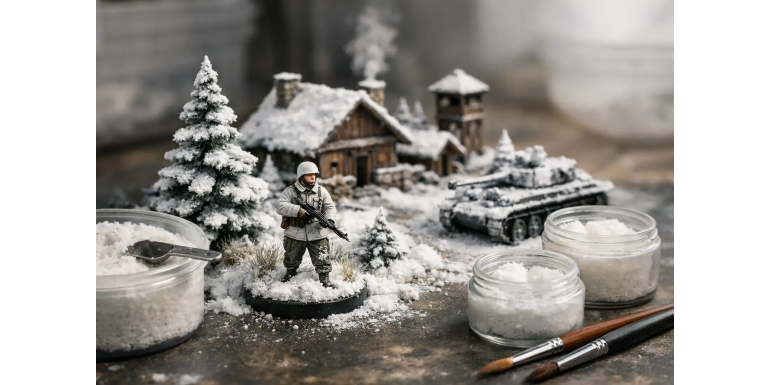
Badly done snow stands out for all the wrong reasons. On the tabletop, a convincing winter base gives an army incredible presence. However, snow that looks like shiny plastic, looks too uniform, or is applied in thick clumps achieves the exact opposite. If you are looking for a great miniature snow effect, the key isn’t just the color white. It lies in the texture, volume, shine, and how well it integrates into the rest of the scene.
What Makes a Miniature Snow Effect Credible?
Real snow is not a flat white layer. It accumulates on edges, leaves compacted areas, reflects light differently depending on humidity and temperature, and rarely covers everything equally. The same goes for miniatures. If you apply it like thick paint, the result usually ends up looking like plaster or dried putty.
That’s why you should first consider what kind of winter you want to represent:
-
Freshly fallen snow on a base.
-
A trampled path or muddy road.
-
A frozen ruin or a forest with light frost.
This choice dictates almost everything: how much volume you need, whether you should go for a matte or slightly wet finish, and if pure white makes sense or needs to be dirtied up a bit.
For gaming projects, there is another practical factor. The snow must withstand handling. A display base allows for more delicacy, but a unit that will be moved in and out of movement trays, foam cases, and tabletops needs a stable, well-fixed finish.
Snow Materials: Not All Yield the Same Results
There are several ways to make snow, and not all work equally well on bases, terrain, or dioramas. Specific hobby products usually offer the best balance between realism and control, especially if you already work with textures, pigments, and weathering effects. They are designed for scale, adhesion, and compatibility with other modeling materials.
Snow Pastes
These are the most straightforward option when you want volume and speed. They are applied with an old brush, spatula, or sculpting tool, allowing you to place accumulations in corners, rocks, logs, or sandbags.
-
Advantage: You don't have to mix much or improvise.
-
Limitation: If overused, they can leave a texture that is too uniform.
Snow Powder and Microflocks
These work exceptionally well when looking for a lighter, more crystalline surface. They are usually applied over PVA glue, varnish, or a fixing mixture. Properly used, they break up the pasty look and provide a more natural grain. The problem arises when used alone without a base or planning, as they can end up looking like sprinkled sugar.
Paste and Powder Combinations
For many hobbyists, this is the most convincing method. First, the relief is created with a dense paste or texture, and then it is topped with fine snow powder to restore freshness. This two-step process avoids a blocky look and significantly improves the reading of the volume.
⚠️ A Note on Homemade Recipes: DIY recipes yield highly irregular results. Some work fine for testing, large terrain pieces, or quick projects, but they usually fall short on medium-to-high-quality miniatures. They can yellow, crack, or lose visual scale over time. If you are already investing time into painting, it is usually worth using dedicated hobby materials.
How to Apply Snow Without Hiding Your Previous Work
Before applying snow, the base or terrain piece should be almost completely finished. Rocks, mud, wood, dead vegetation, or debris must be defined first. Snow should not replace the terrain; it should integrate with it. When placed on a poorly detailed base, it shows. When placed on well-worked terrain, the whole model gains depth.
-
Map out logical accumulation points: In crevices, next to walls, at the base of tree trunks, behind obstacles, and on horizontal surfaces.
-
Avoid certain areas: Exposed sharp edges, high-traffic pathways, and steep slopes. This irregular distribution is one of the biggest differences between a believable base and a simply white one.
-
Control your tools: If using paste, do not spread it like drywall plaster. Deposit it in zones and leave small variations in thickness. A silicone tool, a toothpick, or a damp brush can help break up edges and smooth transitions. If using snow powder, apply it while the adhesive is still active and gently tap off the excess once dry.
-
Work in layers: A common mistake is covering the whole base at once. It works better to build it up. First volume, then fine texture, and final touches at the end. This gives you better control over the finish and allows you to correct mistakes without ruining the piece.
The Base Color Matters More Than It Seems
Beneath the snow, there must be terrain that makes sense. Cool browns, grays, muted earth tones, and occasional dark areas help the white pop. If the base color is already too light, the snow loses contrast and flattens out visually.
Furthermore, not all snow needs to be pure white. In small scales, an off-white or a barely noticeable grayish tone can work much better in shadows and compacted areas. Save pure white for high points, loose snow, or final highlights.
Gloss, Moisture, and Trampled Snow
This is where many effects are decided. Dry snow usually looks more matte and airy. Wet or trampled snow allows for some gloss, especially on paths, melting edges, or high-traffic areas. If everything shines, it will look like plastic. If everything is matte, it can sometimes look too dusty.
The solution usually lies in combining finishes: a matte main layer with some satin or gloss touches in specific areas. On a snow-covered urban terrain piece, for example, a muddy street with remnants of compacted snow requires a different treatment than a roof or a cornice.
Common Mistakes When Making Miniatures Snow
1. Thinking more white equals more realism: Snow needs context. If there is no visible dirt, stones, wood, flattened vegetation, or signs of wear, the base loses its narrative.
2. Ignoring the scale: A grain that is too coarse might work on a hill or a building but look massive on a 28mm base. It is vital to adjust the texture to the project's size. In miniatures, overly coarse snow breaks the illusion instantly.
3. Not fixing the material properly: Some snow effects look great when freshly applied but disastrous after a few games. If the material flakes off when touched, it will end up rubbing off on miniatures, trays, and transport foam. For gaming pieces, durability matters just as much as the finish.
4. Repeating the exact same pattern on every base: If every miniature has an identical distribution of snow, the army looks artificial. Maintain a common palette, but vary the accumulations, clear zones, and small patches of exposed terrain.
Bases, Scenery, and Dioramas: Different Needs
| Project Type | Main Focus | Best Approach |
| Unit Bases | Contrast & Readability | Partial coverage, fine grain paste |
| Scenery & Terrain | Realism & Heavy Volumes | Large accumulations, edge transitions |
| Dioramas | Narrative & Superposition | Mixed products, wet & dry finishes |
-
Unit Bases: These need clarity and quick readability. The miniature snow effect here should complement the color scheme without stealing the spotlight from the figure. It is best to use snow in partial areas, revealing mud, rock, or base texture. This maintains contrast and prevents the miniatures from looking like they were cut out and stuck onto a white disc.
-
Scenery & Terrain: Here, snow can take center stage. Buildings, walls, sandbags, barricades, and forests allow for larger accumulations. It is worth playing with cornices, sheltered corners, and thickness changes, as well as transitions between clean snow and areas stained by use or combat.
-
Dioramas & Display Pieces: This requires a finer level of detail. You can work in footprints, melting snow, icicles, frozen mud, or superimposed layers. This is where mixing products and finishes pays off the most. However, even here, restraint is key. An excess of effects often distracts rather than enhances.
Choosing the Right Option for Your Project
For army bases, a fine-grain snow paste with a few powder touch-ups is usually a solid solution. It is fast, durable, and easy to repeat consistently across units. For large scenery pieces, higher-volume textures combined with selective applications of fine snow on edges and upper planes work well. For dioramas, a mix of paste, loose snow, and wet effects offers the most versatility, though it also demands more control.
If you are just starting out, the wisest move is not to overcomplicate it. A good dedicated product, a well-painted base, and a layered application usually yield better results than a homemade mix full of variables. If you are a hobby veteran, you probably already know that convincing snow doesn't depend on a single trick, but on making choices that make sense for the scene.
In a specialized hobby store like Terrainandminis.com, where the hobby is curated by actual categories of use rather than generic crafts, it makes sense to look for materials designed specifically for the tabletop, bases, and scenery. You can tell when a product is engineered for these types of projects rather than just a quick fix.
Snow works best when it looks like it has fallen onto the terrain, not when it looks placed on top of it. If you look at your base and can almost feel the cold, the weight, and the accumulation, you are on the right track.