Español

Desert effect for bases without complicating things
- 05/17/2026 08:12:29
- Home , Assembly and Painting Guides
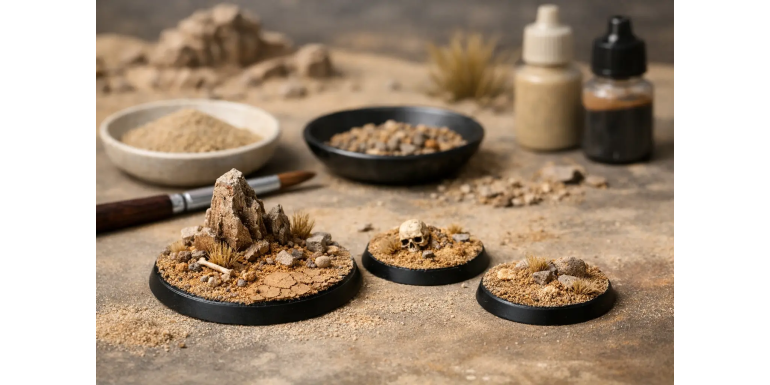
The exact same color scheme gains more contrast, the silhouette reads better on the tabletop, and the figure no longer looks like it’s just standing on a plainly painted disc. If you are looking for a desert effect for bases that works for both gaming and display cases, the key isn't just throwing sand down and drybrushing it. It lies in controlling texture, scale, and color so that everything looks dry, believable, and functional on the tabletop.
What Makes a Desert Base Effect Actually Work
The most common mistake is thinking of the desert as a uniform block of beige. On the tabletop, that usually looks flat, and in photographs, even more so. Real arid ground mixes fine dust, small stones, compacted areas, subtle tone shifts, and sometimes a reddish or grayish hue depending on the terrain you want to represent.
On a base, scale also comes into play. Gravel that looks fine on scenery can look like a boulder field if you place it under a 28mm or 32mm mini. That’s why it’s best to work with fine materials and save larger elements for specific focal points. The result improves significantly when the texture complements the miniature instead of competing with it.
The intended use matters too. A base for an army—which needs to be fast and consistent across dozens of miniatures—is not the same as a character base, where you can afford more layers, pigments, and details. The best method isn't the most complex one; it’s the one that fits your time, your scale, and the finish you are looking for.
Materials That Yield the Best Results
For a reliable desert base, the most practical approach is combining a texture paste or adhesive with fine sand, a bit of carefully controlled gravel, and earth-toned paint. Pigments help immensely with the finishing touches, but they aren't mandatory if you prefer a cleaner, faster process.
-
For a cracked or extremely dry surface: Specific arid terrain textures save time and provide a more convincing relief than loose sand alone.
-
For a rockier desert: A mix of fine sand with small fragments of cork or stone works best.
-
For a dune or compacted dust finish: Less stone and a smoother texture is the way to go.
For gaming bases, you should prioritize durable materials. Poorly secured sand eventually rubs off, and unsealed pigments can lose intensity or smudge. If you transport armies frequently, it’s worth sacrificing a bit of that ultra-matte effect in exchange for good durability.
How to Build the Texture Without It Looking Artificial
Start by thinking about how the base reads. The figure is the boss, so the base must complement the pose rather than block it. If the mini is running or advancing, it works well to leave slightly cleaner areas in front of the leading foot and concentrate more texture on the edges or behind it. If it’s static, you can distribute the terrain more evenly.
Apply the paste or adhesive irregularly. A perfectly flat surface usually looks unnatural, but you also don't want to create exaggerated mounds that raise the miniature too high. On top of that base, sprinkle fine sand and shake off the excess once dry. If you want rocks, place very few and keep them modestly sized. Two or three points of interest are usually enough.
Pro Tip: Mix textures. Fine sand provides scale, while a tiny pinch of slightly coarser material prevents a monotonous look. The important thing is that the mix still looks proportionate. In a desert, less is usually more.
Sand, Texture Paste, or a Mix of Both?
Each option has its advantages:
-
Sand glued with PVA glue: Budget-friendly and fast—ideal for large batches. The downside is that if you don't seal it well, it can shed or leave a surface that is too uniform.
-
Texture paste: Offers more control and usually grips the base better. Plus, some come pre-mixed with fine grit and a base color. On the flip side, they can drive up the cost of a large project if you are basing an entire army.
-
The Mix (The most practical sweet spot): A layer of texture paste or lightweight putty to create volume, fine sand to enrich the surface, and an occasional detail to break up the repetition. This gives you durability and variety without overcomplicating things.
Painting: Where the Desert Stops Being Just Sand
Once the texture is dry, the paint job makes all the difference. If you coat everything in a single light brown and finish with a bone drybrush, you’ll get a decent base, but rarely a memorable one. Arid terrain gains a lot from a mid-tone base and several subtle variations.
1. The Base Coat: Start with a relatively dark earth tone. This can be a warm brown, a grayish-brown, or even a clay color if you want a redder desert. This base layer serves to give depth to all the recesses.
2. The Highlights: Next, bring up the color with progressive drybrushes in sand, bone, or light beige tones. It’s better to do two or three soft increments than one harsh jump.
At this stage, pay attention to the miniature. If the figure wears cream-colored armor, a base that is too light might wash out the contrast. If the color scheme is very dark, a bright, sandy ground helps separate it visually. It’s not just about realism; it’s about presentation.
Washes and Nuances to Avoid a Flat Finish
A highly controlled wash in brown, sepia, or even gray can unify the texture and recover shadows after drybrushing. You can also introduce localized tints: a touch of red for iron-rich ground, a cooler beige for dry dust, or a duller brown where you want to simulate compacted earth.
These shifts should be discrete. On a small base, excessive contrast reads like a smudge. The goal is for the eye to notice visual richness without spotting obvious patches of color.
Pigments: When Are They Worth It and When Are They Not?
Pigments are an incredibly useful tool for finishing a desert effect on bases, especially if you want a realistic, dusty look. Applied dry into reliefs and crevices, they soften transitions and provide that matte appearance that is hard to achieve with acrylic paint alone.
However, they aren't always worth the trouble. On gaming miniatures that get handled a lot, poorly fixed pigment will eventually wear off or stain fingers and transport foam. If you are painting an army, you might want to reserve them for characters, command units, or display bases. For rank-and-file troops, a good sequence of base coat, wash, and drybrush usually performs better in terms of time and durability.
If you do use them, less is more. An excess of pigment can mute the contrast too much or give a chalky, ashen feel rather than a desert vibe. The best result usually comes when the technique itself is barely noticeable, but the dry atmosphere it leaves behind is unmistakable.
Details That Add Value Without Ruining the Aesthetic
The desert doesn't have to be completely empty. A few skulls, a tuft of dead grass, an eroded rock, or scraps of metal can reinforce the miniature's narrative. The problem arises when the base becomes a display case for bits and stops looking like arid ground.
If you are aiming for cohesion, think of a simple story:
-
A patrol crossing rocky terrain.
-
A warrior in an area of half-buried ruins.
-
A creature moving through dust and sun-bleached bones.
With just one clear idea, it’s much easier to choose details that add value instead of causing distraction.
It also helps to repeat certain elements across the entire army. The same range of sand, a similar proportion of rock, and one or two common details make the force look unified on the tabletop. This is where a specialized approach to basing and scenery materials—like what we offer at Terrainandminis.com—makes sense for anyone looking to build a complete project without improvising every single base from scratch.
Frequent Mistakes When Making Desert Bases
-
Using too many rocks: On a small scale, this makes the terrain look like a quarry.
-
Over-brightening the final color: This leaves you with an almost white base that lacks depth and fails to separate from the miniature.
-
Neglecting the base rim: You might have worked hard on the texture, but if the rim is messy or painted in a clashing color, the whole piece loses impact. A dark brown, black, or a clean, neutral tone usually works best.
-
Durability issues: If you don't seal the texture well or glue large elements down poorly, the base will suffer as soon as you start playing regularly. It’s not the most glamorous part of the process, but it is one of the most vital.
Which Method to Choose According to Your Project
| Project Type | Recommended Approach |
| Army / Large Batches | A repeatable process: simple texture, fine sand, a dark base coat, two drybrushes, and a clean rim. It provides unity, holds up well, and won't burn you out halfway through. |
| Skirmish Games / Small Warbands | You can afford a bit more variety in tones and elements. This is where adding specific rocks, small tufts of dead grass, or spot pigments really pays off. |
| Characters / Display Pieces | Raise the bar by working with thinner layers, subtle color nuances, and better-integrated narrative details. But even then, the base is still the support act. If it eclipses the miniature, things have gone too far. |
A good desert base doesn't have to be complicated. It just needs to look dry, believable, and in scale with the figure. Once you nail those three things, the rest is just a matter of how much time you want to dedicate to each miniature.