Español

How Much Terrain Does a Wargaming Table Need?
- 06/11/2026 10:42:38
- Home , Tabletop Terrain
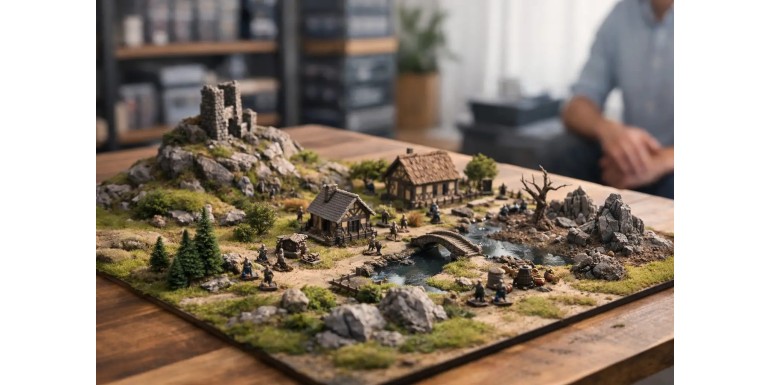
A table with too little terrain plays fast, sure, but almost always worse. Shooting dominates, movements become predictable, and many units lose their tactical value. That is why, when someone asks how much terrain a table needs, the useful answer is never a fixed number, but rather a balance between cover, movement lanes, and the type of game.
The right amount depends on three main factors: the game system, the size of the table, and the role you want the terrain to play. A narrative skirmish game doesn’t require the same density as a competitive match, just as an urban table demands a different setup than an open desert with only a few large pieces. The crucial thing is that terrain should never be just a prop. It must actively influence lines of sight, advance routes, safe zones, and deployment decisions.
How Much Terrain Does a Table Actually Need?
If you are looking for a quick reference, a well-set table usually has between 25% and 40% of its surface area occupied by terrain. This doesn’t mean covering half the table with ruins packed tightly together. It means that between line-of-sight blockers, light cover, elevated elements, and difficult terrain, the board offers enough layers so that no plan is automatic.
-
Skirmish games: It is usually best to pack the density tighter. There are fewer miniatures, individual positioning matters more, and there is a greater need to chain cover together.
-
Mass battle games: On large tables, you can lower the density slightly, provided the pieces have a substantial footprint and effectively block lines of sight. Two large buildings and a few medium ruins can do more for a game than ten small elements placed without criteria.
A fairly common mistake is measuring a table solely by the number of pieces. Eight elements can be too few or too many depending on their size, height, and placement. A linear barricade, a compact forest, and a multi-story factory do not have the same impact on a game, even if they each count as "one piece."
The Game System Changes the Answer
Not all rulebooks treat terrain the same way. Some rely heavily on partial cover, others on true line of sight (TLOS), and some absolutely require solid line-of-sight (LoS) blockers to prevent the first turn from deciding half the match. Therefore, before filling the table, it’s wise to think about how your miniatures interact with the battlefield.
In shooting-heavy games, you need more elements to break angles and force maneuvering. If the table leaves extremely long fire lanes, certain factions or army lists will have an unfair advantage right from deployment. In games focused on close combat or objective control, it is vital to have protected routes and contested areas around the center.
Whether you are playing narrative or competitive also plays a role:
-
Narrative play: You can force a specific aesthetic even if it creates asymmetries, because the story of the table matters too.
-
Competitive play: The priority is usually for both players to have similar access to cover, high ground, and LoS blockers. It doesn't need to be mirror symmetry, but it does need functional fairness.
Table Size and Recommended Density
On a small table, any large piece of terrain has a massive impact. A single ruin can split the board in two, whereas on a large table, that same element barely creates a local cover zone. Because of this, when scaling up, simply adding one or two extra pieces isn't enough. You must maintain the correct ratio between open space, lines of sight, and usable zones.
Skirmish Tables (Small)
Small tables thrive on many medium and small interconnected elements: walls, containers, low ruins, walkways, forests, or scatter terrain. This allows players to move from cover to cover and make tactical choices turn by turn.
Grand Battle Tables (Large)
Large tables work best with a mix of anchor pieces and filler terrain:
-
Anchor pieces: Buildings, rocky outcrops, factories, or dense forests that define entire sectors.
-
Filler terrain: Barricades, craters, fences, pipes, or debris that fill the gaps and prevent dead zones.
? Pro-Tip: If you look at your table and see a completely empty center and two unused corners, you probably have a distribution problem rather than a lack of terrain.
How to Distribute Terrain Without Obstructing the Game
Setting up a table properly is not about cluttering it. The layout should allow miniatures to move comfortably, ensure objectives remain interesting, and prevent the scenery from becoming a physical nuisance. A table overloaded with spectacular but impractical details slows down the game and generates unnecessary arguments.
The most effective approach is to combine three types of zones:
1. True LoS Blockers: Areas that completely block visibility.
2. Intermediate Cover: Zones where a unit can hold out without becoming untouchable.
3. Open Spaces: Areas that can still be crossed, but come with a risk.
If everything blocks sight, shooting loses its value. If nothing blocks sight, movement loses its meaning.
The Center of the Board
The center deserves special attention, as many tables fail right here. It is either so open that nobody wants to step into it, or so cluttered that it becomes an awkward chokepoint. Ideally, the center should invite conflict without giving it away for free. A couple of medium pieces, some scattered cover, and several possible approach lanes usually work better than a single giant element in the middle of the board.
Signs Your Table Lacks Terrain
There are several clear red flags:
-
If you can see almost any relevant enemy unit right from deployment, the table is likely short on terrain.
-
If fast units don't need to plan their routes because everything is in plain sight, you lack density.
-
If a single powerful shooting miniature dominates half the game from turn one, it’s usually not just a problem with its stat line.
-
The "Dead Zone" effect: If half the table is purely decorative and all the action concentrates around the same two good pieces of cover, the layout isn't doing its job. Good terrain distributes tactical value across the board.
Signs You've Overdone It
There is also such a thing as too much terrain:
-
If it’s a struggle to place units, move bases, or measure ranges without bumping into five elements every turn, the table is overcrowded or poorly designed.
-
If almost all lines of sight are blocked and every advance is done blindly until you bump into the enemy, you might have turned the board into a labyrinth.
This often happens when players add too much small scatter terrain because it "looks cool." It might look great, but a playable table needs usable volume, not just detail. Sometimes it pays to remove the finest scatter pieces and leave fewer elements that have a better, more meaningful impact on the game.
What Types of Terrain Offer the Best Gameplay?
Not all terrain pieces contribute equally. The most efficient pieces are those that serve more than one function: partially blocking sight, offering cover, providing verticality, or defining a route. A ruin with a playable ground floor, reasonable windows, and clear access is worth far more than a gorgeous but purely decorative piece.
That is why mixing large buildings or ruins with linear elements and transition terrain works so well:
-
Buildings create sectors.
-
Barricades and walls connect positions.
-
Craters, woods, or rubble zones soften the transition between open ground and safety.
This combination makes the table easy to read at a glance and much better to play on.
For those who set up multiple tables or swap between game systems, the most practical approach is working in layers. Keep a few versatile large pieces, several medium ones to alter the board's character, and plenty of light scatter terrain to fine-tune the density. It’s a much more flexible way to adjust your setups without having to rebuild your entire collection every time.
A Simple Method to Get It Right Before You Start
If you want to avoid overthinking, here is a very practical test:
1. Place the objectives or imagine where they will go.
2. Check if they can be reached via at least two reasonable routes—one more direct and one more protected.
3. Check if there are dominating fire lanes from each deployment zone to multiple objectives at once. If there are, add sight blockers. If there are none at all, open things up a bit.
One final check: Mentally place a large monster or vehicle, an infantry unit, and a fast-moving model at different spots on the board. If one of them holds a clear, overwhelming advantage in almost every sector, adjust the terrain. The best board isn’t the one that favors a single list, but the one that forces every player to make tough decisions.
At that point, you are no longer just setting up scenery—you are designing the game itself. And that’s where a specialized store like Terrainandminis.com makes all the difference. It’s not just about having a vast catalog; it’s about being able to combine pieces that truly work together on the tabletop.
Ultimately, good terrain is noticed when nobody talks about it as a problem, but everyone plays better because of it. If by the end of the game there were successful flanks, crucial cover saves, calculated risks, and a hard-fought center, you won't need to count pieces. The table had exactly the terrain it needed.