Español

How to Use Pigments on Miniature Bases (Without Overdoing It)
- 06/12/2026 08:53:23
- Home , Assembly and Painting Guides
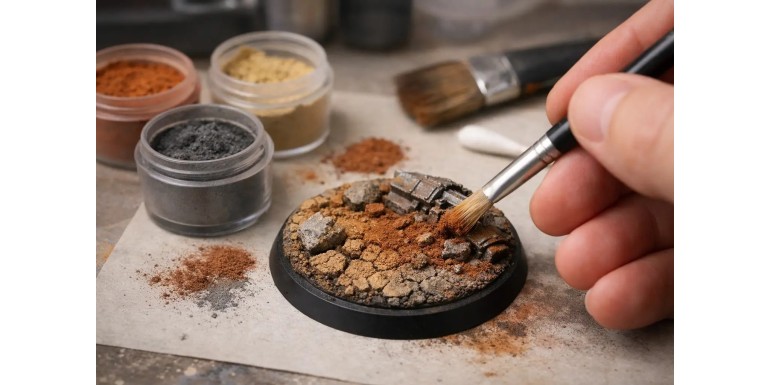
A well-painted base can support a decent miniature. A well-textured base finished with pigments can make the entire piece look like it's part of a real-world environment. If you are looking into how to use pigments on miniature bases, the key isn't just throwing colored powder on at the end; it's about understanding what effect you want and exactly where it fits into your workflow.
Pigments work exceptionally well when you want to break up the flat look of acrylic paint. They provide dust, dry earth, old mud, ash, rust, or accumulated grime with a level of realism that is hard to achieve with a brush alone. However, there is a catch: if you apply them without control, the base will look clogged, the color will turn dull, or it will simply look dirty. On the tabletop, that stands out much more than you might think.
How to Apply Pigments to Miniature Bases for Realistic Results
The first step is deciding what story the base is telling. An urban base with fine rubble requires a different approach than a desert, a damp trench, or a volcanic plain. The most common mistake is using the same earthy brown for everything. Pigments work best when they reinforce a terrain that has already been defined by texture and base colors—not when trying to invent it from scratch.
Before applying them, the base should already have volume, base coats, and, if applicable, dry brushing or washes. Pigments do not replace the painting phase; they complement it. On a flat, unworked surface, even a great dust tone will look artificial. Conversely, on sand, cork, texture paste, fine gravel, or bits of scenery, it settles much more naturally.
Scale matters too. At 28mm, a pigment that is too coarse or heavily accumulated can look like an out-of-scale layer of mud. On busts or larger bases, you have more room for visible transitions and deposits. That is why there is no universal amount: it depends on the size of the miniature, the type of base, and the overall contrast of your color scheme.
Which Method to Use Depending on the Effect
There are three common ways to work with pigments on bases: dry, with a fixer, or mixed to create mud. Each serves a different purpose, and picking the wrong method is usually what ruins the finish.
1. Dry Application: This is the fastest option and often the most convincing for surface dust. Take a small amount with an old brush and place it in specific areas: edges of stones, recesses, high-traffic paths, or the lower parts of terrain features. Then, blend it out by dragging the brush gently. This method gives a very matte and natural finish, but it is fragile. If you handle the miniature frequently, some of the effect will rub off.
2. Using Pigment Fixer: This offers more durability. You apply the pigment first and then moisten it with the fixer to lock it in place. You need a light hand here. If you soak it too much, the tone changes, darkens, and sometimes loses that dusty appearance that makes pigments so useful. It works great for compacted earth or persistent grime, but for dry dust, it isn’t always the best option.
3. Mixing Mud: The third approach is mixing pigment with water, medium, matte varnish, or specific mud products. This is used to create actual accumulation, dense splashes, or wet terrain. It works wonders on narrative bases or heavily weathered miniatures. However, if you overdo it across an entire army, it can look too uniform and detract from the readability of the miniature.
Where to Place Pigments for Ultimate Realism
Pigment should not be spread across the entire base as if it were a final layer of primer. Real-world dirt accumulates logically. If you want the result to work, think about weight, moisture, friction, and wind.
-
On dry terrain, dust tends to concentrate in cracks, joints between elements, low areas, and around stones or debris. It also makes sense to reinforce the contact points with the miniature's feet to integrate it better into the scene. A small halo of dust or dirt around the boots helps far more than covering the entire base evenly.
-
On muddy or damp bases, the behavior changes. Accumulations appear in depressions, the edges of puddles, and areas where the texture traps material. Here, you can work with dark earth tones, denser mixes, and some selective gloss varnish if you want to simulate recent moisture. If everything shines, it will look like enamel paint; if nothing stands out, it will just look like dark brown.
-
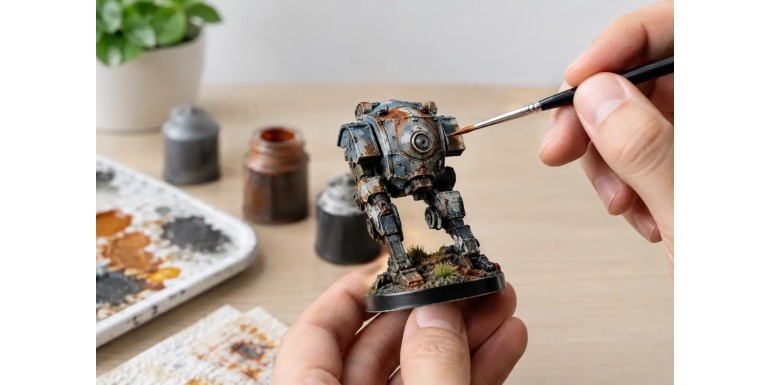
In urban or industrial settings, greys, muted ochres, rusts, and off-blacks usually perform better than generic browns. Here, the goal is to dirty up edges, blend debris, and create fine deposits that simulate concrete, soot, or weathered metal. A well-placed pigment on a pipe, a grate, or a broken tile breathes much more life into the piece than a uniform coat over everything.
Colors That Work Best
If you are just starting out, it is best to work with a small palette. A light ochre, a medium earth tone, a dark brown, and a dusty grey cover a massive range of situations. Adding rust red, ash black, or muted green depends entirely on the environment you want to replicate.
What usually fails isn't the pigment itself, but the contrast with the underlying paint. If the base is already painted in very similar browns, adding a pigment of the exact same value will barely show up. If it is too light or too saturated, it will look like makeup. As a general rule, a slightly lighter tone works best for surface dust, while a darker tone is ideal for wet or compacted accumulations.
Mixing two pigments usually yields more believable results than using just one. Real earth is almost never a flat color. A little variation between areas allows the base to breathe better, especially on large bases or terrain pieces. On small bases, this mixing technique works well too, but should be used in moderation.
Frequent Mistakes When Using Pigments on Bases
The first mistake is applying them at the very end, in a rush, just to "finish it off." It shows immediately. Pigments need to be part of the base’s design concept, even if they are applied in an advanced stage. If the base wasn't planned to have that specific weathering, the pigment usually looks pasted on top rather than integrated.
The second mistake is over-fixing. Many hobbyists discover a perfect dry finish and ruin it by trying to seal it completely. Sometimes it is worth sacrificing a bit of durability to maintain a natural look, especially for display miniatures or pieces with limited handling. For gaming pieces, you have to balance durability and aesthetics.
Another common slip-up is covering the rim of the base with pigment residue. It might seem like a minor detail, but it dirties the presentation. A clean rim in black, dark brown, or your usual choice of color makes all your hard work look much more polished and intentional.
You should also avoid the "universal mud" trap. That medium brown, glossy, thick tone used interchangeably for deserts, forests, urban ruins, and melting snow rarely looks convincing. Each environment demands a different kind of dirt. Shifting the hue and placement slightly makes a world of difference.
A Simple Workflow That Works Every Time
If you want a reliable way to work, start by texturing the base and painting it with its base colors. Next, define your highlights and shadows using dry brushing, washes, or both. Once the base works well on its own, apply dry pigments to the areas where you want dust or a color transition.
From there, decide if any areas require fixer. Not everything needs to be sealed the same way. You can leave lighter, matte areas as they are, and only reinforce the deposits that need to withstand handling or look more compacted. This combination usually yields a richer result than a uniform coat of fixer.
If you want mud, add it at the end in specific spots. Less is more—it is better to have a small amount well-placed than half the base covered. And before calling the piece finished, look at the miniature from tabletop distance. At twenty or thirty centimeters away, you will instantly see if the effect adds value or if it has swallowed up the overall readability of the model.
For those painting entire armies, it pays off to standardize two or three base recipes rather than fifteen. You save time, maintain visual consistency, and still leave room for minor variations between units. In a specialized store like Terrainandminis.com, where we handle a lot of material designed for gaming and terrain, this practical logic makes perfect sense: the finish must look good, withstand use, and not overcomplicate the process.
Pigments look best when they feel inevitable, not when they are crying out for attention. If you look at a base and think about the terrain first and the technique second, you are on the right track.