Español

How to repair broken miniatures without ruining them
- 06/15/2026 09:02:59
- Home , Assembly and Painting Guides
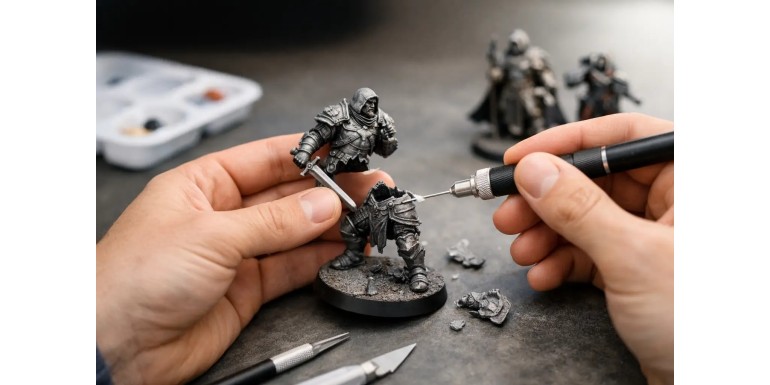
There are few things more frustrating at the workbench than hearing that sharp snap when opening a box, moving a tray, or picking up a miniature by the wrong part. If you are wondering how to repair broken miniatures, the good news is that most breaks can be fixed if you choose the right adhesive, prepare the joint properly, and do not try to rush the curing process.
Not all breaks are treated equal, and that is precisely where many fixes fail. A snapped sword, a resin wrist, a wing joint on metal, or a thin plastic banner all share the same fundamental problem, but they do not share the same solution. The material, the weight of the piece, and the contact surface area completely change the required approach.
How to Repair Broken Miniatures by Material
The first step is to identify exactly what the miniature is made of. It sounds obvious, but it is the difference between a repair that withstands entire gaming campaigns and one that snaps apart during your next transit.
In hard plastic, it is customary to work with plastic cement if the break is clean and both pieces fit together perfectly. This product does not act as a traditional glue; instead, it slightly melts the surface plastic to create a single, incredibly solid welded bond. The issue is that it only works with specific plastics, so it will not solve anything on soft PVC or resin.
In resin, cyanoacrylate (super glue) is usually the most practical option. It cures fast, grips well, and allows you to work on tiny pieces with considerable precision. Even so, it has a clear limitation: on thin joints or those subjected to mechanical tension, gluing without reinforcement can fall short.
In metal, weight dominates. A metal miniature or a large alloy component needs a strong adhesive, but it also frequently requires internal reinforcement. If you glue a heavy arm using just a single drop of super glue, it might hold today but break loose two weeks from now.
What You Need Before Starting
You do not need to set up a full industrial workshop, but you do need to have the essentials within arm's reach. A clean repair typically requires a hobby knife (scalpel), a fine file or smooth sandpaper, tweezers, cyanoacrylate, modeling putty (such as Milliput or Green Stuff), and, in some cases, a pin vice with thin metal wire or paperclips for pinning. If the mini was already painted, it is also wise to keep primer and your touch-up paints nearby.
Always work under good lighting and dry-fit the parts before applying any glue. This simple step prevents the classic mistake: applying adhesive, discovering the piece fits awkwardly, and ending up with a crooked joint or excess glue oozing over highly visible details.
Cleaning and Preparing the Break
A fresh break usually leaves fairly clean edges. Even so, it is important to inspect the contact zone for flash, burrs, old glue residue, or accumulated paint. The cleaner the surface, the better the bond strength will be.
If the miniature has been repaired before, you must carefully remove the old adhesive. Scrape away just enough with a hobby knife or very fine sandpaper until you restore a flat surface. When handling resin and plastic, do this with touch and care—shaving away sculpted detail due to rushing is a very expensive way to fix a minor accident.
When the piece fits but wobbles slightly, do not ignore it. That micro-gap usually translates to a weak joint. Sometimes it can be corrected by truing up the contact point; other times, you will need to backfill the gap later with modeling putty.
Simple Gluing for Clean Breaks
If the component has snapped cleanly and possesses a reasonable contact surface area, the gluing process can be straightforward. Apply a very minimal amount of adhesive. More glue does not equal more strength. In fact, an excess creates a thick layer that takes longer to cure, can weaken the bond, and will likely overflow onto the surrounding sculpted details.
Hold the piece in position for a few seconds or for the duration specified by the product. If you can leave it completely undisturbed for several minutes more, all the better. The majority of failures in simple repairs come from premature handling. It may feel like it has gripped, but the molecular bond is not yet ready to withstand stress or tension.
When working on hard plastic with specific plastic cement, let the chemical do its job. Apply gentle pressure, align it perfectly, and do not keep adjusting it repeatedly. If you reposition it ten times, you will deform the melted edges and ruin the flush fit.
When Pinning Is Required
Here lies the difference between a temporary fix and a professional repair. If a thin piece, a load-bearing joint, or a heavy component has broken, the most reliable method is to drill both sides and insert a small metal pin. This pin can easily be crafted from thin brass rod or a straightened paperclip, depending on the thickness of the part.
The process demands patience. Drill a centered hole on each side of the fracture, test the depth with your metal pin, and verify that both parts align perfectly before introducing glue. If the angle is skewed, you cannot easily correct it later with putty. The pin should fit firmly without being forced so hard that it splits the material.
This technique is exceptionally useful for arms, wings, ankles, spears, banners, and the mounting joints between a rider and their mount. It is also essential for large metal and resin figures, where structural weight stresses the joint even if the miniature spends most of its time safely inside a display cabinet.
Filling Gaps Without Losing Detail
Following the gluing process, many breaks leave a visible seam line or a small offset step. If you plan to paint or repaint the miniature, it is well worth the effort to correct this. Modeling putty serves to fill cracks, reconstruct missing edges, and conceal areas damaged during the initial break.
The key is to use a minimal amount and work it while damp or with the appropriate sculpting tool, depending on the type of putty. If you over-apply and cover too much area, you will have to do more sanding later, risking erasing nearby textures like cloth, armor, or fur. On finely detailed miniatures, less is almost always more.
In some instances, you do not need to make the area structurally perfect. On a scenic base, a joint can be integrated using texture pastes, sand, mud, or artificial snow. On a smooth shoulder pad or a sword blade, however, any lump or imperfection stands out immediately. The required level of finish depends heavily on the location of the break and how the miniature will be used.
How to Repair Broken Miniatures That Are Already Painted
When a miniature is fully finished, undertaking a repair commands more respect because you are not just repairing structure—you are also protecting painted art. Here, it pays to slow down and isolate your workspace carefully.
If you can manipulate the piece without touching delicate, highly blended areas, do so. If not, mount it on a temporary painting handle or hold it strictly by the base. Before gluing, strip away paint only at the exact point of contact if it prevents a solid bond. Gluing onto thick layers of acrylic paint yields a far weaker result than joining material directly to material.
Once the adhesive has fully cured, review the finish. It might suffice to touch up the fracture line, re-highlight an edge, or apply a quick wash to blend everything together. If the repair has left a noticeable scar, you may need to apply primer locally with a brush. Do this with precision so you do not introduce an unwanted texture right in the middle of a smooth surface.
Common Mistakes That Ruin a Repair
The most common mistake is using the wrong adhesive for the material. The second is trying to resolve a structural joint without a pin. The third is premature handling. These errors are incredibly common because a quick fix often seems simpler than it actually is.
It is also wise to avoid using super glue activators (accelerators) without testing them first, especially on visible surfaces. Some can cause frosting, leaving an ugly white residue around the cyanoacrylate. And if the miniature is resin, never force a misaligned piece assuming the glue will gap-fill and compensate. It won't.
Another oversight is failing to consider transportation. There are miniatures that break repeatedly because the transport case, foam tray, or the way they are handled constantly puts stress on the exact same weak point. Repairing them is great, but if you do not alter your storage and transport solutions, you will find yourself repeating this process far more than necessary.
When Is It Worth Rebuilding vs. Replacing?
Some breaks call for a comprehensive restoration, while others accept a practical hobby hack. A lost spear tip, a small horn, or a decorative skull on a base can easily be remade using modeling putty or similar leftover bits from your spares box. Conversely, a highly detailed hand or a damaged face might require so much sculpting work that it may be more economical to replace the entire component if a spare bit is available.
If the miniature is meant for the gaming table, prioritize structural durability and visual cleanliness at tabletop distance. If it is a display or collection piece, the standard changes completely, and it is well worth investing more time to completely camouflage the repair. Neither option is inherently better than the other; it depends on its purpose, the value of the figure, and how much you wish to alter the original sculpt.
Furthermore, in army projects, consistency matters. A solid, well-integrated fix is usually preferable to spending hours on a flawless museum restoration for a single miniature while the rest of the backlog remains waiting. If you work in batches, keeping hobby-specific adhesives, putties, and finishing materials ready saves both time and headaches. That is exactly where a specialized hobby store like
Repairing a broken miniature is not about hiding an accident at all costs. It is about returning it to the gaming table or display case with a reliable joint, a dignified finish, and the peace of mind that it will not snap again at the first movement.