Español

How to paint non-metallic metal without losing contrast
- 06/10/2026 08:58:49
- Home , Assembly and Painting Guides
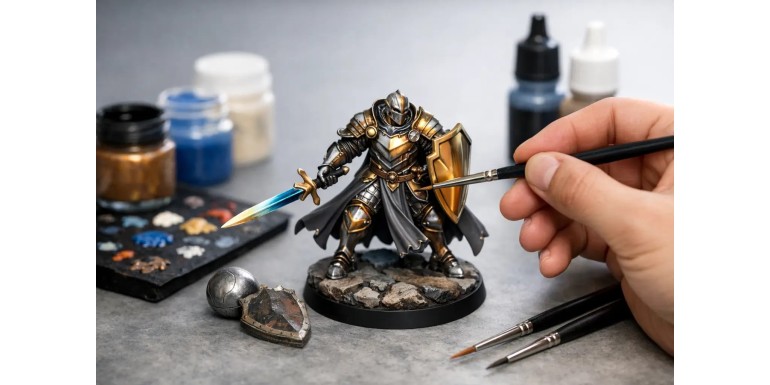
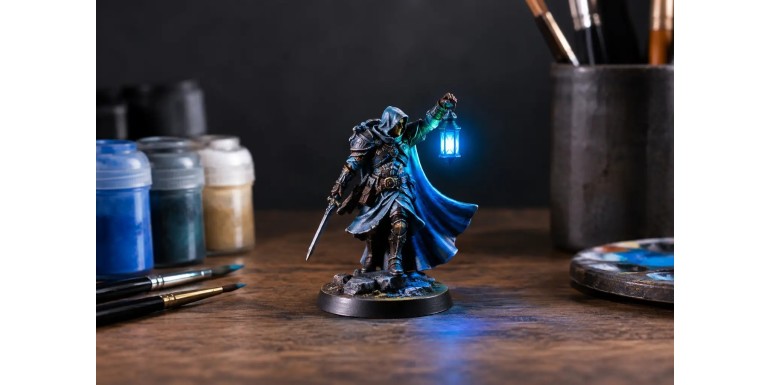
There is a very clear difference between armor that simply looks gray and one that truly sells the NMM effect. When you learn how to paint non-metallic metal, you stop relying on the paint's actual sheen and start controlling the light entirely. On gaming miniatures and display pieces, this changes the final look more than you might think.
Non-metallic metal, or NMM, consists of painting metallic surfaces using matte colors and extreme contrast to simulate reflections. There are no metallic particles doing the work for you. Everything depends on where you place your shadows, midtones, and highlights. It sounds demanding—and it is—but it is also a very logical technique once you understand how light behaves on steel, gold, or bronze.
How to Paint Non-Metallic Metal Without It Looking Flat
The most common mistake isn't the blending; it's the value range. Many painters stick to a scale that is too timid: gray shadows, light gray highlights, and a smooth transition—sure—but without that visual tension that makes the eye register it as metal. Metal reflects light harshly. That is why NMM requires deep blacks, bright highlights, and relatively sharp transitions in specific areas.
Put practically, metal is not painted "softly" everywhere. There are areas where you want to blend and others where you want a sharp contrast. On a sword, for example, a silky smooth transition can work on the flat part of the blade, but the edge and certain reflections look better with sharper jumps. If everything is perfectly blended, the effect sometimes loses its punch.
The size of the miniature also plays a huge role. At 28mm or 32mm, you aren't painting physically realistic metal to scale; you are painting a visual interpretation that reads well from a gaming distance. This forces you to exaggerate the contrast more than you would on a large figure or a bust.
Before You Start: Think About Light, Not Color
If you truly want to understand how to paint non-metallic metal, it helps to stop thinking about "steel" or "gold" first and start thinking about light, medium, and dark. NMM relies on values before tone. A cold steel can carry blue, gray, or even a bit of violet. Gold can lean toward ochres, browns, or sand tones. But if the placement of the highlights isn't convincing, color alone won't save the effect.
Tip: A great way to plan your approach is to imagine the piece almost in black and white. Where would the deepest shadow be? Where would the main reflection hit? Which edge catches a line of light? Creating this mental map beforehand saves you from a lot of repainting later.
In fantasy and sci-fi miniatures, a clear zenithal light usually works beautifully. It is easy to read and fits perfectly on armor, swords, shoulder pads, and helmets. If the piece has multiple metallic surfaces, keeping a consistent light direction does more for the final result than any color recipe.
Which Surfaces Are Easiest to Practice On?
Not all surfaces are equally forgiving when it comes to NMM. Sword blades, wide armor plates, and smooth helmets are usually great exercises because they allow you to clearly see the relationship between planes. Conversely, chainmail, tiny filigrees, or highly textured areas complicate the learning process, as the detail breaks up the reflection pattern.
If you are just starting out, it is better to pick a miniature with large, clean surfaces. A champion with a broadsword or a segmented suit of armor lends itself much better to study than a rank-and-file trooper covered in rivets and tiny ornaments.
The Step-by-Step Process
1. Start with a mid-tone base. For steel, a neutral or slightly bluish gray. For gold, a medium ochre brown. It doesn't need to be the definitive tone. The important thing is to have a surface from which you can push both up and down.
2. Block in the deep shadows. Don't hold back. For steel, you can go down to charcoal gray or almost black. For gold, a mix of dark brown with a desaturated touch works beautifully. These shadows shouldn't just sit in the recesses; in NMM, they often appear right in the middle of a flat surface because the reflection changes with the angle of the plane.
3. Place the first highlights with confidence. This is where many painters hesitate too much. If a plane catches the light, push it up clearly. For steel, move toward a very light gray and finally almost white. For gold, head toward bone, light sand, or warm ivory. The brightest light usually takes up less space than you think, but it must be strong enough to create contrast.
4. Smooth transitions where needed. Do this without erasing the shape of the reflection. You can use thin glazes, highly diluted layers, or intermediate mixes. The key is not to lose the structure of your lights and shadows. If everything becomes too uniform while blending, it's worth going back to reinforce the extremes.
5. Add edge highlights and specular dots. On an edge, a rivet, the tip of a sword, or the corner of a shoulder pad, a tiny dot of near-white does an immense amount of work. Use this with restraint, though—if you fill the entire miniature with shiny dots, the eye won't know where to look.
Where to Place Reflections to Make Them Look Like Metal
This is the least intuitive but most important part. Metal reflects light more harshly than fabric or leather, so changes in value usually follow the geometry of the plane.
-
On a straight sword: A dark band right next to a light band usually works better than a continuous gradient from top to bottom.
-
On a curved shoulder pad: You might have a strong shadow at the bottom, a wide light in the middle, and a very bright edge at the top.
-
On cylindrical surfaces: For gun barrels, metallic handles, or rounded greaves, the pattern usually alternates: dark, light, dark, topped with a very thin, bright reflection line.
-
On flat surfaces: What matters most is the angle relative to the light source. The clearer you are about the volume of the piece, the easier it will be to decide.
If an area doesn't read as metal, it is almost always for one of two reasons: either it lacks contrast, or the reflection was placed as if the material were fabric. NMM is quite unforgiving with generic highlights.
Steel, Gold, and Other Metals
-
NMM Steel: This is usually the most accessible because it works within a contained palette. Gray, blue-gray, white, and black allow you to focus purely on values. If you want a clean look for a gaming miniature, using fewer tones and more decisive placement usually yields the best readability.
-
NMM Gold: This requires a bit more control because, in addition to contrast, you need to maintain temperature. If you make it too brown, it looks like polished leather. If you make it too yellow without deep shadows, it loses its richness. A safe route is to start from a medium brown, work your way up through ochre and sand to ivory, and cool down some shadows with a grayish-brown to keep it from looking flat.
-
Bronze or Brass: A similar rule applies here. These metals are very rewarding on scenery, statues, iconography, and decorative armor, but they require a balance between weathering and shine. If you add too much verdigris or grime, the metal disappears; if you don't add any dirt at all, it can look artificial. It depends heavily on the context of the miniature.
Common Mistakes When Painting Non-Metallic Metal
-
Using too many translucent layers too soon: Glazes help, but if you apply them before firmly establishing your lights and shadows, the whole effect becomes soft and muddy. First design the reflection, then refine it.
-
Highlighting all edges equally: This looks striking on the tabletop, but it doesn't always look like metal. Some edges should shine brighter than others depending on the direction of the light. If every edge has the same intensity, the effect becomes decorative rather than convincing.
-
Ignoring the surroundings: An impeccable NMM sword can get lost if the rest of the miniature has a much lower contrast. The eye naturally compares things. That’s why, when doing NMM on a centerpiece character, it usually pays off to slightly turn up the general contrast on fabrics, leather, and the base as well.
When is NMM Worth It (and When Is It Not)?
It is not always the best option. On a large unit of infantry, traditional metallic paint (TMM) is usually faster, more forgiving, and more practical for getting an army tabletop-ready. On characters, monsters, commanders, or competition pieces, NMM allows for much greater visual control.
It also depends on the style. If you are aiming for a highly atmospheric miniature with directed light and an illustrated finish, NMM fits perfectly. If you prefer a realistic, fast finish that looks great under natural light, metallic paint might make more sense. It isn't a hierarchy; it’s a choice of visual language.
How to Practice Without Getting Frustrated
The best way to improve is not to paint five different metals on a single miniature. It is to repeat the exact same surface until you understand it. One sword, then another. One shoulder pad, then another. Make small changes each time and observe what happens when you push the highlights further or narrow the bright reflection band.
Taking black-and-white photos of your work helps immensely because it forces you to look at values without getting distracted by color. It also works well to paint a quick test on a spare bit or a small piece of terrain before bringing the scheme over to your main miniature.
If you are putting together a more ambitious project, having a well-thought-out range of grays, ochres, browns, and transition tones on hand saves you time and unnecessary mixing. At a specialized store like Terrainandminis.com, that is usually what makes the difference—because you aren't looking for standard craft paint, but colors that perform exceptionally well at a miniature scale.
NMM has a reputation for being a difficult technique, but it isn't magic or an exhibition trick. It is observation, contrast, and repetition with intent. Your first sword might not impress you, but by the third one, you’ll start speaking the right language. From there, every reflection stops being a gamble and becomes a decision.