Español

How to magnetize round bases without fail
- 06/07/2026 08:34:29
- Home , Assembly and Painting Guides
The first time a mini snaps off inside your transport case, learning how to magnetize round bases stops sounding like an exaggeration. You don't even need a massive army to experience it: a poorly closed tray, a sudden brake in the car, or a base with minimal surface area is all it takes for a miniature that took hours of painting to end up loose, scratched, or completely broken.
Magnetizing a round base properly isn't complicated, but it does require attention to detail. And in this hobby, details rule. Magnet size, base thickness, the type of metal tray, and even the clearance height between miniatures drastically change the result. If you wing it, it might work sometimes. If you do it with clear criteria, it works every single time.
How to Magnetize Round Bases by Size
Not all round bases require the same solution. A 25mm base for light infantry doesn't behave the same way as a 40mm base with a resin miniature, or a 60mm base with a wide pose and a top-heavy distribution. That’s why you should think about real stability, not just "making it stick."
-
Small Bases: A single magnet is usually enough if it has a reasonable thickness and is well-centered.
-
Medium Bases: A single magnet is still a valid option, but it’s worth checking if the mini has a high center of gravity.
-
Large or Heavy Bases: It often pays off to use two smaller, spaced-out magnets instead of a single one in the center. This provides a more uniform grip and reduces wobbling.
This brings us to one of the most common mistakes: choosing the magnet's diameter based solely on what fits inside the underside. What matters isn't just that it fits, but that it makes good contact with the metallic surface without forcing or warping the base. A deformed or uneven base causes more long-term problems than a slightly more modest but well-placed magnet.
What You Need to Magnetize Round Bases
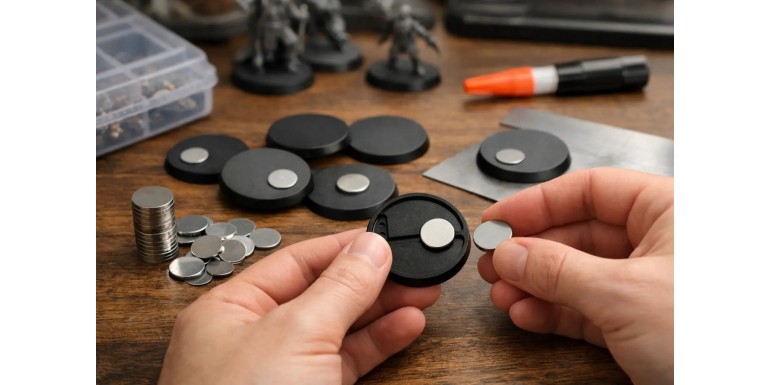
The required materials are straightforward. Typically, you will work with neodymium magnets, cyanoacrylate (super glue) or epoxy adhesive, and a metallic surface where the miniatures will be transported or stored. If the base has a hollow underside, assembly is very direct. If the bottom is closed or irregular, you’ll need to make a few adjustments.
It is also wise to have putty or a filler material on hand if the magnet doesn't sit flush. This matters more than it seems:
-
If the magnet is too deep, it loses effective pull because the distance to the metal sheet increases.
-
If it protrudes too much, the base will wobble or sit unevenly.
In both cases, performance drops even if the magnet itself is high quality.
Pro Tip: For those transporting entire armies, keep in mind that not all metal trays respond the same way. Steel usually offers better performance than other thin or heavily painted metal sheets. If you notice a magnetized mini has a weak grip, the issue isn't always the base—sometimes it's the target surface.
Step-by-Step Process for Magnetizing Round Bases
1. Check the underside: Inspect the bottom of the base. If it has a cavity, measure the available depth before gluing anything. The magnet should sit as close to the ground level as possible without sticking out. This position offers the best balance between strength and stability.
2. Dry fit first: Test-fit the magnet before applying any glue. It sounds obvious, but it prevents many failures. Some bases have internal injection gates, ridges, or shapes that prevent the magnet from sitting flat in the center. If you glue it without checking, it might dry crooked and lose uniform contact.
3. Glue the magnet: Once tested, clean the area and glue the magnet. Super glue (cyanoacrylate) works well when the fit is snug and the surfaces are clean. If there is a gap or you want extra security for heavy miniatures, epoxy resin provides a more solid anchor, though it takes longer to cure. Do not move the base until the adhesive has completely set.
4. Test on two surfaces: Check the stability on a flat table and on the actual metal surface you plan to use. These are two different tests. A base might seem stable on a table but perform poorly on a vertical tray, or vice versa. If your miniature is going to travel upright inside a metal box, that is the test that counts.
5. Adjust the height: If the magnet is too recessed, fill around it or add a thin layer of material to bring it closer to the bottom plane. If it sticks out too much, it’s best to correct it before moving on. Forcing the base to "more or less work" usually ends up causing wobbling or detachment.
Frequent Mistakes When Magnetizing Round Bases
-
Underestimating magnetic pull: This happens a lot when hobbyists use magnets that are too thin out of fear that they won't fit. It might work for lightweight plastic minis, but as soon as you handle white metal, dense resin, or bulky conversions, the grip falls short.
-
Relying on a single contact point for large bases: This isn't always wrong, but it depends heavily on the weight and how it's distributed. A winged creature or a figure leaning heavily to one side can twist and snap off during transit, even if the central magnet seems sufficient at rest.
-
Gluing onto dirty surfaces: Adhesives fail when applied over sanding dust, mold release agents, or paint residue. Glue needs real contact. If the bond fails, it’s not the magnet's fault—it’s the surface prep.
-
Mixing transport systems blindly: A base magnetized for a horizontal tray might not respond the same way on vertical panels, magnetic lids, or boxes with thin sheet metal. If you change your storage system, test it before magnetizing fifty identical miniatures.
When to Use One vs. Two Magnets
On small round bases, a single centered magnet is usually the cleanest solution. It keeps the base balanced and speeds up assembly line work when prepping a whole squad. For standard infantry, there is usually no need to overcomplicate it.
From a certain size or weight upward, two magnets start making a lot of sense. This is not just for extra strength, but for anti-twist control. When a miniature has lateral volume or a dynamic, off-center pose, distributing the support points helps tremendously. However, be careful: if you place them poorly and one sits higher than the other, you’ll create the opposite problem—a base that won't sit flat.
There is no absolute rule. If in doubt, run a test with a finished mini and move it just like it would move during actual transport. Tilt the tray, give it a few controlled taps, and watch if the base shifts or pivots. In this hobby, an honest test saves more time than any theory.
What to Do with Fully Textured or Finished Bases
If the mini is already painted and varnished, you need to work more carefully. Magnetizing after the fact is perfectly possible, but there is less room for error; any misplaced pressure can mark the base or even snap the figure off its scenic elements.
In these cases, the safest route is to work strictly from underneath without forcing the piece. If the cavity doesn't allow the magnet to sit flush, you can compensate by adding a thin washer, a plastic shim, or a leveling sheet to even out the base. It might not be the most elegant hidden solution, but it is often the wisest choice when you don’t want to redo a finished base.
Also, keep the total weight of the piece in mind. A base decorated with cork, putty, resin, or heavy terrain elements can weigh significantly more than it looks. If the mini is going to move constantly between the gaming table, display cabinet, and transport case, it’s worth upsizing the magnet system slightly rather than settling for the bare minimum.
How to Know If Your Base is Well-Magnetized
The sign of success isn't that the mini is incredibly hard to pull off with your hand. The real sign of success is that the miniature stays firmly in place during normal use and detaches smoothly, without sudden jerks that put the figure at risk. If the grip is so strong that you have to yank it from the top, you might end up bending spears, snapping banners, or breaking delicate joints.
A well-magnetized base behaves predictably. It doesn't wobble, it doesn't pivot easily, and it doesn't require repositioning every time you move the tray. That is worth much more than overkill magnetic strength on paper.
For hobbyists managing full armies, consistency matters just as much as pulling power. Using the same criteria across your entire force makes transport effortless and prevents surprises between units. If you source your materials from a specialized shop like Terrainandminis.com, it makes perfect sense to maintain consistency in your measurements and magnet choices to avoid mixing incompatible systems.
Magnetizing round bases is a small upgrade until you stop worrying about transport altogether. That is when it truly pays off. If you choose the right magnet, respect the clearance height, and test the setup under real conditions, your miniatures will travel safely, and you will play with a lot less stress.