Español

How to choose modular wargaming terrain
- 06/14/2026 08:40:42
- Home , Tabletop Terrain
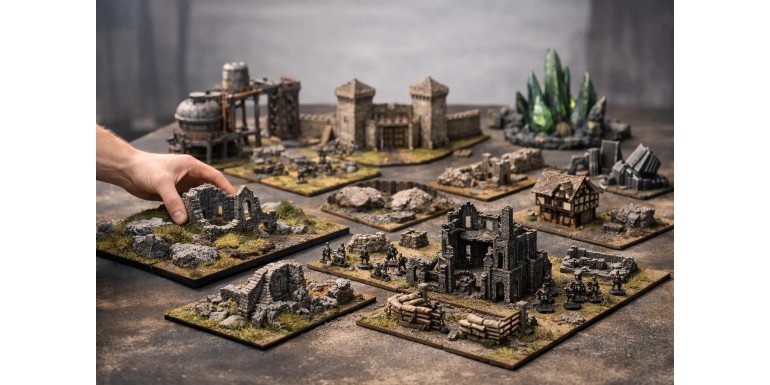
There is a massive difference between a beautiful table and a table that actually works well turn after turn. If you are wondering how to choose modular wargaming terrain, the secret doesn't just lie in the visuals. What truly defines the right purchase is how well it fits your game, your space, and the type of matches you want to host, without turning every deployment into an annoying puzzle.
Modular terrain makes sense because it allows you to vary tables, adapt cover, and reuse pieces in campaigns, casual games, or competitive matches. However, not all modularity is created equal. Some sets are designed to look great in photos, others are built to withstand heavy use, and some simply complicate things more than they help. Choosing wisely from the start prevents you from accumulating spectacular pieces that barely ever leave the box.
How to Choose Modular Wargaming Terrain Without Failing
The first filter isn't the design; it's the game system. A skirmish game with a few miniatures doesn't demand the same layout as a large-scale battle game. In skirmish games, you need every element to have a real tactical impact, featuring broken lines of sight, playable heights, and plenty of cover. In mass-battle games, the priority is usually filling the table coherently without overcrowding it, which would make unit movement frustrating.
Scale is also king. A piece of terrain that works perfectly for 28-32mm can look strange in 15mm or feel completely oversized in 40mm. Doors that are too low, poorly proportioned windows, or floors unable to accommodate bases are very common mistakes. When a piece doesn't respect the scale properly, it shows on the table immediately, no matter how well-painted it is.
Next comes table density. Many people buy by the individual visual unit rather than looking at the set as a whole. The result is usually a mix of good pieces that fail to build a solid table layout. The most practical approach is to think in blocks:
-
Large elements to anchor the composition.
-
Medium pieces to create routes and conflict zones.
-
Scatter terrain to fill in the gaps.
If everything consists of large buildings, the table becomes rigid. If everything is small scatter elements, the board loses personality and effective cover.
Real Modularity vs. Catalogue Modularity
It pays to be a bit demanding here. Some wargame scenery is marketed as "modular" simply because it includes several separate pieces. That doesn't always mean it can be reconfigured in a meaningful way. Useful modularity is what allows you to change the layout, height, or function of a piece without making it look forced.
A great example includes systems with wall sections, stackable ruins, walkways, shipping containers, barricades, or buildings that support multiple configurations. This allows you to set up completely different tables using the exact same base material. On the other hand, a highly specific, closed-off piece can be excellent as a central focal point, but it offers less flexibility if you buy multiple copies.
It is also worth looking at how the pieces connect. If they require delicate joints, highly specific magnets, or overly tight tolerances, they can become a hassle over time. In this hobby, this matters more than it seems. Modular terrain is handled constantly—stored, transported, and passed through many hands. The easier it is to assemble and disassemble, the more you will actually use it.
The Balance Between Aesthetics and Playability
A highly thematic table instantly catches the eye, but if it blocks basic movement or makes miniatures unstable, it ceases to be practical. This point is especially critical for buildings with interiors, elevated platforms, and stairs. They look fantastic, yes, but you need to check if bases actually fit, if models can stand securely, and if you can measure distances without fighting every single corner.
Key Takeaway: The best modular terrain never sacrifices the gameplay for the photo. It has enough detail to set the mood but maintains usable surfaces, logical heights, and clear access points. If you play frequently, you will end up valuing a well-thought-out ruin much more than a spectacular but impractical centerpiece.
Materials: What’s Worth It Based on Use and Budget
The choice of material dictates price, durability, weight, and finish. There is no universally superior option; it all depends on how you play and how much wear and tear the table will endure.
1. MDF (Medium-Density Fibreboard)
MDF remains a highly practical solution for those looking for a high volume of terrain at a reasonable price. It allows you to build complete tables without skyrocketing your budget, offering clean and consistent structures. Its weak point is that if the design isn't clever, it can look visually flat or overly geometric. Additionally, it requires some hobby work if you want a more organic finish.
2. Resin
Resin typically offers a very high level of detail, making it ideal for centerpiece features or elements with rich textures. On the downside, it is heavier, more expensive, and isn't always the best choice for filling an entire table. For pure modularity, it usually performs best when combined with other materials rather than as a standalone system.
3. Plastic (HIPS / Injection Molded)
Plastic is fantastic when looking for durability, repeated assembly, and kit compatibility. It stands up well to heavy use and makes conversions easy. On sci-fi tables and industrial environments, it works exceptionally well due to its sharp shapes and the ease of creating repeatable structures.
4. Rigid Foam and Foamed PVC
Foamed PVC (Forex) or rigid foam materials have one major strength: they allow for massive pieces without turning transportation into a nightmare. If you set up and pack away your tables every week, this detail matters more than you think.
5. PLA (3D Printed FDM)
With the rise of home 3D printing and specialized commercial studios, PLA has become a game-changer for modular terrain. It offers an incredible balance between the high detail of resin and the structural affordability of MDF. Since it is printed layer by layer, it allows for highly complex, hollow modular systems (like interlocking walls or ruins with hidden clips) that would be impossible or too expensive to manufacture otherwise. Its main drawback can be visible print lines, which require a bit of priming or textured painting to hide, and its sensitivity to extreme heat if left in a car during summer.
How to Choose Modular Wargaming Terrain for Your Space
You don't need a dedicated gaming room to set up great tables, but you do need to buy smartly. If you store your terrain at home among boxes of miniatures, gaming mats, and paints, storage volume matters just as much as design. Some pieces look incredibly attractive until you realize they take up half a bookshelf.
The best purchases for small spaces are usually pieces that are stackable, nestable, or fully collapsible. Elements that fit into multiple settings with minimal visual changes also work wonders. A container, a barricade, generic ruins, or a flexible industrial structure can go a long way. In contrast, terrain that is heavily tied to a single faction or setting requires a greater commitment and rotates less on the table.
If you play away from home or at a local club, add another criterion: transport resilience. Sharp edges, delicate antennas, or fragile joints will eventually break. For high-intensity use, prioritize solid pieces and shapes that can handle frequent manipulation.
Compatibility with Rules and Match Formats
This point usually separates an impulsive purchase from a smart one. Not all terrain works the same way for every rulebook. Some games reward a large amount of line-of-sight blocking (obscuring) cover. Others require accessible vertical levels and clearly defined terrain zones. Others rely heavily on specific traits like defensible, difficult, elevated, or blocking.
Therefore, you should think of your table as a gameplay tool, not just decoration. Before buying, it’s worth answering three questions:
1. How much cover does your gaming group actually need?
2. How many playable floors do you realistically use?
3. How much modularity are you truly going to take advantage of?
Some players enjoy changing every building for every single game. Others prefer a stable set that is quick to assemble without too many variables.
Furthermore, in competitive formats, relative symmetry and visual clarity matter immensely. If a piece constantly generates doubts regarding lines of sight, access, or cover, it will end up slowing down the game. While narrative environments offer more leeway, even there, the table layout must be easy to read at a glance.
Buying in Phases Always Works Better
Unless you are building a complete table from scratch for a specific tournament or event, the most sensible approach is to build your collection in layers:
-
Phase 1: Structural pieces that serve as the foundation for many different games.
-
Phase 2: Elements that add vertical variety or thematic flavor.
-
Phase 3: Small details (scatter terrain) that connect everything and bring the board to life.
This approach avoids two common mistakes. The first is spending too much on a specific aesthetic and then running short on functional cover. The second is buying sets that are too similar to one another, only to discover that even though you have plenty of scenery, every table feels exactly the same.
In a specialized store like Terrainandminis.com, where the wargaming terrain catalogue is extensive, this way of shopping gives you a clear advantage: you can fine-tune your search by scale, setting, and table function, instead of improvising with generic products.
Signs of a Great Purchase
When modular terrain is well-chosen, you notice it immediately. You set up the table quickly, miniatures stand perfectly without tipping over, the battlefield changes completely from one game to the next, and every piece finds its place effortlessly. You don't have to justify why something looks out of place, nor do you have to push half the scenery aside just to move a unit.
You will also notice it in the medium term. The pieces still fit together smoothly, they haven't become a storage nuisance, and they continue to serve multiple games or settings. That real versatility is worth far more than a flashy design that only works well once.
If you are torn between two options, it is usually better to pick the one that offers more playable configurations and fewer operational headaches. In modular terrain, the most eye-catching purchase isn't always the best. The one that truly pays off is the one that makes you want to set up another table the very next day.
Good terrain doesn't just fill a board. It delivers clearer, more varied, and far more memorable games—which, at the end of the day, is what makes a table worth setting up again and again.